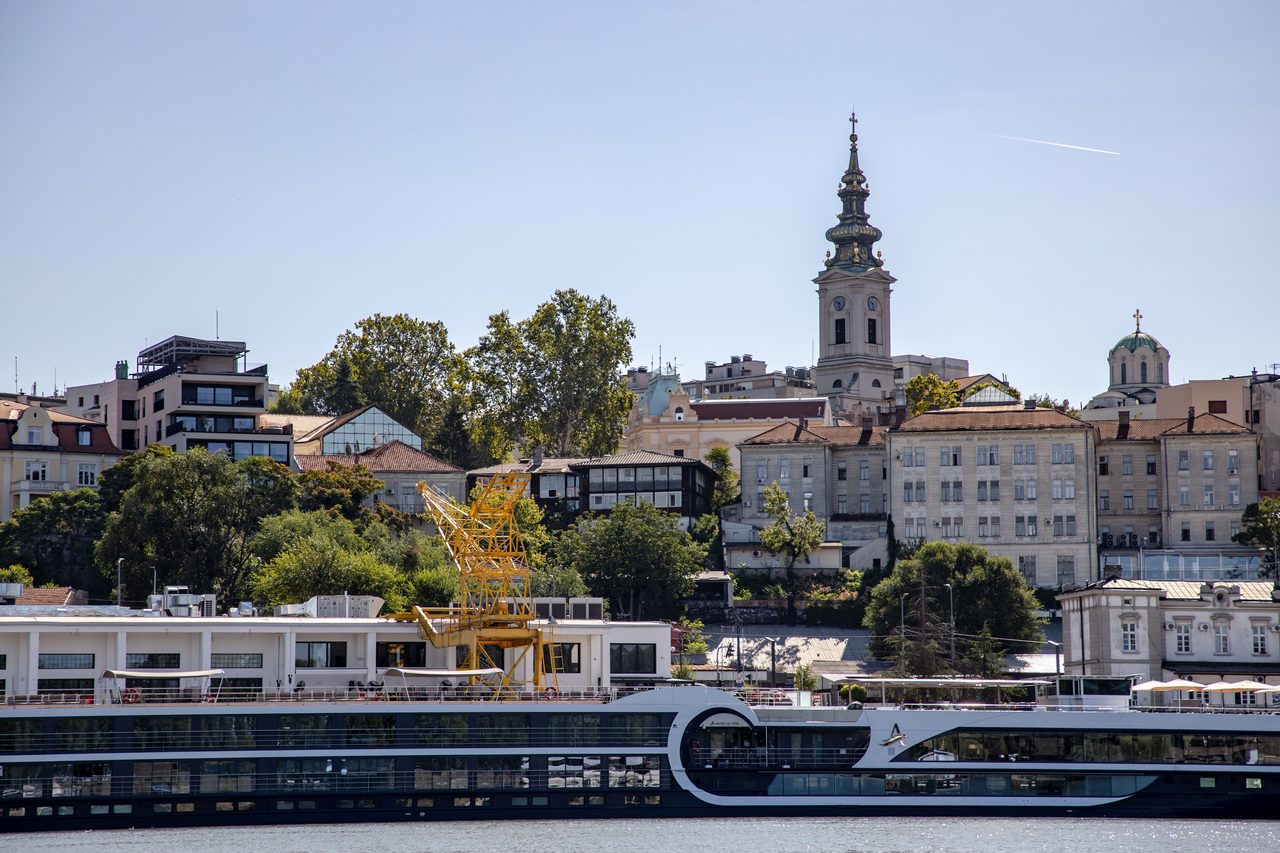
Belgrade is the capital and largest city of Serbia, set at the confluence of the Sava and Danube rivers. Known for the Kalemegdan Fortress, the bohemian Skadarlija quarter, the Temple of Saint Sava and a lively splavovi (river barge) nightlife, it blends Ottoman, Habsburg and Yugoslav layers into one of the Balkans' most energetic cities.
Belgrade sits where the Sava meets the Danube, a position that made it a fortress city for more than two thousand years. The modern city mixes the cobbled lanes of Skadarlija and Kosančićev venac with the pedestrian Knez Mihailova, the grand Temple of Saint Sava, the Yugoslav-era boulevards of Novi Beograd and the red roofs of Zemun on the Danube. It is also known as a night-life capital, with hundreds of splavovi (floating clubs and bars) along both rivers, and as one of Europe's more affordable capitals: a meal in a kafana costs around 1,500 RSD (~$15), and most museums charge under 800 RSD (~$8). Visitors pay in Serbian dinars (RSD), with cards widely accepted but cash needed for small museums and markets.
The 25 destinations our editors recommend — from iconic landmarks to under-the-radar finds.
Belgrade Fortress and Kalemegdan Park
Belgrade's defining landmark, a layered Roman, Byzantine, Serbian, Ottoman and Austrian fortress on the ridge above the Sava and Danube confluence, set inside the city's largest park. Visitors walk the Upper Town ramparts, the Victor monument and the Lower Town gates, with the Clock Tower and Roman Well as paid add-ons.
Military Museum (Belgrade Fortress)
Serbia's national military museum holds a very large collection, from Roman and medieval arms to First World War uniforms and Yugoslav-era weapons, housed in Fortress buildings. An open-air terrace displays tanks, cannon and artillery.
Temple of Saint Sava
One of the largest Orthodox churches in the world, a white marble and granite dome rising above the Vračar plateau on the site where the Ottomans burned the relics of Saint Sava in 1594. The interior mosaics, including the gold dome mosaic, have been completed in stages. The crypt of Saint Lazar is richly mosaicked.
Nikola Tesla Museum
A small villa museum guarding Tesla's urn and the largest archive of his papers, with live demonstrations of the Tesla coil and wireless lighting. Tours are guided and run in English at set hours, so arrive early to join the next slot.
Skadarlija Bohemian Quarter
A cobbled bohemian street, nicknamed Belgrade's Montmartre, lined with traditional kafanas, old-style restaurants and live musicians. The quarter flourished from the late 19th century as the home of writers and actors, and today it is the best-known place for Serbian grilled meat and rakija.
Gardoš Tower and Zemun Old Core
A Hungarian-style millennium tower built in 1896 on Gardoš hill, overlooking the Danube and the red-roofed old town of Zemun. The cobbled lanes below, once an Austro-Hungarian border town, are full of small cafes.
Recommended itineraries
Pick a length, follow the route. Each itinerary balances headline sights with breathing room.
5-Day Belgrade Explorer
Day 1Arrive in Belgrade, explore city center
Day 2Visit top attractions and museums
Day 3Day trip to nearby highlights
Day 4Local markets and hidden gems
Day 5Final sightseeing, departure
7-Day Classic Belgrade
Days 1-2Belgrade city highlights
Days 3-4Regional exploration
Days 5-6Cultural immersion and local experiences
Day 7Return and departure
14-Day Ultimate Belgrade
Days 1-3Belgrade comprehensive city tour
Days 4-6Northern region exploration
Days 7-9Eastern highlights
Days 10-12Southern attractions
Days 13-14Return to Belgrade, departure
Where to stay in Belgrade
Three tiers, every traveller covered — from cost-conscious to flagship hotels.
Budget 4,500 RSD (~$45)
Hostels, budget hotels, and guesthouses offer affordable stays without sacrificing experience.
Mid-range 12,000 RSD (~$120)
Boutique hotels and well-located accommodations provide comfort and convenience at reasonable prices.
Luxury 28,000 RSD+ (~$280+)
World-class resorts and premium hotels deliver unforgettable experiences.
Hotel Moskva
Terazije, Stari Grad · $$$
Belgrade's best-known historic hotel, a Russian-secession landmark on Terazije square since 1908. Rooms are classic-style and the location is a short walk from Knez Mihailova street, Republic Square and the main bus and tram lines. Its pastry shop is a local institution.
Large 5-star business and leisure hotel in Novi Beograd beside the Sava Centar congress hall. Guests get an indoor pool, whirlpool, sauna and steam room in the Club Olympus Fitness & Spa. Roughly 10 minutes by taxi from the old town.
International-chain hotel on the Novi Beograd side of the Sava, close to Sava Centar. A practical choice for travellers who want chain standards and easy taxi or bus access to the centre.
Small 5-star boutique hotel on Studentski trg, a short walk from Kalemegdan Fortress and Knez Mihailova street. Design-led rooms, a spa and a quiet central position make it one of the top-rated addresses in the old town.
Cafés, neighbourhood gems, and tasting menus worth the table reservation.
Kafana ? (Znak Pitanja)
Serbian - traditional kafana · $$
Belgrade's oldest surviving kafana, a small early-19th-century house directly opposite the Saborna (Cathedral) Church in the old town. It serves plain Serbian grill and oven dishes in a compact dining room and on a pavement terrace, and is a convenient first kafana meal for a solo traveler on foot between Knez Mihailova and Kalemegdan.
Manufaktura
Serbian - regional produce · $$
A casual Serbian restaurant in Stari Grad built around regional Serbian cheeses, cured meats and Mangalica pork, with a shop-like interior of local products. It is open all day, so it works for a late breakfast, an afternoon snack board or dinner near the cathedral.
Tri Šešira
Serbian - Skadarlija kafana · $$$
A Skadarlija institution operating since 1864 on the cobbled bohemian street. Live tamburitza musicians move between the tables in the evening, and the menu centres on grilled meat and old-Belgrade cooking. Touristy but atmospheric; expect music at the table while eating.
Dva Jelena (Two Deer)
Serbian - traditional · $$$
One of the oldest kafanas on Skadarska street, with a large terrace under the trees and traditional live music in the evening. Serves classic Serbian grilled meats, stews and salads.
Šešir Moj
Serbian - tavern · $$$
An authentic Serbian tavern a few doors up Skadarska street from Tri Šešira, set in a period house with a courtyard terrace. A quieter alternative on the same cobbled street with the same grill-based menu.
Langouste
Modern European - tasting menu · $$$$
Belgrade's Michelin-starred restaurant, led by chef Marko Đerić, in the historic Kosančićev venac quarter above the Sava. Seasonal tasting menus built on Balkan produce and seafood. Closed Sunday.
Belgrade is well connected: Nikola Tesla Airport (BEG) is 18 km west of the centre, the Beograd Centar railway station (Prokop) serves domestic and regional trains including the new high-speed line to Novi Sad, and intercity buses leave from the new main bus station in New Belgrade. Inside the city, buses, trams, trolleybuses and BG Voz trains are free for all passengers since 1 January 2025. All prices use 1 USD = 100 RSD and 1 EUR = 117 RSD.
Budget breakdown
Daily spend by tier in RSD, broken out by category.
Category
Budget
Mid-range
Luxury
Accommodation
2,000 RSD (~$20) hostel dorm
6,500 RSD (~$65)
16,000 RSD (~$160)
Food (per day)
1,500 RSD (~$15)
3,500 RSD (~$35)
8,000 RSD (~$80)
Transportation
500 RSD (~$5)
700 RSD (~$7)
2,000 RSD (~$20)
Activities
500 RSD (~$5)
1,300 RSD (~$13)
2,000 RSD (~$20)
Daily total
4,500 RSD (~$45)
12,000 RSD (~$120)
28,000 RSD+ (~$280+)
Best time to visit Belgrade
Weather through the year in Belgrade
Best timeShoulderWorth avoiding
Average daytime temperature in °C. Figures are for Belgrade.
Essential travel tips
Carry some cash: small museums, markets and the Tesla Museum accept dinars only
Learn to read the Cyrillic and Latin alphabets; both appear on signs
Restaurants usually open for lunch around 12:00 and dinner around 19:00
Try ćevapi, pljeskavica, kajmak and burek at a local kafana or bakery
Tipping about 10% in restaurants is customary
Hidden gems
Off-the-beaten-path corners most travellers miss.
Kosančićev venac
Cobbled quarter above the Sava where Old Belgrade houses and the Cathedral Church stand, quieter than Knez Mihailova
Great War Island (Veliko Ratno Ostrvo)
Protected wetland with birds and a quiet beach on the Zemun shore
Jevremovac Botanical Garden
A 19th-century garden with a greenhouse in the middle of Vračar
Bajrakli Mosque
Belgrade's last surviving mosque, in Dorćol
Kalenić Market (Kalenićeva pijaca)
Neighbourhood green market in Vračar with local cheese, honey and rakija
Tašmajdan Park and Saint Mark
Quiet park around one of the largest Orthodox churches in the centre
Safety information
INFO
Belgrade is generally safe for visitors and violent crime against tourists is rare; the main risks are pickpocketing and bag theft in crowded places (Knez Mihailova, Republic Square, Kalemegdan, Zeleni Venac market, the Slavija area and on packed trams and buses), inflated taxi fares and overcharging in some nightlife venues
INFO
Emergency numbers: 112 (general emergency, works with any phone), 192 (police), 193 (fire brigade), 194 (ambulance). Dial from a mobile with the number alone; staff at 112 can usually handle English
INFO
Foreign visitors must be registered with the police within 24 hours of arrival. Hotels and hostels do this automatically; if staying in a private apartment, ask the host to register you and keep the confirmation slip with your passport
INFO
Carry a photocopy or phone photo of the passport and keep the original in the hotel safe; police may ask foreigners for identification
INFO
Avoid political demonstrations, which have been frequent in Belgrade since late 2024 (around Republic Square, the Slavija roundabout, Nemanjina street and government buildings); they are usually peaceful but can cause road closures and occasional clashes. Check the US Embassy and your own government's alerts
INFO
Use ride-hailing apps (CarGo, Yandex Go, Bolt) or taxis booked by phone rather than hailing cars at the airport, bus station or train station; insist that the meter is switched on
INFO
Be careful in nightlife areas (Skadarlija, Savamala, the river-barge splavovi): check the printed menu and prices before ordering, avoid following street promoters into bars, and watch your drink
INFO
Stray dogs are common on the edges of the city and in parks; do not approach or feed them, and seek medical care for any bite
INFO
Summer heat can exceed 35 C (95 F) in July and August, and the cold, dry, gusty kosava wind blows in autumn and winter; dress for the conditions and drink water
INFO
Swim only in supervised areas at Ada Ciganlija lake (lifeguards in summer); swimming in the Sava or Danube is hazardous because of currents and boat traffic
Frequently asked questions
Do I need a visa to visit Belgrade?
Serbia is outside the EU and Schengen. Citizens of the EU, US, UK, Canada, Australia and many other countries can enter visa-free for up to 90 days with a passport. Requirements vary by nationality, so check the Serbian foreign ministry (mfa.gov.rs) before traveling.
What is the best way to get from Belgrade airport to the city?
Take the A1 minibus from Nikola Tesla Airport to Slavija Square (about 300-400 RSD / ~$3-4), city bus line 72 (about 50 RSD / ~$0.50), or an official voucher taxi (about 3,500 RSD / ~$35). Taxi apps CarGo and Yandex Go also serve the airport.
What currency is used in Belgrade?
The Serbian dinar (RSD). 100 RSD is roughly $1. Cards are widely accepted, but small museums, markets and kiosks may require cash.
What food is Belgrade famous for?
Belgrade is known for ćevapi and pljeskavica grilled meats, kajmak (clotted cream), burek pastry, karađorđeva šnicla and rakija plum brandy, best tried in a traditional kafana.
What are the top attractions in Belgrade?
Top attractions are Kalemegdan Fortress, the Temple of Saint Sava, Skadarlija, the Nikola Tesla Museum and Zemun's Gardoš tower, plus the splavovi river barges at night.
Explore Belgrade by city
The cities below have their own guides — hotels, attractions and where to eat, in depth.