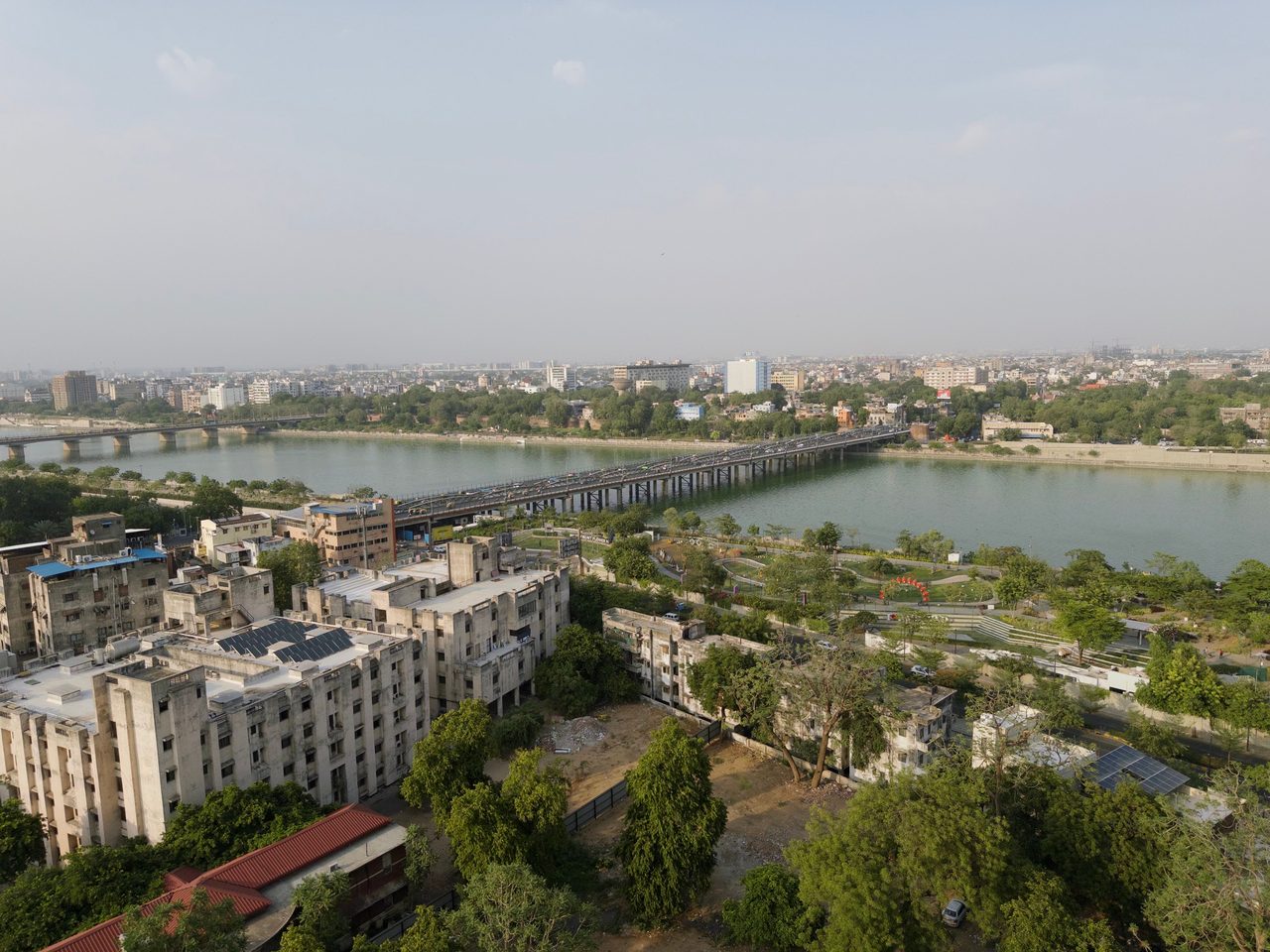
Ahmedabad is Gujarat's largest city and India's first UNESCO World Heritage City (2017), a Sabarmati River metropolis where the walled Old City's carved-wood pols, Sultanate-era mosques, and Gandhi's Sabarmati Ashram sit alongside a fast-growing metro, riverfront promenades, and one of India's best vegetarian food cultures.
Ahmedabad was founded in 1411 by Sultan Ahmad Shah I on the east bank of the Sabarmati River, and its walled Old City still holds the layers of that history. Bhadra Fort, the huge Jama Masjid, and the filigree stone windows of the Sidi Saiyyed Mosque mark the Sultanate era, while the pols, tightly packed residential clusters with carved timber havelis and bird-feeding towers, earned the city UNESCO World Heritage City status in 2017, the first in India. On the west bank, Sabarmati Ashram preserves the home from which Mahatma Gandhi launched the 1930 Salt March, and modern landmarks such as the Sabarmati Riverfront, Kankaria Lake, and Gujarat Science City show the newer city. Ahmedabad is a vegetarian-leaning food capital, famed for Gujarati thalis, fafda-jalebi breakfasts, and the night market at Manek Chowk, and the whole state is dry under Gujarat's alcohol prohibition. Two festivals define the calendar: Uttarayan on 14 January, when the sky fills with kites, and the nine nights of Navratri in autumn, when the city dances Garba. The Sardar Vallabhbhai Patel International Airport (AMD) and a growing metro make it an easy base for Modhera, Lothal, Patan, and Adalaj day trips.
Capital
Gandhinagar is the capital of Gujarat; Ahmedabad is the state's largest city and commercial hub
Largest city
Ahmedabad
Population
About 5.6 million in the city proper at the 2011 census, with the urban agglomeration estimated at roughly 8 million today
The 16 destinations our editors recommend — from iconic landmarks to under-the-radar finds.
Sabarmati Ashram (Gandhi Ashram)
The riverside ashram where Mohandas Gandhi lived from 1917 to 1930 and from which he set out on the Dandi salt march on 12 March 1930. Hriday Kunj (his cottage), the Upasana Mandir prayer ground, Magan Niwas and the Gandhi Smarak Sangrahalaya museum with its letters, photographs and library are open to visitors.
Calico Museum of Textiles
India's leading textile museum, founded in 1949 by the Sarabhai family in a haveli at Shahibaug. Its collections of Mughal court textiles, Patan patola, brocades, Pichhwai hangings and tribal costume are shown through guided gallery tours, and the adjoining haveli galleries of carved woodwork are part of the visit. Photography is not permitted inside.
Sidi Saiyyed Mosque
Built in 1573, the year the Gujarat Sultanate fell to Akbar, this small mosque is famous for the tree-of-life stone jaali panels on its western windows, which became the emblem of Ahmedabad and of the Indian Institute of Management Ahmedabad. It is an active place of worship, so modest dress and quiet behaviour are expected.
Jama Masjid (Ahmedabad)
Ahmed Shah I completed this congregational mosque in 1424 using stone from earlier Hindu and Jain temples, and it is regarded as the finest of the city's Sultanate mosques. About 260 pillars support the prayer hall, and the yellow sandstone courtyard sits in the Manek Chowk market district. It is the end point of the AMC Heritage Walk.
Bhadra Fort and Teen Darwaza
Ahmed Shah I raised the Bhadra citadel in 1411 as the first fortified core of the new city of Ahmedabad. The Azam Khan Sarai, the Royal Square (Bhadra Plaza), the Bhadrakali Temple and the triple-arched Teen Darwaza gateway (c. 1415) stand within a few hundred metres of each other.
Adalaj Stepwell (Adalaj ni Vav)
A five-storey Indo-Islamic stepwell completed in 1499 and commissioned by Queen Rudabai, wife of the Vaghela chief Rana Veer Singh, and finished under Sultan Mahmud Begada. Octagonal landings, carved pillars and niches with Hindu and Islamic motifs descend to the cool water level. It is managed by the Archaeological Survey of India.
Recommended itineraries
Pick a length, follow the route. Each itinerary balances headline sights with breathing room.
5-Day Ahmedabad Explorer
Day 1Arrive in Ahmedabad, explore city center
Day 2Visit top attractions and museums
Day 3Day trip to nearby highlights
Day 4Local markets and hidden gems
Day 5Final sightseeing, departure
7-Day Classic Ahmedabad
Days 1-2Ahmedabad city highlights
Days 3-4Regional exploration
Days 5-6Cultural immersion and local experiences
Day 7Return and departure
14-Day Ultimate Ahmedabad
Days 1-3Ahmedabad comprehensive city tour
Days 4-6Northern region exploration
Days 7-9Eastern highlights
Days 10-12Southern attractions
Days 13-14Return to Ahmedabad, departure
Where to stay in Ahmedabad
Three tiers, every traveller covered — from cost-conscious to flagship hotels.
Budget ₹2,500 (approx $26 USD)
Hostels, budget hotels, and guesthouses offer affordable stays without sacrificing experience.
Mid-range ₹6,000 (approx $63 USD)
Boutique hotels and well-located accommodations provide comfort and convenience at reasonable prices.
Luxury ₹20,000+ (approx $208 USD)
World-class resorts and premium hotels deliver unforgettable experiences.
Hyatt Regency Ahmedabad
Ashram Road / Usmanpura · INR 6,000-12,000 per night (approx $63-125 USD)
A five-star business hotel on Ashram Road in Usmanpura, on the Sabarmati riverfront side of the city and close to Sabarmati Ashram.
Ahmedabad is Gujarat's largest city and easier to navigate than most Indian metros. The metro's Blue Line links the eastern suburbs to the old city and Kalupur Railway Station, and the Red and Yellow lines reach Sabarmati, Motera Stadium and Gandhinagar. Auto-rickshaws and app cabs cover everything else, and the compact walled city is best on foot. Long-distance rail from Ahmedabad Junction (Kalupur) reaches Mumbai by Vande Bharat and Vadodara, Udaipur, Jaipur and Delhi by conventional express trains.
Budget breakdown
Daily spend by tier in INR, broken out by category.
Category
Budget
Mid-range
Luxury
Accommodation
₹1,000 (approx $10 USD)
₹3,000 (approx $31 USD)
₹12,000 (approx $125 USD)
Food (per day)
₹600 (approx $6 USD)
₹1,500 (approx $16 USD)
₹4,000 (approx $42 USD)
Transportation
₹300 (approx $3 USD)
₹600 (approx $6 USD)
₹2,000 (approx $21 USD)
Activities
₹600 (approx $6 USD)
₹900 (approx $9 USD)
₹2,000 (approx $21 USD)
Daily total
₹2,500 (approx $26 USD)
₹6,000 (approx $63 USD)
₹20,000+ (approx $208 USD)
Best time to visit Ahmedabad
Weather through the year in Ahmedabad
Best timeShoulderWorth avoiding
Average daytime temperature in °C.
Essential travel tips
Join the AMC Heritage Walk, which starts at the Swaminarayan Temple in Kalupur at 8am and ends around 10:30am at the Jama Masjid; listed prices are about ₹300 (approx $3.13 USD) for foreign visitors and ₹200 (approx $2.08 USD) for Indian nationals
Book the Calico Museum of Textiles guided tour well ahead; the museum requires registration at least 15 days in advance and is closed on Mondays and bank holidays
Dress modestly and remove shoes at mosques and Jain temples, and avoid visiting the Sidi Saiyyed Mosque on Fridays, when congregational prayers are held
Sabarmati Ashram is free to enter and open roughly 8:30am to 6:30pm daily; allow at least an hour
Kankaria Lake and Gujarat Science City are closed on Mondays
Carry cash for street food and old-city markets; UPI is accepted almost everywhere else
Try fafda-jalebi for breakfast and a full Gujarati thali for lunch; most restaurants are vegetarian, and non-vegetarian food is concentrated in areas such as the Bhatiyar Gali kebab lanes
Hidden gems
Off-the-beaten-path corners most travellers miss.
Lucky Restaurant (New Lucky)
A tea-and-bun restaurant with tables set between the graves of a Muslim cemetery, treated by locals as a normal meeting place.
Das Khaman House
A Gujarati farsan (snack) house dating to 1922; khaman, fafda and jalebi are a local breakfast.
Pol lanes of Kalupur and Khadia
Wooden-fronted havelis, bird-feeding towers (chabutaras) and community-run lanes still lived in by families.
Law Garden night market
Evening shopping for embroidered Kutchi textiles, mirror-work bags and jewellery.
Rani Sipri's Mosque (Masjid-e-Nagina)
A small mosque of 1514 commissioned by Rani Sipri, whose carved minarets and jali work resemble a piece of jewellery. It stands a short walk from Lal Darwaja and draws few tourists.
Lal Darwaja, Old City
Jhulta Minara (Sidi Bashir Mosque)
Two minarets that are said to sway when gently shaken, surviving from the Sidi Bashir Mosque near Sarangpur after the rest of the mosque collapsed in 1957.
Sarangpur, Old City
Pols of Kalupur and Khadia
Narrow gated residential lanes with painted wooden facades and community bird-feeder towers, best seen on a guided morning walk.
Kalupur and Khadia, Old City
Shreyas Folk Art Museum
A folk museum run by the Shreyas Foundation in Ambawadi that displays textiles, embroidery, pottery and tribal craft from Gujarat.
Ambawadi, west Ahmedabad
Sanskar Kendra Kite Museum
A Le Corbusier-designed civic building at Paldi that houses the Patang (Kite) Museum, covering Uttarayan and the craft of kite-making.
Paldi, west Ahmedabad
Agashiye rooftop, House of MG
Views across the old-city rooftops toward the Sidi Saiyyed jaali; thali service is by reservation.
Opp. Sidi Saiyad Jali, Lal Darwaja
Atal Bridge midpoint
Cross at dusk for lit-up reflections; the bridge closes at 9 PM in most months.
Sabarmati Riverfront
Kankaria Lake promenade
Walk the lake edge for city and lake lights.
Maninagar
Teen Darwaza arches
Shoot through the triple arches while old-city traffic is thin.
Bhadra
Safety information
INFO
Use Uber, Ola or the Rapido app for fixed fares, or agree the fare before entering an auto-rickshaw, particularly near Kalupur Railway Station and the airport.
INFO
Drink only sealed bottled or filtered water and avoid ice and cut fruit from street stalls, although hot freshly cooked Gujarati snacks are generally safe.
INFO
Carry small notes, since rickshaw drivers and market sellers often claim to have no change.
INFO
Cross roads with care: traffic in Ahmedabad is dense and lane discipline is loose, and two-wheelers frequently mount pavements.
INFO
Avoid outdoor sightseeing between 12:00 and 16:00 from April to June when temperatures regularly pass 40°C; carry water and oral rehydration salts.
INFO
Carry photo ID or a photocopy of the passport and visa page, as hotels, permit offices and some monuments require it.
INFO
Alcohol is prohibited in Gujarat except with a tourist permit; carrying or consuming liquor without one can lead to arrest, so do not accept offers of illicit bottles from touts or drivers.
INFO
Keep bags worn to the front in crowded markets such as Manek Chowk, Law Garden and Kalupur, and around the railway and bus terminals.
INFO
During the Uttarayan kite festival on 14 January, avoid riding two-wheelers and stay off open rooftops and lanes at dusk, when glass-coated kite string causes serious neck injuries.
INFO
Dress modestly when visiting temples, mosques and Jain shrines, remove footwear where required, and cover shoulders and knees.
INFO
Check local news before travelling around large religious processions such as Rath Yatra in June or July and avoid crowd crushes.
INFO
Take out comprehensive travel insurance with medical evacuation cover, as private hospital care is billed to foreign patients up front.
INFO
Use pre-paid airport taxis or app cabs at night rather than unmarked vehicles, and share live trip details with a contact when travelling alone.
INFO
Avoid flooded underpasses and waterlogged roads in monsoon months, when heavy downpours from July to September can close routes.
Frequently asked questions
Do travellers need a visa to visit Ahmedabad?
Most foreign nationals need a visa for India. Citizens of roughly 165 eligible countries can apply online for an e-Tourist Visa in 30-day, 1-year, or 5-year variants, with government fees of about $25, $40, and $80 respectively plus a bank transaction charge. Applications can be lodged between 4 and 120 days before travel, and passports must be valid at least six months. Rules and fees vary by nationality, so travellers should confirm current requirements on the official Indian government e-Visa portal or with the nearest Indian mission before booking.
Why is Ahmedabad a UNESCO World Heritage City?
Ahmedabad was inscribed in 2017 as India's first UNESCO World Heritage City. The walled city founded in 1411 by Sultan Ahmad Shah I preserves its pols, the dense residential clusters with carved timber havelis, along with Sultanate-era mosques and tombs. The best way to see it is the guided AMC Heritage Walk from the Swaminarayan Temple in Kalupur, which starts at 8am and finishes near the Jama Masjid.
Can visitors drink alcohol in Ahmedabad?
Gujarat is an alcohol-prohibition state, so alcohol is not sold in ordinary bars and restaurants across Ahmedabad. Visitors from outside Gujarat who want to drink must obtain a temporary permit under state rules, and conditions change, so travellers should confirm current requirements with their hotel or the Gujarat authorities before travelling.
What food is Ahmedabad famous for?
Ahmedabad is best known for Gujarati vegetarian cooking. Signature dishes include the full thali with dal, kadhi, shaak, and sweets, fafda-jalebi for breakfast, dhokla, khaman, handvo, undhiyu in winter, and Gujarati-style street food such as bhaji pav and pizza at Manek Chowk. Agashiye, Gordhan Thal, Vishalla, and Swati Snacks are well-known places to try it, and Bhatiyar Gali offers non-vegetarian kebabs.
What are the top attractions in Ahmedabad?
The top attractions are Sabarmati Ashram, the Sidi Saiyyed Mosque, Adalaj Stepwell, Jama Masjid, Bhadra Fort, the Calico Museum of Textiles, the Sabarmati Riverfront, Kankaria Lake, and the old-city pols. Sabarmati Ashram and the Sidi Saiyyed Mosque have free entry, and Kankaria Lake and Gujarat Science City are closed on Mondays.
Is the tap water safe to drink in Ahmedabad?
No. Tap water in Ahmedabad is not safe for visitors to drink. Sealed bottled water is inexpensive at around ₹20 (approx $0.21 USD) per litre, and many hotels and cafes provide filtered water. Travellers should also use safe water for brushing teeth and avoid ice in informal street stalls.
When is the best time to visit Ahmedabad?
October to March is the comfortable season, with daytime highs of about 25-32°C. April to June brings extreme heat above 40°C and June to September is the monsoon. Festivals add reasons to time a trip: Uttarayan kite festival falls on 14 January, and Navratri, nine nights of Garba dancing, takes place in autumn.