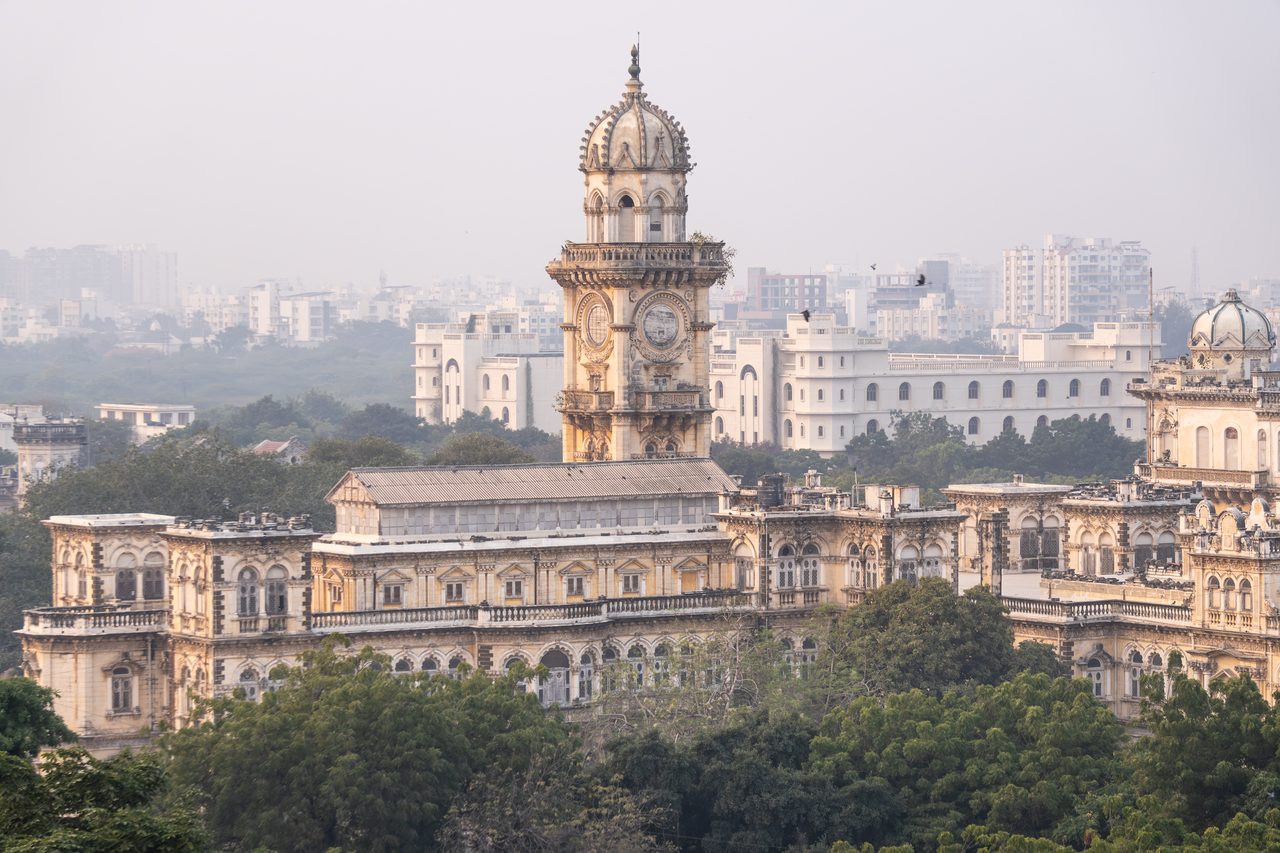
Gujarat is India's westernmost state, a broad sweep of Arabian Sea coastline, salt desert, and temple towns on the border with Pakistan and Rajasthan. It holds four UNESCO World Heritage Sites plus the walled city of Ahmedabad, the only Asiatic lion population on earth at Gir, the white salt flats of the Rann of Kutch, and the 182-metre Statue of Unity. It is also an alcohol-prohibition state with a famously vegetarian kitchen, from the multi-course Gujarati thali to Surat's locho and Kutch's dabeli.
Gujarat runs from the Rann of Kutch salt desert in the northwest to the industrial belt of Surat in the south, wrapping around the Gulfs of Kachchh and Khambhat with roughly 1,600 km of coast, the longest of any Indian state. Ahmedabad, a UNESCO World Heritage City since 2017, is the natural entry point: Sabarmati Ashram, the carved stone screens of Sidi Saiyyed Mosque, the pols of the old walled city, and the night food market at Manek Chowk. Beyond it lie the stepwell of Rani ki Vav at Patan, the Sun Temple at Modhera, the Harappan cities of Dholavira and Lothal, the hilltop mosques of Champaner-Pavagadh, the Jain temple-city of Palitana, and the coastal pilgrim towns of Somnath and Dwarka. Gir is the last wild home of the Asiatic lion, Velavadar shelters blackbuck, and the Little Rann shelters the Indian wild ass. Gujarat is dry by law, so evenings belong to garba dancing, chai stalls, dessert houses, and street food rather than bars.
The 26 destinations our editors recommend — from iconic landmarks to under-the-radar finds.
Statue of Unity
The world's tallest statue at 182 metres, honouring Sardar Vallabhbhai Patel, rising from Sadhu Bet island in the Narmada river facing the Sardar Sarovar Dam at Ekta Nagar (formerly Kevadia). A high-speed lift carries visitors to a viewing gallery inside the statue's chest at about 153 metres, and the surrounding Ekta Nagar precinct holds a museum, the Valley of Flowers, a jungle safari park and a laser-and-light show after dark. Tickets are sold on soutickets.in and at the counters near the bus bay; the site closes on Mondays for maintenance.
Sabarmati Ashram (Gandhi Ashram)
Mahatma Gandhi's home on the west bank of the Sabarmati river from 1917 to 1930, and the point from which he began the Dandi Salt March in March 1930. Hriday Kunj, the simple tiled cottage he shared with Kasturba, stands preserved with his spinning wheel, writing desk and sandals, while the adjoining Gandhi Smarak Sangrahalaya museum designed by Charles Correa holds letters, photographs and original manuscripts. Entry is free and the riverside grounds are open every day of the year.
Adalaj Stepwell (Adalaj ni Vav)
A five-storey octagonal stepwell sunk into the ground north of Ahmedabad, completed in 1499 by Queen Rudabai of the Vaghela dynasty and finished under the Sultanate, which is why Hindu, Jain and Islamic motifs share the same carved pillars. Flights of steps descend past three landings to the water, and the temperature at the bottom stays several degrees cooler than the surface. The site is protected by the Archaeological Survey of India and charges a nominal ticket; drones are prohibited.
Swaminarayan Akshardham, Gandhinagar
A pink sandstone temple complex in Gujarat's capital, built without structural steel and opened in 1992, set in 23 acres of landscaped gardens with a 49-foot gilded statue of Nilkanth Varni. Temple darshan and the gardens are free; separate tickets cover the exhibition halls and the 45-minute Sat-Chit-Anand water show projected after sunset onto a screen of falling water. Security is airport-style and cameras, phones and bags must be left in the free cloakroom.
Rani ki Vav, Patan
An eleventh-century subterranean stepwell built in memory of King Bhimdev I by Queen Udayamati, inscribed on the UNESCO World Heritage List in 2014 and depicted on the Indian 100-rupee note. Seven levels of stairs descend past more than 500 principal sculptures, most of them of Vishnu in his ten avatars, and the well shaft is lined with tiers of carved panels. Silt from the Saraswati river buried the well for centuries, which is why the carving survives in such sharp condition.
Modhera Sun Temple
A Solanki-era temple to Surya built around 1026-27 under King Bhima I, consisting of a sabha mandapa, the main shrine and a vast rectangular stepped tank, the Surya Kund, ringed by 108 miniature shrines. No worship takes place here now, which leaves the carving and the geometry of the tank open to unhurried study. Modhera village became India's first fully solar-powered village in 2022, and a projection show lights the temple most evenings.
Recommended itineraries
Pick a length, follow the route. Each itinerary balances headline sights with breathing room.
5-Day Gujarat Explorer
Day 1Arrive in Gujarat, explore city center
Day 2Visit top attractions and museums
Day 3Day trip to nearby highlights
Day 4Local markets and hidden gems
Day 5Final sightseeing, departure
7-Day Classic Gujarat
Days 1-2Gujarat city highlights
Days 3-4Regional exploration
Days 5-6Cultural immersion and local experiences
Day 7Return and departure
14-Day Ultimate Gujarat
Days 1-3Gujarat comprehensive city tour
Days 4-6Northern region exploration
Days 7-9Eastern highlights
Days 10-12Southern attractions
Days 13-14Return to Gujarat, departure
Where to stay in Gujarat
Three tiers, every traveller covered — from cost-conscious to flagship hotels.
Budget INR 2,400 (~$25)
Hostels, budget hotels, and guesthouses offer affordable stays without sacrificing experience.
Mid-range INR 7,500 (~$78)
Boutique hotels and well-located accommodations provide comfort and convenience at reasonable prices.
Luxury INR 22,000+ (~$229+)
World-class resorts and premium hotels deliver unforgettable experiences.
A restored 1924 mansion of the Mangaldas family in the walled city, beside Sidi Saiyad Mosque. Home to the Agashiye rooftop restaurant and a short walk from the Old City heritage walk.
Ahmedabad's flagship luxury hotel, styled on Gujarat's step-wells and palaces. It has a full-service spa, an outdoor pool, and well-regarded North Indian dining.
A high-rise Taj hotel on the western side of the city with skyline views, an indoor pool and a spa. It suits business travellers and visitors staying near the SG Highway dining strip.
Cafés, neighbourhood gems, and tasting menus worth the table reservation.
Agashiye - The House of MG
Gujarati - heritage thali · $$$
The rooftop thali restaurant of The House of MG, a 1924 textile magnate's mansion converted into a heritage hotel opposite the Sidi Saiyyed Mosque. The name means 'on the terrace', and the unlimited daily-changing thali is served in silver or kansa (bell-metal) platters after starters in the lounge. It is the single most celebrated Gujarati meal in Ahmedabad and the benchmark version of the format.
Gordhan Thal
Gujarati and Rajasthani thali · $$
A large, polished thali house on the Sarkhej-Gandhinagar Highway opposite Rajpath Club, widely rated among Ahmedabad's best value unlimited Gujarati thalis. The platter runs to twenty-plus items including multiple shaak, farsan, dal, kadhi, hot rotli off the tawa and two sweets. It is efficient, air-conditioned and built for families, and queues form at weekends.
Vishalla
Gujarati - village-style thali · $$$
A recreated Gujarati village on the southern edge of Ahmedabad where diners sit on floor mats under thatched canopies and eat an unlimited thali served on leaf platters by lamplight. Folk musicians and puppeteers perform through the evening, and the site includes the Vechaar utensil museum. It is a theatrical, open-air alternative to a conventional dining room.
Rajwadu
Gujarati and Rajasthani village thali · $$$
A lantern-lit village-themed compound behind the Ambaji temple in Jivraj Park, serving an unlimited Gujarati and Rajasthani thali of twenty-odd dishes brought to the seat. Mud-plastered walls, a courtyard shrine and nightly garba and folk performances give it a festival atmosphere. It is the closest rival to Vishalla and popular with local families.
Chandravilas
Gujarati - farsan and fafda-jalebi · $
Ahmedabad's oldest surviving restaurant, trading on Gandhi Road in the walled city since 1900 and credited with putting the Gujarati thali on a commercial menu. It is best known today for fafda with papaya chutney and hot jalebi, sold to queues that form early on Sundays and at Dussehra. Simple, historic and cheap.
Lucky Restaurant
Irani cafe - tea, bun maska and light meals · $
A 1950s Irani-style tea house on Mirzapur Road at Lal Darwaja, built around a medieval Muslim graveyard so that iron-railed tombs sit between the dining tables. It serves chai, bun maska, omelettes and simple meals, and once counted the painter M.F. Husain among its regulars, who gifted the owner a painting that still hangs there. Ahmedabad's most unusual room.
Gujarat is large - roughly 1,600 km of coastline and a spread of regions from the Kutch desert to the south Gujarat coast - so most itineraries combine trains for the long legs with a hired car for the last stretch. Sardar Vallabhbhai Patel International Airport in Ahmedabad (AMD) is the main gateway, with Surat (STV), Vadodara (BDQ), Rajkot's new Hirasar airport (HSR), and Bhuj (BHJ) handling domestic traffic. Indian Railways runs frequent fast services along the Mumbai-Ahmedabad-Delhi spine, including Vande Bharat trains to Mumbai Central and Gandhinagar Capital, while branch lines serve Bhuj, Dwarka, Okha, Veraval, and Ekta Nagar for the Statue of Unity. Ahmedabad has a two-line metro plus the Janmarg BRTS; GSRTC state buses fill in everywhere else. The Mumbai-Ahmedabad bullet train is under construction and not yet carrying passengers.
Budget breakdown
Daily spend by tier in INR, broken out by category.
Category
Budget
Mid-range
Luxury
Accommodation
INR 1,000 (~$10)
INR 4,000 (~$42)
INR 13,000 (~$135)
Food (per day)
INR 600 (~$6)
INR 1,800 (~$19)
INR 4,500 (~$47)
Transportation
INR 500 (~$5)
INR 1,000 (~$10)
INR 2,500 (~$26)
Activities
INR 300 (~$3)
INR 700 (~$7)
INR 2,000 (~$21)
Daily total
INR 2,400 (~$25)
INR 7,500 (~$78)
INR 22,000+ (~$229+)
Best time to visit Gujarat
Weather through the year in Gujarat
Best timeShoulderWorth avoiding
Average daytime temperature in °C. Figures are for Gujarat.
November to February is the clear winner: daytime highs of 25-30C, cool desert nights, the Rann Utsav tent city at Dhordo open, Gir safaris running, and every heritage site comfortable to walk. October and March are warm but workable shoulder months. April to mid-June brings 40-45C heat across Kutch and Saurashtra, and the June-September monsoon closes Gir and makes the Rann a shallow sea.
Gir National Park closes 16 June to 15 October every year. Rann Utsav at Dhordo runs roughly 1 November 2026 to 7 March 2027; full-moon nights on the salt flats book out first. Navratri fills Ahmedabad and Vadodara hotels for nine nights, so reserve months ahead.
Essential travel tips
Gujarat is a prohibition state: alcohol is not sold openly, and visitors from outside the state can apply for a tourist liquor permit through a licensed hotel or authorised liquor shop with a passport and visa copy. GIFT City near Gandhinagar is the exception, where approved hotels and restaurants serve alcohol to non-residents of Gujarat on production of photo ID.
Book Gir safari permits at girlion.gujarat.gov.in up to three months ahead; December to February slots sell out weeks in advance
Book Statue of Unity tickets at soutickets.in; general entry with the exhibition is INR 150 (~$1.56) for adults and the viewing gallery ticket INR 380 (~$3.96)
Foreign visitors pay far more than Indians at ASI monuments: Rani ki Vav is about INR 40 (~$0.42) for Indians and INR 600 (~$6.25) for foreigners, and children under 15 enter free
Meals are vegetarian by default almost everywhere; say jainu if you need food cooked without onion, garlic, or root vegetables
Dress modestly for temples and mosques, remove shoes and leather belts at Jain and Hindu temples, and expect cameras to be banned inside Somnath and many shrines
Carry cash for small towns and safaris, but use UPI or cards where possible; ATMs are plentiful in cities and scarce in Kutch villages
Uttarayan on 14 January fills the sky over Ahmedabad with kites; hotels sell rooftop access and book out early
Hidden gems
Off-the-beaten-path corners most travellers miss.
Ratan Pole spice and farsan shops
The old-city lane where Ahmedabad households actually buy dhana jeera, undhiyu green masala, dabeli masala and chaas masala by weight, at a fraction of airport or hotel-shop prices
Khamasa farsan counters at 8AM
Ahmedabad eats farsan for breakfast, standing at a counter, and Khamasa is where it happens at volume. The khaman is hottest between 7AM and 9AM, and the trays are emptied and refilled continuously.
Amul Dairy, Anand
The cooperative that reorganised Indian dairy farming, in the small town it came from, 70 km south of Ahmedabad on the Vadodara road. The plant runs visitor tours and the parlour sells at cooperative prices.
Ponkh season in Surat
For roughly six weeks in the cold months, Surat eats ponkh, tender green jowar grains roasted and tossed with sev, lime and chutney at dedicated seasonal stalls. It exists nowhere else in India in this form and vanishes completely by February.
Sarkhej Roza at sunset
A fifteenth-century mosque, tomb and palace complex around a large tank on the south-western edge of Ahmedabad, admired by Le Corbusier and almost entirely ignored by visitors. Local families use it as a park in the late afternoon.
Agashiye rooftop, The House of MG
The rooftop is a restaurant, so the view requires booking a thali; lunch bookings are easier to get and the view is the same
Several stalls have rough upstairs seating; asking for a plate upstairs costs nothing extra and turns the chaos into a spectacle
Manek Chowk, old city, Ahmedabad
Surya Kund steps, Modhera
Stand on the west side of the tank so the temple is reflected in the water with the low sun behind the camera
Sun Temple, Modhera, Mehsana District
Safety information
INFO
Gujarat is one of India's safer states for visitors, with low levels of violent crime; the realistic risks are heat, monsoon flooding, road traffic and opportunistic scams rather than personal attack
INFO
April to June is dangerously hot across Gujarat, with Ahmedabad, Rajkot and Kutch regularly above 43C and occasional 45C+ heatwave days; the city runs a formal Heat Action Plan, and outdoor sightseeing between 11AM and 4PM in those months should simply be avoided
INFO
The south-west monsoon (mid-June to September) brings flash flooding to Ahmedabad, Surat, Vadodara and Saurashtra; underpasses flood within minutes, rural causeways wash out, and the Gir National Park jungle trail closes entirely from 16 June to 15 October
INFO
The Saurashtra and Kutch coasts sit in the Arabian Sea cyclone track - Cyclone Biparjoy made landfall near Jakhau in Kutch in June 2023 and forced mass evacuations; check IMD warnings at mausam.imd.gov.in before coastal travel in June and again in October-November
INFO
Gujarat is a dry state: manufacture, sale, transport and consumption of alcohol are prohibited. Foreign tourists and Indian visitors from other states can apply for a legal e-permit at eps.gujarat.gov.in; buying or drinking without one is a criminal offence
INFO
The Great Rann of Kutch runs to the Pakistan border. A permit is required to enter the White Rann and Kalo Dungar area, issued at the Bhirandiyara check post on the Bhuj-Dhordo road (roughly INR 100 per person plus a vehicle charge) or online at rannpermit.gujarat.gov.in; carry a passport and visa copy as a foreign national
INFO
Road traffic is the most statistically serious hazard. National and state highways carry trucks, tractors, motorcycles and livestock at wildly different speeds, and night driving on rural Saurashtra and Kutch roads is genuinely risky - travel intercity by day, by train or GSRTC bus where possible
INFO
Drink only sealed bottled or filtered water, avoid ice of unknown origin, and eat street food from busy stalls with high turnover; stomach upsets are the most common thing that derails a Gujarat trip
INFO
Dress modestly - covered shoulders and knees - at Somnath, Dwarka, Akshardham, Palitana and Jama Masjid; phones and cameras must be deposited in free lockers at Somnath and Dwarkadhish, and Palitana's Shatrunjaya hill involves roughly 3,800 steps with no food or leather permitted
INFO
Ahmedabad's walled city, Manek Chowk at night, Law Garden market, Kalupur railway station and Navratri garba grounds in October are the crowded settings where pickpocketing and bag-snatching occur; carry a cross-body bag worn in front
Frequently asked questions
Do I need a visa to visit Gujarat?
Most foreign nationals need an Indian e-Visa, applied for online at indianvisaonline.gov.in/evisa at least four days before arrival. The 30-day e-Tourist Visa costs around USD 25 (about USD 10 for April-June arrivals), the one-year around USD 40, and the five-year around USD 80, with fees varying by nationality. Ahmedabad airport (AMD) is an approved e-Visa entry point. Requirements change, so confirm with the official portal or your nearest Indian mission before booking.
Can you drink alcohol in Gujarat?
Gujarat has been a prohibition state since 1960, so alcohol is not sold in ordinary shops, bars, or restaurants. Visitors from outside Gujarat, including foreign nationals, can apply for a tourist liquor permit through a licensed hotel or an authorised liquor shop, presenting a passport, visa, and proof of arrival. GIFT City near Gandhinagar is the exception: since a December 2025 notification, approved hotels, clubs, and restaurants there serve alcohol to visitors from outside the state on production of photo ID. Everywhere else, evenings revolve around garba, chai stalls, dessert houses, and night food streets such as Manek Chowk.
When is the best time to visit Gujarat?
November to February, when days sit around 25-30C and the desert nights are cool. That window covers the Rann Utsav tent city at Dhordo (roughly 1 November 2026 to 7 March 2027), the open season at Gir, and the Uttarayan kite festival on 14 January. Avoid April to mid-June, when Kutch and Saurashtra reach 40-45C, and note that Gir National Park is closed from 16 June to 15 October for the monsoon.
How do you see the Asiatic lions at Gir?
Jeep safari permits are issued only through the official portal girlion.gujarat.gov.in, bookable up to three months ahead, in two fixed daily slots with gate times that shift by season. Permits run roughly INR 800-1,000 (~$8-10) for Indian nationals and INR 3,500-4,500 (~$36-47) for foreign nationals, plus a camera fee of about INR 200 (~$2), with the vehicle and guide charged separately. The park is closed from 16 June to 15 October, and December to February permits often sell out two to four weeks in advance. Sasan Gir village is the usual base, reachable by train from Junagadh or by road from Keshod airport.
What food is Gujarat famous for?
Gujarat cooks India's best-known vegetarian food. The centrepiece is the unlimited Gujarati thali, with rotli, dal, kadhi, several shaak, farsan, and a sweet. Signature dishes include dhokla and khaman, khandvi, thepla, undhiyu in winter, fafda with jalebi for breakfast, Kutchi dabeli, Surti locho, and ghari from Surat. Jain food, cooked without onion, garlic, or root vegetables, is available almost everywhere. The Saurashtra coast around Veraval also lands seafood, though vegetarian menus dominate inland.
What are the top attractions in Gujarat?
The headline sights are the Statue of Unity at Kevadia, Gir National Park for Asiatic lions, the White Rann of Kutch near Dhordo, the UNESCO stepwell Rani ki Vav at Patan, the Sun Temple at Modhera, Ahmedabad's UNESCO-listed walled city with Sabarmati Ashram and Sidi Saiyyed Mosque, Champaner-Pavagadh, the Harappan sites of Dholavira and Lothal, and the coastal temple towns of Somnath and Dwarka. Most travellers base themselves in Ahmedabad for the north, Bhuj for Kutch, and Junagadh or Sasan Gir for the Saurashtra circuit.
Explore Gujarat by city
The cities below have their own guides — hotels, attractions and where to eat, in depth.