
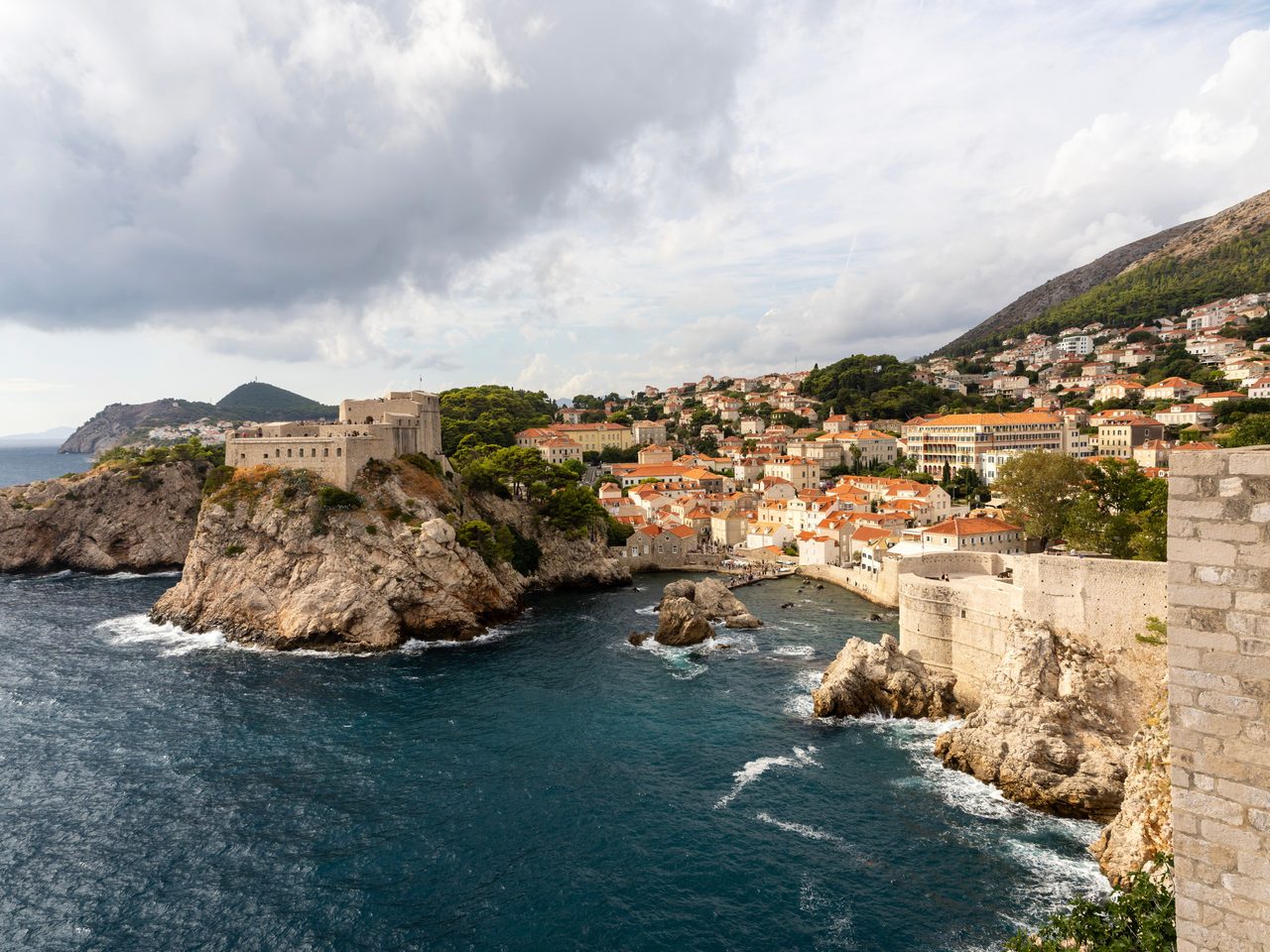
City Walls of Dubrovnik
A complete 1,940 m ring of medieval and Renaissance walls with towers and forts around the Old Town; the walk runs one way (anticlockwise) and has steep steps and little shade.
Dubrovnik Neretva · 23 Places · Best Late
Dubrovnik is a walled city on Croatia's southern Adriatic coast, home to about 41,500 people. Its car-free Old Town (Stari Grad), a UNESCO World Heritage Site since 1979, is ringed by nearly 2 km of medieval walls and sits beside clear swimming coves, Lokrum island and the Elafiti islands.
Dubrovnik stretches along a narrow strip of coast below Mount Srđ in the far south of Croatia, about 20 km from the Montenegro border. The Old Town is entered through the Pile Gate (west) and the Ploče Gate (east); its marble main street, Stradun (Placa), runs between the Franciscan Monastery and the Rector's Palace, Sponza Palace and the Cathedral. The City Walls walk and Fort Lovrijenac give the classic views, and the cable car climbs Mount Srđ in about four minutes. West of the Old Town lie the residential districts of Pile and Gradac, then Gruž with the ferry port, the main bus station and the morning market, and the Lapad and Babin Kuk peninsulas with most of the larger hotels and pebble beaches. Boats run from the Old Port to Lokrum and Cavtat and from Gruž to the car-free Elafiti islands (Koločep, Lopud, Šipan). The Dubrovnik Summer Festival fills squares and forts with theatre and music from 10 July to 25 August. Cavtat, Ston and Mali Ston, the Trsteno Arboretum, Montenegro's Bay of Kotor and Mostar are common day trips.
Jump straight to the experience you're planning.
The 23 destinations our editors recommend — from iconic landmarks to under-the-radar finds.
A complete 1,940 m ring of medieval and Renaissance walls with towers and forts around the Old Town; the walk runs one way (anticlockwise) and has steep steps and little shade.
The limestone-paved main street of the Old Town, rebuilt with uniform Baroque houses after the 1667 earthquake.
The western entrance to the Old Town (1537) with a stone bridge, a former drawbridge and a statue of St Blaise above the arch.
The eastern entrance to the Old Town, with a stone bridge and a wooden drawbridge between the walls and Fort Revelin.
Gothic-Renaissance seat of the rectors of the Republic of Ragusa, now the Cultural History Museum with period rooms, portraits and the atrium used for Summer Festival concerts.
A 1516-1522 Gothic-Renaissance customs house and mint that survived the 1667 earthquake; it holds the State Archives and the Memorial Room of the Dubrovnik Defenders of 1991-1995.
Pick a length, follow the route. Each itinerary balances headline sights with breathing room.
Three tiers, every traveller covered — from cost-conscious to flagship hotels.
Hostels, budget hotels, and guesthouses offer affordable stays without sacrificing experience.
Boutique hotels and well-located accommodations provide comfort and convenience at reasonable prices.
World-class resorts and premium hotels deliver unforgettable experiences.
Five-star hotel opened in 1913 on the Ploče seafront, a short walk east of the Old Town, with an indoor pool, spa and views of the Old Port and Lokrum. Part of Adriatic Luxury Hotels.
Check rates on Booking.comCliffside luxury hotel east of the Old Town with Villa Spa, a rooftop bar, terraces and the Pjerin restaurant; the Villa Kolin residence has a private pool. Listed in the Michelin Guide with Two Keys.
Check rates on Booking.comSmall five-star hotel in a Baroque palace on Gundulić Square inside the walls, with the Lucijan and Magdalena restaurants and beach access arranged for guests. Old Town streets are pedestrian-only and stepped.
Check rates on Booking.comFive-star hotel in a building dating from 1895 beside the Pile Gate, with 139 rooms and 8 suites overlooking the city walls. The best-placed large hotel for walking into the Old Town.
Check rates on Booking.comCafés, neighbourhood gems, and tasting menus worth the table reservation.
Chef Marijo Curic leads a kitchen that pairs Mediterranean produce with Asian and French technique, served on a terrace above the harbour.
A long-running formal restaurant just outside Pile Gate, with two sea-facing terraces and a strong wine list.
Hotel restaurant outside the walls serving seasonal Mediterranean dishes with Adriatic seafood and Croatian wine pairings.
One of the oldest fish restaurants in the city, built on the day's catch and shellfish from Mali Ston Bay.
A small-plates restaurant with a short seasonal menu and tables on a stepped lane.
A Lapad bistro that reworks Dalmatian ingredients with creative touches.
Book a food tour in Dubrovnik We may earn a commission from bookings made through this link.
Dubrovnik's Old Town is car-free and best explored on foot; expect many steps. Libertas city buses link the Pile Gate and Ploče stops with Gruž, Lapad and Babin Kuk and run to Cavtat and the airport area. Dubrovnik Airport (DBV) is at Čilipi, about 20 km south-east of the Old Town. Intercity buses use the Main Bus Station in Gruž (Obala pape Ivana Pavla II 44A), and Jadrolinija ferries and catamarans to the islands and Split leave from Gruž port nearby. There is no railway station in Dubrovnik.
Daily spend by tier in EUR (approx. USD at 1 EUR = 1.15 USD), broken out by category.
| Category | Budget | Mid-range | Luxury |
|---|---|---|---|
| Accommodation | €35 (~$40) | €140 (~$161) | €400 (~$460) |
| Food (per day) | €25 (~$29) | €50 (~$58) | €130 (~$150) |
| Transportation | €5 (~$6) | €10 (~$12) | €40 (~$46) |
| Activities | €20 (~$23) | €20 (~$23) | €30 (~$35) |
| Daily total | €85 (~$98) | €220 (~$253) | €600+ (~$690+) |
Best time Shoulder Worth avoiding
Average daytime temperature in °C.
Dubrovnik has a Mediterranean climate with hot, dry summers and mild, wet winters. Late May to June and September to early October combine warm sea temperatures with fewer cruise crowds than July and August.
The sea is warm enough for most swimmers from about late May to October (above 18°C/64°F from May, peaking near 25.5°C/78°F in July). The cable car runs April to November only. Walk the walls at opening time or in the last two hours before closing to avoid heat and cruise groups. The Feast of St. Blaise on 3 February is the main winter event. The bura (cold north-east wind) and jugo (warm, wet south-east wind) can cancel island boats, so check forecasts at meteo.hr (DHMZ).
Pickpockets work Stradun, Pile Gate, the crowded Libertas buses and cruise-ship days. Keep bags zipped and in front, phones out of back pockets and valuables in the hotel safe.
The City Walls offer almost no shade and few exits once on the circuit. Climb at opening time or in the last two hours before closing in July and August, carry at least 1 L of water, a hat and sunscreen, and rest in the shade at the first sign of dizziness.
The polished limestone of Stradun and the Old Town steps becomes slick when wet or worn smooth. Wear shoes with grip, not flip-flops, and hold handrails on the walls stairs.
Swim at marked beaches such as Banje, Sulić and Lapad, and wear water shoes on rocky coves because sea urchins are common. Do not swim in strong bura or jugo winds or near boat lanes; red flags mean no swimming.
Use the free 24-hour dispatch line 0800 0970, the Uber and Bolt apps, or the taxi ranks at Pile, Ploče, Gruž and the airport. Agree the price or insist on the meter, photograph the car number at night and share the ride with a contact. Taxis cannot enter the Old Town.
Outdoor fires and barbecues are prohibited outside designated areas from 1 June to 31 October, with fines of EUR 2,000-20,000 (~$2,300-23,000). On hot, windy days avoid hiking Mount Srđ and report smoke to 112.
The Adriatic coast is seismically active and small tremors occur several times a month. In a tremor move away from facades and loose masonry, take cover under a sturdy table and call 112 if hurt.
Bars in the Old Town and Lapad are generally safe; watch your drink and agree prices before ordering. Avoid venues where touts approach on the street, and note that public drinking, sleeping outdoors and shirtless walking in the Old Town draw fines.
Dubrovnik and its surroundings are clear of marked mine hazards; remaining landmines are in other parts of Croatia. On Mount Srđ and any hillside trail stay on marked paths and never enter uncultivated land.
Coastal roads are narrow, steep and busy in summer; the Old Town is car-free. The drink-drive limit is 0.05%, zero for drivers under 24. Montenegro and Bosnia day trips need a passport and rental-car cross-border permission.
Carry a passport or ID. Drug possession, even small amounts, can bring jail and heavy fines; public-order offences can be fined up to EUR 4,000 (~$4,600).
Two full days cover the City Walls, Stradun, the Rector's Palace, the cable car and Lokrum. Three to four days add a boat trip to the Elafiti islands or Cavtat and a day trip to Ston or Montenegro.
The Platanus shuttle bus leaves after scheduled arrivals and stops at Pile Gate and Gruž bus station (about €10 / ~$11.50 one way, 30-40 minutes). A taxi costs about €35-40 (~$40-46); Uber and Bolt also operate.
The adult ticket is about €40 (~$46) in high season and includes Fort Lovrijenac. The 1-day Dubrovnik Pass, €40 (~$46), includes the walls plus museums and bus rides.
Yes. Violent crime against visitors is rare; the main risks are pickpocketing in crowds, summer heat on the walls and slippery stone. Emergency number 112.
Late May to June and September to early October offer warm seas and fewer crowds. July and August are hottest and busiest but host the Dubrovnik Summer Festival (10 July-25 August).