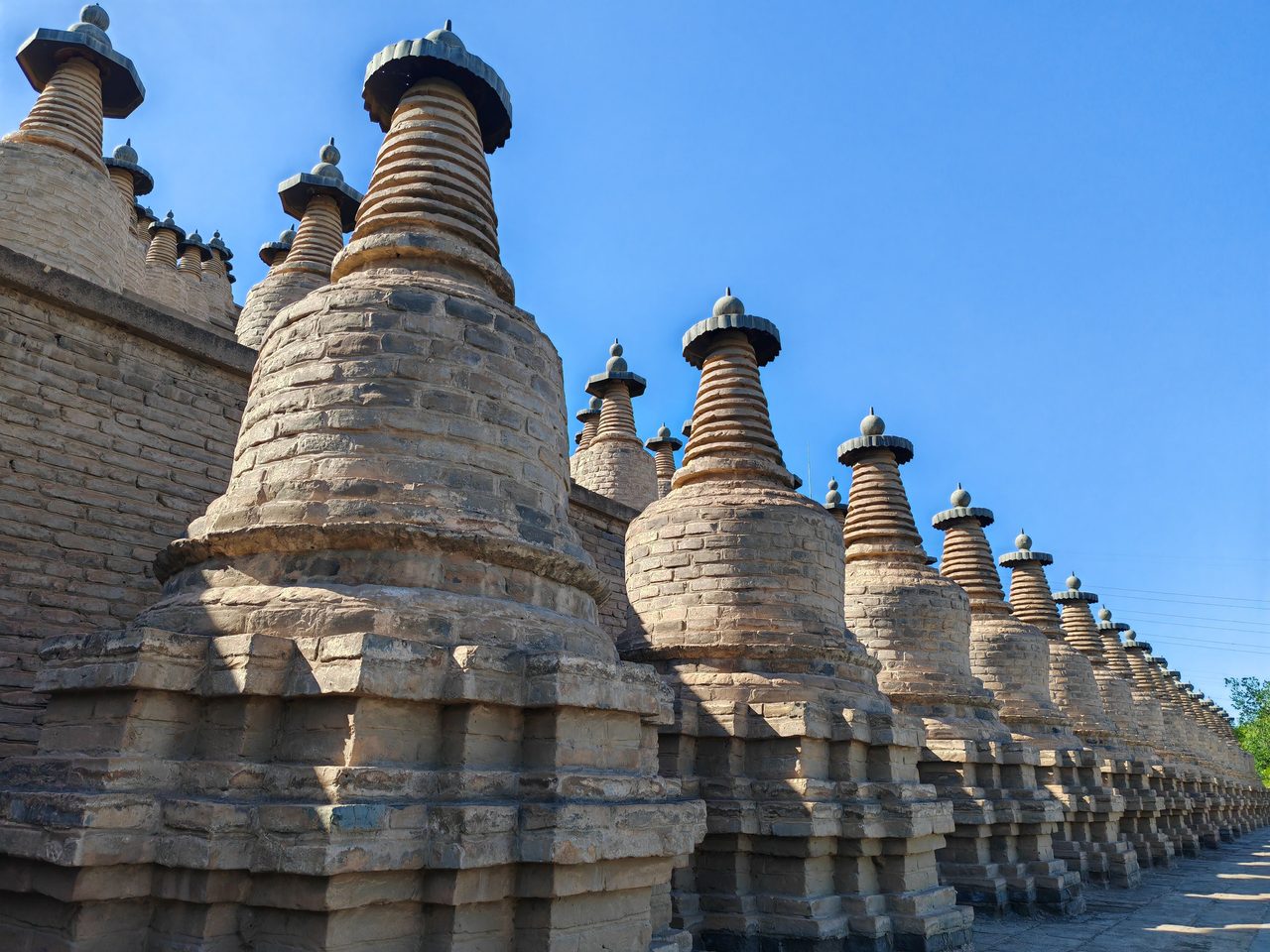
Ningxia · 17 Places · Best May, June, September, early October
Ningxia
Ningxia Hui Autonomous Region is a compact, landlocked province in north-central China, straddling the upper Yellow River between the Gobi and Tengger deserts and the Helan Mountains. Home to a large ethnic Hui Muslim population alongside the Han majority, Ningxia blends desert scenery, Yellow River irrigation culture, Xixia (Western Xia) dynasty heritage, and a fast-growing wine industry into one of China's most underrated travel regions.
Ningxia is one of China's smallest provincial-level regions, a narrow corridor following the Yellow River south to north between the Loess Plateau and the Tengger and Mu Us deserts. The capital, Yinchuan, sits on an ancient irrigation network fed by the river and is ringed by the Helan Mountains to the west, where Neolithic and Bronze Age rock carvings survive at Helankou. South of Yinchuan, the Western Xia Imperial Tombs mark the vanished Tangut empire of the Xixia dynasty (1038-1227). Further west, Zhongwei sits on the edge of the Tengger Desert at Shapotou, where dunes meet the river, while the hilly south around Guyuan preserves Silk Road grotto art at Xumishan. Ningxia is also China's fastest-rising wine region, with vineyards along the east foot of the Helan Mountains, and its Hui Muslim heritage shapes the region's mosques, halal cuisine, and street food.
The 17 destinations our editors recommend — from iconic landmarks to under-the-radar finds.
Helan Mountain Rock Art (Helankou)
A scenic area on the eastern foothills of the Helan Mountains holding thousands of Neolithic and Bronze Age petroglyphs, including the well-known 'Sun God' face carving, alongside the Yinchuan World Rock Art Museum.
Western Xia Imperial Tombs
Nine large earthen mausoleums and over 200 satellite tombs of the Tangut Xixia dynasty (1038-1227) spread across a desert plain at the eastern foot of the Helan Mountains, often called the 'Eastern Pyramids'.
Shahu Lake (Sand Lake) Scenic Area
A national 5A-rated desert-wetland reserve in Pingluo County covering more than 80 square kilometers of freshwater lake, reed marsh, sand dunes, and bird-nesting islands.
Shapotou Scenic Area
The point where the Tengger Desert meets the Yellow River, 16km west of Zhongwei, offering sand-sliding, camel trekking, desert cable cars, and Yellow River sheepskin-raft rides.
Zhenbeibu Western Film Studio
A former Ming-dynasty military fort converted into a film set in 1961, used for hundreds of Chinese martial-arts and western films, with reconstructed ancient streets, courtyards, and stunt shows.
Shuidonggou Ruins
A Paleolithic archaeological site and geological park east of Yinchuan combining 40,000-year-old prehistoric excavations with a section of the Ming-dynasty Great Wall and defensive tunnels.
Recommended itineraries
Pick a length, follow the route. Each itinerary balances headline sights with breathing room.
5-Day Ningxia Explorer
Day 1Arrive in Ningxia, explore city center
Day 2Visit top attractions and museums
Day 3Day trip to nearby highlights
Day 4Local markets and hidden gems
Day 5Final sightseeing, departure
7-Day Classic Ningxia
Days 1-2Ningxia city highlights
Days 3-4Regional exploration
Days 5-6Cultural immersion and local experiences
Day 7Return and departure
14-Day Ultimate Ningxia
Days 1-3Ningxia comprehensive city tour
Days 4-6Northern region exploration
Days 7-9Eastern highlights
Days 10-12Southern attractions
Days 13-14Return to Ningxia, departure
Where to stay in Ningxia
Three tiers, every traveller covered — from cost-conscious to flagship hotels.
Budget ¥250 (approx $37)
Hostels, budget hotels, and guesthouses offer affordable stays without sacrificing experience.
Mid-range ¥600 (approx $90)
Boutique hotels and well-located accommodations provide comfort and convenience at reasonable prices.
Luxury ¥1,500+ (approx $224+)
World-class resorts and premium hotels deliver unforgettable experiences.
Cafés, neighbourhood gems, and tasting menus worth the table reservation.
Laomao Hand-Grabbed Lamb & Copper Hotpot
Hui halal - hand-grabbed lamb specialist · $$
A century-old Yinchuan institution founded in 1888 and recognized as part of Ningxia's Intangible Cultural Heritage, built entirely around hand-grabbed lamb and copper hotpot. The lamb is boiled in lightly salted water until tender and served on the bone with a garlic-chili dip, while the copper hotpot version simmers lamb and offal tableside.
Ying Bin Lou Restaurant
Hui - Ningxia home cooking · $
A well-regarded Yinchuan restaurant near the Drum Tower and Nanmen Square known for its hand-grabbed lamb neck, boiled tender in salted water, alongside a homemade five-nut ice brick dessert. Generous portions and fair prices make it a favourite with local diners.
Sanyixuan
Hui - steamed lamb and goji specialties · $$
A Yinchuan restaurant next to Xinyue Square known for steamed lamb and dishes built around Ningxia wolfberries, including goji-stewed lamb soup. It draws a steady stream of local diners for its balance of traditional Hui cooking and the region's signature wolfberry ingredient.
Guo Qiang Hand-Grabbed Lamb
Hui halal - hand-grabbed lamb and offal · $
A neighbourhood hand-grabbed lamb restaurant in Yinchuan's Xingqing District serving classic shouzhua yangrou alongside lamb offal soup. Straightforward and unpretentious, it is popular with locals for a fast, satisfying lamb meal.
Huanghelou Islamic Restaurant
Hui halal - all-day Ningxia dining · $
An all-day halal restaurant on Xinhua Dongjie serving breakfast through late-night snacks, best known for yangzasui offal soup with baibing flatbread and a reliable bowl of yangrou saozi mian. A dependable choice at any hour of the day.
Gulou Shangjie Night Market
Hui halal street food - lamb skewers and grilled snacks · $
An open-air food street northeast of Yinchuan's historic Drum Tower that comes alive after sunset, with grills sizzling lamb fat and Hui vendors turning out skewers, roujiamo and grilled lamb chops. One of the best places in the city for an evening street-food crawl.
Ningxia is compact by Chinese standards, with Yinchuan as its transport hub. Yinchuan Hedong International Airport connects the region to the rest of China, and a high-speed rail spine (the Yinchuan-Lanzhou and Yinchuan-Xi'an lines) links Yinchuan with Zhongwei, Wuzhong and beyond. Inside Yinchuan a BRT line and city buses cover the built-up districts, and DiDi ride-hailing plus metered taxis fill the gaps. Reaching the region's signature desert, lake and historic sites - Shapotou, Shahu, the Helan Mountain rock art, and the Western Xia Tombs - generally means a long-distance bus, a chartered driver, or a rental car, since public transit does not reach most of them directly.
Budget breakdown
Daily spend by tier in CNY, broken out by category.
Category
Budget
Mid-range
Luxury
Accommodation
¥90 (approx $13)
¥280 (approx $42)
¥800 (approx $119)
Food (per day)
¥60 (approx $9)
¥150 (approx $22)
¥350 (approx $52)
Transportation
¥40 (approx $6)
¥80 (approx $12)
¥150 (approx $22)
Activities
¥60 (approx $9)
¥90 (approx $13)
¥200 (approx $30)
Daily total
¥250 (approx $37)
¥600 (approx $90)
¥1,500+ (approx $224+)
Best time to visit Ningxia
Weather through the year in Ningxia
Best timeShoulderWorth avoiding
Average daytime temperature in °C. Figures are for Ningxia.
The best time to visit Ningxia is May-June or September-early October, when daytime temperatures are warm but not extreme, nights are cool and comfortable, skies are clear, and the desert sites at Shapotou and Shahu are at their most pleasant.
Desert diurnal temperature swings are extreme year-round - even on a hot summer day, evenings at Shapotou can turn surprisingly cool, so pack a light layer regardless of season
Essential travel tips
Base in Yinchuan for Helan Mountain, the Xixia Tombs, and the wine region, and add a side trip to Zhongwei for Shapotou
High-speed trains make Yinchuan-Zhongwei a comfortable day trip in about an hour
Try Ningxia hand-grabbed lamb (shou zhua yang rou) and hand-pulled noodles, regional specialties rooted in Hui cuisine
Many attractions close or reduce hours on Mondays; check individual site schedules before visiting
Hidden gems
Off-the-beaten-path corners most travellers miss.
Shuidonggou Ruins
A Paleolithic archaeological site and Ming-dynasty Great Wall fortress combined in one desert canyon east of Yinchuan, far quieter than Shapotou
Lingwu, Yinchuan
Xumishan Grottoes
A remote cliff of Buddhist cave carvings near Guyuan dating to the Northern Wei dynasty, including a 20-meter seated Maitreya Buddha, rarely visited by foreign tourists
Sanying Town, Guyuan
Liupanshan National Forest Park
A green, forested mountain range in southern Ningxia where the Red Army once camped, offering cool hiking away from the desert heat
Jingyuan County, Guyuan
Safety information
INFO
Ningxia has very low rates of violent crime against visitors; the main practical concerns are traffic, desert heat and sun exposure, and standard China-wide precautions around registration and internet access
INFO
Register your stay: hotels in Yinchuan and Zhongwei handle foreigner registration automatically at check-in, which is a legal requirement in China; carry your passport at all times, as police can request ID checks
INFO
At Shapotou and Shahu, desert temperatures swing sharply between day and night, and midday sun on the dunes is intense; carry water, wear a hat and sunscreen, and avoid the sandboarding and camel-ride areas in the hottest early-afternoon hours in July-August
INFO
The Yellow River sheepskin-raft crossing and boat rides at Shapotou and Shahu are generally well supervised, but always use a properly equipped operator with visible life jackets rather than an unofficial tout offering a cheaper ride
INFO
Internet access is restricted under China's firewall; VPNs are commonly used by travelers but are in a legal gray area - download and configure one before arrival, since VPN provider websites are usually blocked once inside China
INFO
Air quality in Yinchuan can be poor during dust-storm season (spring) and winter heating season; check daily AQI and consider a mask on high-pollution or dust-storm days
INFO
Winter (December-February) brings very cold, dry conditions with occasional strong winds on the open Ningxia plain; dress in warm layers and be cautious of icy pavements in Yinchuan
INFO
Mobile data and offline maps are essential outside Yinchuan - Google Maps does not work reliably in China, so use a China-compatible map app (Baidu Maps, Amap/Gaode, or a downloaded offline map) before heading to Shapotou, Shahu, or Guyuan
Frequently asked questions
Do I need a visa to visit Ningxia?
Entry requirements follow mainland China's national rules. Most visitors need a Chinese visa obtained in advance, though some nationalities qualify for visa-free transit of up to 240 hours at designated ports if continuing to a third country. Requirements vary by nationality, so check with the nearest Chinese embassy or consulate before traveling.
What is the best way to see Ningxia's desert attractions?
Base in Yinchuan or Zhongwei and use trains for the Yinchuan-Zhongwei route, then taxis, tour vehicles, or a rental car for Shapotou, Shahu Lake, and the Helan Mountain rock art site, none of which have direct rail access.
What food is Ningxia famous for?
Ningxia is known for Hui Muslim halal cuisine, especially hand-grabbed lamb (shou zhua yang rou) and hand-pulled noodles. The region is also a rising wine producer, with vineyards along the east foot of the Helan Mountains, and grows much of China's goji berry crop.
What are the top attractions in Ningxia?
The top attractions in Ningxia include the Helan Mountain rock art site, the Western Xia Imperial Tombs, Shahu Lake, Shapotou desert park, and the Zhenbeibu Western Film Studio. Each showcases a different side of the region, from prehistoric carvings and dynastic ruins to desert adventure and film history.
Explore Ningxia by city
The cities below have their own guides — hotels, attractions and where to eat, in depth.