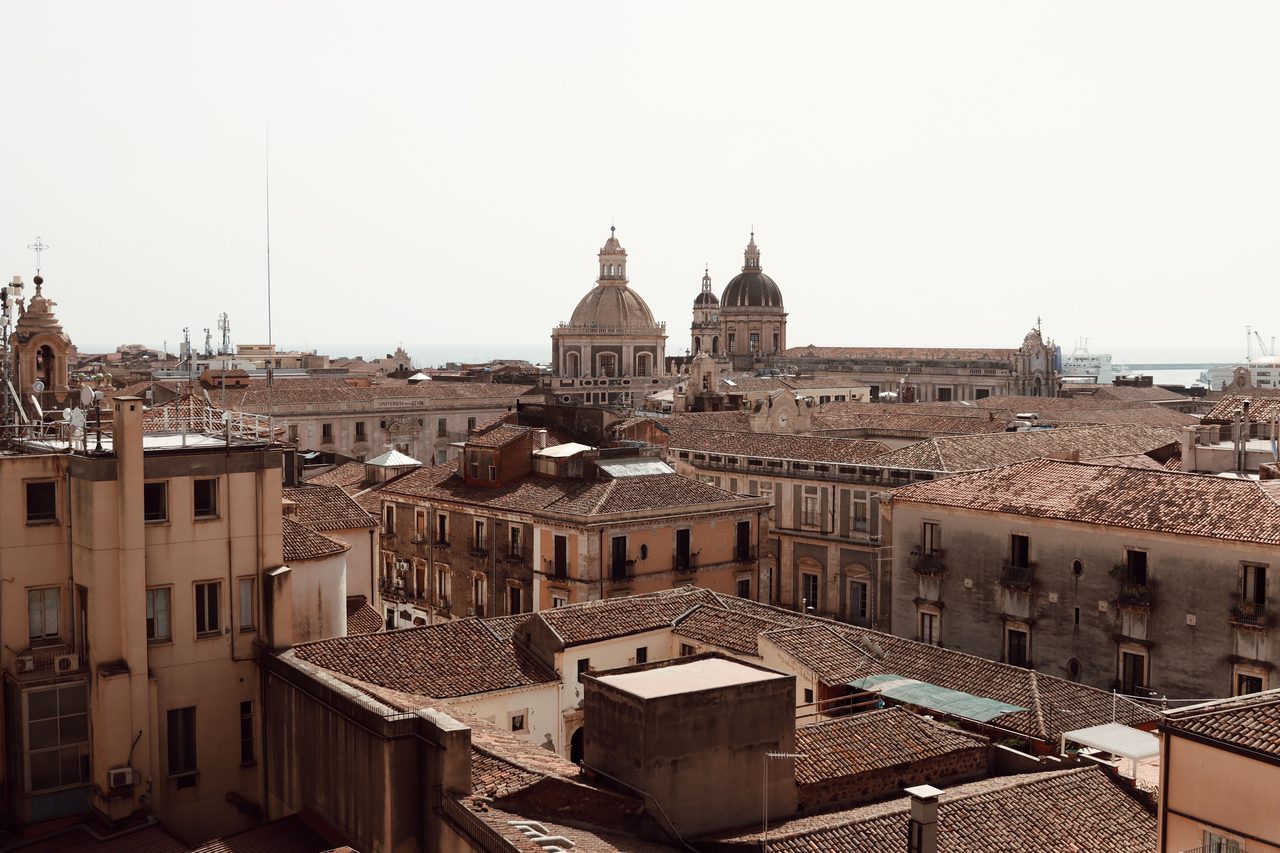
Catania is Sicily's second city, on the island's east coast at the foot of Mount Etna, Europe's most active volcano. The historic centre was rebuilt in black lava stone and Baroque style after the 1693 earthquake, and it belongs to the UNESCO-listed Late Baroque Towns of the Val di Noto. Piazza del Duomo, with the Fontana dell'Elefante and the Cattedrale di Sant'Agata, anchors the old town, Via Etnea runs north in a straight line toward the volcano, and the lively Pescheria fish market fills the streets behind the square every morning. Castello Ursino, the Roman theatre and odeon, the Villa Bellini gardens and the Benedictine monastery of San Nicolò l'Arena (now a university and UNESCO site) are all within walking distance. Food is a draw in itself: arancini, pasta alla Norma, horse-meat grills, granita with brioche and cannoli. The coast to the north, with Ognina, Aci Trezza with its Cyclops sea stacks, and Aci Castello with its Norman castle, is a short bus or train ride away, and Taormina, Siracusa, Noto and Etna are easy day trips. For solo travelers the compact centre, low prices and a student-driven nightlife around Piazza Bellini and Via Montesano make Catania an easy base.
Capital
Catania
Largest city
Catania
Population
About 298,000 (municipality, ISTAT estimate 1 January 2025); about 1.07 million in the Metropolitan City of Catania
Languages
Italian
Currency
Euro
Time zone
Central European Time (CET, UTC+1); Central European Summer Time (CEST, UTC+2) from the last Sunday of March to the last Sunday of October
The 15 destinations our editors recommend — from iconic landmarks to under-the-radar finds.
Piazza Duomo and Cattedrale di Sant'Agata
Catania's UNESCO-listed main square, dominated by the Baroque cathedral of Saint Agatha, rebuilt after 1693 with a facade by Giovanni Battista Vaccarini (completed 1711). The nave holds the tomb of composer Vincenzo Bellini; the Roman Terme Achilliane lie beneath.
Fontana dell'Elefante (Liotru)
Catania's emblem: a lava-stone elephant of Roman or Byzantine origin topped by an Egyptian obelisk, set on a fountain designed by Giovanni Battista Vaccarini in 1736. Locals call the elephant u Liotru.
La Pescheria Fish Market
Open-air fish and produce market behind Piazza Duomo, documented since at least the early 19th century in a tunnel beneath the Palazzo del Seminario and the Charles V walls. Stalls sell fresh fish, shellfish and local street food; the nearby Fontana dell'Amenano flows from the buried river Amenano.
Via Etnea
Catania's main axis, laid out in a straight line toward Mount Etna after the 1693 earthquake. It runs north from Piazza Duomo through Piazza Universita and Piazza Stesicoro to Villa Bellini and beyond, lined with shops, cafes and Baroque palaces built of black lava stone.
Teatro Romano and Odeon
Roman theatre built into the hillside, thought to date to about the 2nd century AD, with 21 rows of seats and room for nearly 7,000 spectators. The smaller Odeon beside it was used for music. Houses were built into the structure until the 1959 clearance.
Anfiteatro Romano
Roman amphitheatre of the 2nd century AD, partly visible from the street in Piazza Stesicoro and open below ground level, where arena corridors and arches can be walked. The Comune di Catania has run the ticket desk under an agreement with the regional archaeological park since March 2026.
Recommended itineraries
Pick a length, follow the route. Each itinerary balances headline sights with breathing room.
5-Day Catania Explorer
Day 1Arrive in Catania, explore city center
Day 2Visit top attractions and museums
Day 3Day trip to nearby highlights
Day 4Local markets and hidden gems
Day 5Final sightseeing, departure
7-Day Classic Catania
Days 1-2Catania city highlights
Days 3-4Regional exploration
Days 5-6Cultural immersion and local experiences
Day 7Return and departure
14-Day Ultimate Catania
Days 1-3Catania comprehensive city tour
Days 4-6Northern region exploration
Days 7-9Eastern highlights
Days 10-12Southern attractions
Days 13-14Return to Catania, departure
Where to stay in Catania
Three tiers, every traveller covered — from cost-conscious to flagship hotels.
Budget €75 (~$86)
Hostels, budget hotels, and guesthouses offer affordable stays without sacrificing experience.
Mid-range €180 (~$207)
Boutique hotels and well-located accommodations provide comfort and convenience at reasonable prices.
Luxury €450+ (~$518+)
World-class resorts and premium hotels deliver unforgettable experiences.
Palazzo Sangiorgio
Centro storico, Catania · €230–550 per night (~$265–633) (indicative; check live rates)
Five-star hotel in an 18th-century palazzo in the Baroque centre of Catania, close to the Biscari Museum and the Duomo, with a spa and rooftop terrace.
Catania is served by Vincenzo Bellini Airport (CTA) at Fontanarossa, about 5 km south of the centre, and by Catania Centrale railway station on the edge of the old town near the port. The historic centre is compact and best covered on foot. AMT Catania runs the city buses, and the FCE (Ferrovia Circumetnea, circumetnea.it) runs a short metro line through the city plus a narrow-gauge railway around the base of Etna. Trenitalia regional trains run along the coast to Acireale, Taormina-Giardini, Messina and Siracusa, and intercity buses reach Palermo, Taormina, Siracusa, Ragusa and the Etna area from the bus terminal beside the station. Traffic is heavy and parking is tight, so solo travelers do best without a car in town and renting one only for Etna or the interior.
Alibus (airport bus)
AMT Alibus from the arrivals area to Catania Centrale station in about 15-25 minutes; first departure about 04:40 and last about 00:30, roughly every 20-25 minutes
Cost: About €4 (~$4.60) single, valid 90 minutes; pay on board or via the AMT Catania app, and verify at amt.ct.it
Taxi (airport to centre)
Official white taxis wait outside arrivals; a fixed fare applies from the airport to the centre and the ride takes 10-20 minutes
Cost: About €25-€30 (~$29-$35) to the old town; insist on the meter or the fixed fare before getting in
AMT city buses
AMT Catania operates urban bus lines across the city; tickets are sold at tabacchi shops, machines and on the app, and must be validated on board
Cost: About €1 (~$1.15) per single 90-minute ticket; verify current fares at amt.ct.it
FCE metro and Circumetnea railway
FCE operates the metro line from Stesicoro through the city and the narrow-gauge Circumetnea railway from Borgo station around Etna via Adrano, Bronte and Randazzo to Riposto, a scenic trip of about 3 hours
Cost: Metro about €1 (~$1.15) per ride; Circumetnea sections about €3-€10 (~$3.50-$12) depending on distance; verify at circumetnea.it
Regional trains and intercity buses
Trenitalia regional trains from Catania Centrale to Acireale, Taormina-Giardini, Messina and Siracusa (about 40 minutes to 1.5 hours); intercity buses to Palermo (about 2 hours 30 minutes) and Taormina leave from the terminal beside the station
Cost: From about €3-€15 (~$3.50-$17) depending on destination; trenitalia.com for trains, interbus.it and saisautolinee.it for buses
Walking
The old town is flat and compact; Piazza del Duomo, Via Etnea, the Pescheria, Castello Ursino and Villa Bellini are all within 20-30 minutes on foot. Lava-stone paving is slippery when wet, and cars and scooters often ignore crossings
Cost: Free
Budget breakdown
Daily spend by tier in EUR, broken out by category.
Category
Budget
Mid-range
Luxury
Accommodation
€38 (~$44)
€105 (~$121)
€280 (~$322)
Food (per day)
€20 (~$23)
€42 (~$48)
€110 (~$127)
Transportation
€7 (~$8)
€13 (~$15)
€30 (~$35)
Activities
€10 (~$12)
€20 (~$23)
€30 (~$35)
Daily total
€75 (~$86)
€180 (~$207)
€450+ (~$518+)
Best time to visit Catania
Weather through the year in Sicily
Best timeShoulderWorth avoiding
Average daytime temperature in °C. Figures are for Sicily.
April-June and late September-October
April to early June and late September to October combine warm weather with open attractions, and the sea is good for swimming from June to October. July and August are very hot in the city, so sightseeing is best early or late with the afternoon at the beach. Winter is mild and wet but quiet, with lower hotel prices; Etna is at its most scenic with snow from December to March, but excursions depend on weather and volcano activity. The Sant'Agata festival and Easter fill hotels, so booking early helps.
Essential travel tips
Buy Alibus or AMT tickets from the AMT Catania app, machines or tabacchi shops where possible, and validate paper tickets on board
Check Etna access before booking an excursion: summit areas are restricted by the authorities and a licensed guide is mandatory above the permitted altitude; confirm the zone with the operator and the INGV bulletin at ct.ingv.it
The Pescheria is best from 7-11AM and is mostly finished by early afternoon; many churches close at midday and require covered shoulders and knees
Lunch runs about 1-3PM and dinner from 8PM; many places close on Sunday evenings or Mondays
Eat street food standing at the counter: an arancino, a slice of scaccia or a granita with brioche costs about €2-€5 (~$2.30-$5.75); the Savia cafe at Via Etnea 302 is a classic arancini stop
A city tourist tax is charged per person per night at hotels and is paid at the property; confirm the amount for the accommodation category
Trains in Sicily can run late; check times on trenitalia.com and allow a buffer before any flight or ferry
Hidden gems
Off-the-beaten-path corners most travellers miss.
Terme della Rotonda
Roman baths from the 1st-2nd century AD, enlarged in the 3rd century and later converted into the Byzantine church of Santa Maria della Rotonda. Usually viewed from outside as part of guided Roman Catania walks.
Antico Corso
Casa Museo Giovanni Verga
Preserved home where novelist Giovanni Verga (1840-1922), author of I Malavoglia, lived and died, with his study, library and furniture.
Civita
Palazzo Biscari
Baroque noble palace built 1695-1763 on the old sea walls by the Princes of Biscari after the 1693 earthquake. Access is by private event or special opening.
Giudecca
Safety information
INFO
Save 112 (general emergency) and 118 (ambulance) before arrival; operators handle English
INFO
Wear bags cross-body and zipped on the building side of the pavement to defeat scooter snatchers, and keep phones out of hand near the kerb
INFO
Check ct.ingv.it and aeroporto.catania.it before departure and again on the day of a flight; ash emissions can close Fontanarossa with little notice, and flights may divert to Comiso, Trapani or Palermo
INFO
Book Etna excursions only with licensed guides or the cable-car operator, and obey the exclusion zones and weather and wind restrictions
INFO
Use only white licensed taxis from ranks or the Alibus, and agree the fare before getting in
INFO
Do not drive into the ZTL (look for the blue camera signs); park outside the centre and use the metro or buses
INFO
Keep the passport copy and one spare payment card separate from the main wallet and photograph the passport page
INFO
Carry water, sun protection and warm layers, especially for Etna where temperature can drop by 20°C compared with the city
INFO
Cross streets slowly and make eye contact with drivers, because vehicles often do not stop at zebra crossings
Frequently asked questions
Is Catania safe for solo travelers in 2026?
Catania is generally safe for solo travelers who take normal city precautions. Petty theft, including pickpocketing and scooter bag-snatching around the Pescheria, the station and the port, is the main concern, and traffic is chaotic. The European emergency number is 112; ambulance is 118 and State Police is 113.
What is the best time to visit Catania?
April-June and September-October offer warm weather of about 18-28°C (64-82°F) and a swimmable sea. July and August are hot, sometimes above 35°C (95°F), while winters are mild in town and snowy on Mount Etna.
Do I need a visa to visit Catania?
Italy follows Schengen rules. EU/EEA/Swiss citizens need only a valid ID. US, Canadian, Australian, and UK citizens can stay up to 90 days in any 180 without a visa for tourism. Check travel-europe.europa.eu/etias for the ETIAS start date.
What currency is used in Catania?
The currency in Catania is the Euro (EUR). ATMs are widely available and cards are accepted at most hotels and restaurants, but carry some cash for markets, street food stalls and small trattorie.
How do I get from Catania airport to the city?
Vincenzo Bellini Airport (CTA) is about 5 km south of the centre. The AMT Alibus reaches Catania Centrale in about 15-25 minutes for roughly €4 (~$4.60); a taxi costs about €25-€30 (~$29-$35).
What are the top attractions in Catania?
The top attractions include Piazza del Duomo and the Elephant Fountain, the Pescheria market, Castello Ursino, the Roman theatre, Villa Bellini and Mount Etna, with Taormina and Siracusa as day trips.