
Amber Fort (Amer Fort)
The 16th-century hilltop fort-palace of the Kachwaha rulers, 11 km north of Jaipur, with the Sheesh Mahal mirror hall, Ganesh Pol and Diwan-i-Aam, reached by a ramp or jeep from the Maota Lake road.
Rajasthan · 20 Places · Best November to February
Jaipur is the capital of Rajasthan and the Pink City of India's Golden Triangle, a planned 1727 walled city of terracotta bazaars, the City Palace, Hawa Mahal and Jantar Mantar, ringed by the Aravalli hill forts of Amber, Jaigarh and Nahargarh and known for block-print textiles, gemstones, blue pottery and Rajasthani food.
Jaipur was founded on 18 November 1727 by Maharaja Sawai Jai Singh II, who moved his court from Amber to a planned city on a nine-block grid with broad bazaars and seven gates. The Old City was painted terracotta pink in 1876 to welcome the Prince of Wales, and the colour remains a legal requirement of its facades. The City Palace, Jantar Mantar observatory and Hawa Mahal sit within walking distance of each other, while Amber Fort, Jaigarh and Nahargarh crown the hills to the north. Jantar Mantar was listed by UNESCO in 2010, Amber Fort with five other Rajasthan hill forts in 2013 and the Walled City in 2019. Jaipur is a craft capital, famous for block printing from Sanganer and Bagru, kundan and gemstone jewellery in Johari Bazaar, blue pottery and carpets, and for dal baati churma, laal maas and ghewar. The Jaipur Literature Festival in January and the Teej and Gangaur festivals shape the calendar. Jaipur International Airport (JAI), Jaipur Junction rail station and a growing metro make it an easy base for day trips to Abhaneri, Ranthambore, Ajmer and Pushkar.
Jump straight to the experience you're planning.
The 20 destinations our editors recommend — from iconic landmarks to under-the-radar finds.
The 16th-century hilltop fort-palace of the Kachwaha rulers, 11 km north of Jaipur, with the Sheesh Mahal mirror hall, Ganesh Pol and Diwan-i-Aam, reached by a ramp or jeep from the Maota Lake road.
The royal complex founded by Maharaja Sawai Jai Singh II in 1727, still partly the residence of the Jaipur royal family, with the Mubarak Mahal, Sarvato Bhadra courtyard, Diwan-i-Khas and the Pritam Niwas Chowk peacock gate.
The five-storey pink sandstone facade of 953 small jharokha windows built in 1799 by Maharaja Sawai Pratap Singh so royal women could watch street life unseen.
UNESCO World Heritage astronomical observatory built by Sawai Jai Singh II between 1728 and 1734, with 19 instruments including the 27 m Samrat Yantra, the world's largest stone sundial.
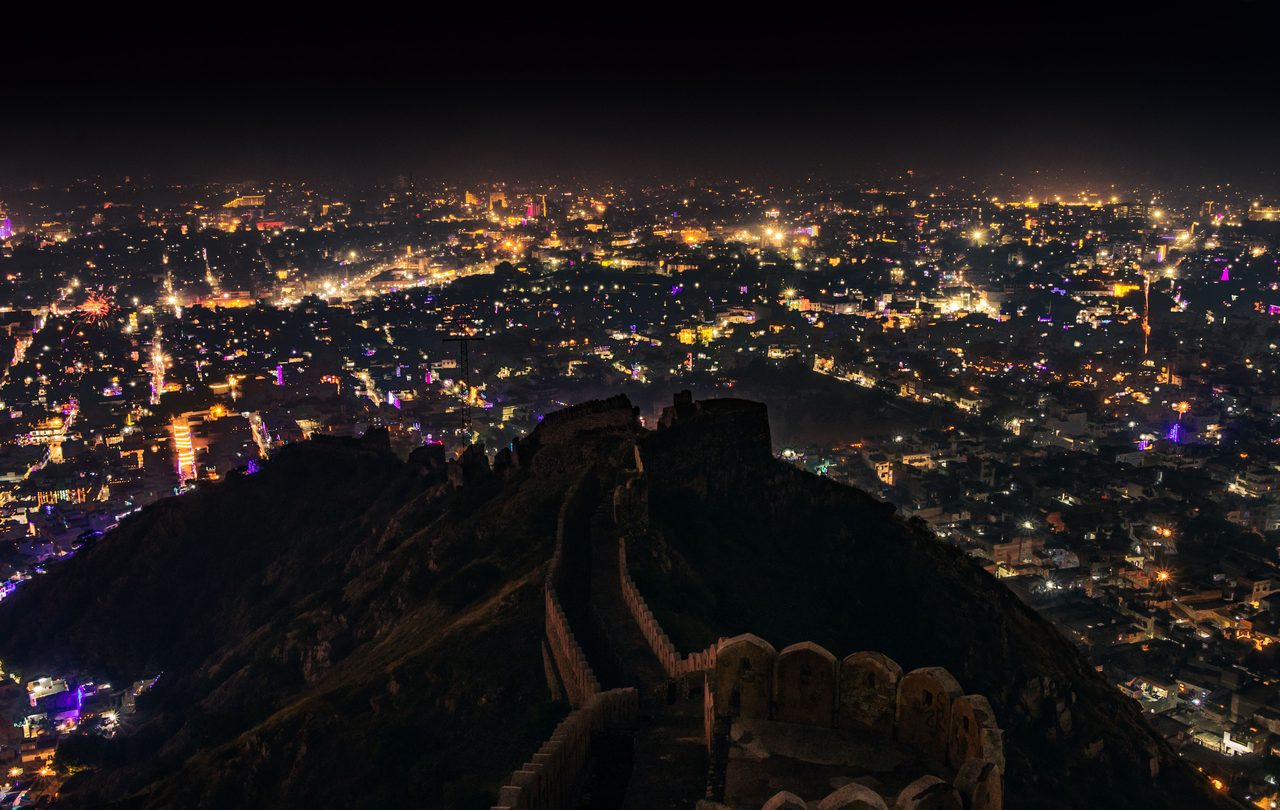
The 1734 fort on the Aravalli ridge above the Old City, known for sunset views over Jaipur, the Madhavendra Bhawan suites and a stepwell, reached by a winding road or a hiking trail.
The 1726 fort above Amber that guarded the dynastic treasury, home to Jaivana, the world's largest cannon on wheels, a cannon foundry, a small museum and long walls with valley views.
Pick a length, follow the route. Each itinerary balances headline sights with breathing room.
Three tiers, every traveller covered — from cost-conscious to flagship hotels.
Hostels, budget hotels, and guesthouses offer affordable stays without sacrificing experience.
Boutique hotels and well-located accommodations provide comfort and convenience at reasonable prices.
World-class resorts and premium hotels deliver unforgettable experiences.
A Taj palace hotel in the former residence of Maharaja Sawai Man Singh II, set in landscaped Mughal-style gardens in the Rambagh district south of the city centre.
Check rates on Booking.comA walled luxury resort on Goner Road in the eastern outskirts, built as a Rajput fort-palace with gardens, pools, a spa and luxury tents.
Check rates on Booking.comA large palace-style Fairmont hotel at Kukas on the northern edge of Jaipur, closer to Amber Fort than to the city centre, with several restaurants and a spa.
Check rates on Booking.comA Taj-managed 18th-century palace hotel on Jacob Road in Civil Lines, set in Mughal-style gardens with a pool and fine-dining restaurants.
Check rates on Booking.comCafés, neighbourhood gems, and tasting menus worth the table reservation.
A landmark pure vegetarian restaurant and sweet shop on Johari Bazaar, long associated with ghewar, kachori and Rajasthani thali.
The city's reference point for pyaaz kachori and mawa kachori, in business for decades near Sindhi Camp.
A well-known MI Road dining room for slow-cooked meat curries and tandoori dishes.
A palace-style restaurant within the fort walls at Amer, known for Rajasthani royal dishes and lake views.
A palatial dining room inside Rambagh Palace, the city's most formal dinner setting.
A long-running village-style dining and entertainment complex south of Jaipur, with a seated thali.
Book a food tour in Jaipur We may earn a commission from bookings made through this link.
Jaipur is the capital of Rajasthan and the northern point of the Golden Triangle, with a walled Pink City surrounded by newer districts such as C-Scheme, Malviya Nagar and Mansarovar. The metro's Pink Line, app cabs and autos cover most trips, while the compact old city is best on foot. Jaipur Junction is one of the best connected stations in Rajasthan, with Vande Bharat, Shatabdi and express services to Delhi, Ajmer and Udaipur, and the Delhi-Jaipur expressway makes the road trip from the capital a day's drive.
Daily spend by tier in INR, broken out by category.
| Category | Budget | Mid-range | Luxury |
|---|---|---|---|
| Accommodation | ₹1,000 (approx $10 USD) | ₹3,500 (approx $36 USD) | ₹20,000 (approx $208 USD) |
| Food (per day) | ₹600 (approx $6 USD) | ₹1,500 (approx $16 USD) | ₹5,000 (approx $52 USD) |
| Transportation | ₹300 (approx $3 USD) | ₹800 (approx $8 USD) | ₹2,500 (approx $26 USD) |
| Activities | ₹600 (approx $6 USD) | ₹1,200 (approx $13 USD) | ₹2,500 (approx $26 USD) |
| Daily total | ₹2,500 (approx $26 USD) | ₹7,000 (approx $73 USD) | ₹30,000+ (approx $313 USD) |
Best time Shoulder Worth avoiding
Average daytime temperature in °C.
Visit Jaipur from November to February for dry, sunny weather and the main festivals. October and March are good shoulder months, while April to June is hot and July to August brings monsoon rain and lower prices.
Book hotels and Vande Bharat or Shatabdi tickets weeks ahead for Diwali, Christmas and the Jaipur Literature Festival in mid-January.
Use Uber, Ola, Rapido or InDrive for fixed fares, or agree the fare with an auto driver before boarding
Buy Amber, City Palace, Hawa Mahal and Jantar Mantar tickets only at the official counters or on the official Rajasthan Tourism and Archaeological Survey of India (ASI) channels
Decline unsolicited help from friendly strangers near the railway station, Hawa Mahal and Amber Fort who offer to take you to a 'government shop', 'export outlet' or 'exhibition'
Never agree to carry, buy or ship gemstones, jewellery or carpets for resale abroad; the 'gem export' scheme is a well-known fraud in Jaipur
Keep bags zipped in front of you in Johari Bazaar, Bapu Bazaar, Tripolia Bazaar and at the Sindhi Camp bus stand, where pickpockets work crowds
Carry a photocopy or phone photo of the passport and keep the original in the hotel safe
Drink only sealed bottled water or filtered water, and avoid ice and raw salads from roadside stalls
Protect against heat from April to June: carry water, wear a hat and sunscreen, and sightsee at dawn and after 5pm
Do not touch or feed monkeys at Galtaji, Amber Fort and Nahargarh; they snatch food, bags and sunglasses and can bite
Wear a seatbelt in cabs, and avoid rear seats of two-wheeler taxis without a helmet
Keep small notes for tips and fares so you do not have to open a wallet in public
Share the live ride link with a friend when travelling at night by app cab
Save 112, 1363 (tourist helpline) and 1091 (women's helpline) in your phone before arrival
Take care at Holi (March), when crowds, thandai laced with bhang and rough play can be risky; keep to hotel-hosted celebrations if unsure
Most foreign nationals need a visa for India. Citizens of roughly 165 eligible countries can apply online for an e-Tourist Visa in 30-day, 1-year, or 5-year variants, with government fees of about $25, $40, and $80 respectively plus a bank transaction charge. Applications can be lodged between 4 and 120 days before travel, and passports must be valid at least six months. Rules and fees vary by nationality, so travellers should confirm current requirements on the official Indian government e-Visa portal or with the nearest Indian mission before booking.
Jaipur's Old City was painted terracotta pink in 1876 to welcome the Prince of Wales, and the colour has been maintained ever since. The Walled City of Jaipur was inscribed as a UNESCO World Heritage Site in 2019.
The top attractions are Amber Fort, City Palace, Hawa Mahal, Jantar Mantar, Nahargarh Fort, Jaigarh Fort, Jal Mahal (viewed from the promenade) and Albert Hall Museum. Galtaji, Panna Meena ka Kund and the Birla Mandir are free.
Reported 2026 prices are about ₹200 (~$2.08) for Indian and ₹1,000 (~$10.42) for foreign adults at Amber Fort, and about ₹100 (~$1.04) and ₹600 (~$6.25) at Hawa Mahal, Jantar Mantar and Nahargarh. Prices can change, so confirm at the ticket counter.
Jaipur is known for dal baati churma, laal maas (a fiery mutton curry), pyaaz kachori, ghewar sweets, mawa kachori and lassi. LMB, Rawat Mishthan Bhandar and Chokhi Dhani are well-known places to try them.
No. Tap water in Jaipur is not safe for visitors to drink. Sealed bottled water costs around ₹20 (~$0.21) per litre, and hotels and cafes usually provide filtered water.
October to March is the comfortable season, with daytime highs of about 20-30°C. April to June often passes 40°C and July to September is the monsoon. The Jaipur Literature Festival takes place in January.