
Mogao Caves (Mogao Grottoes)
A UNESCO World Heritage cave complex 25 km southeast of Dunhuang with fourth- to fourteenth-century Buddhist murals and painted sculptures, and the Library Cave where the Diamond Sutra manuscript was found.
Gansu · 21 Places · Best May, June, September, early October
Gansu is a long, narrow province in northwest China that follows the Hexi Corridor, the Silk Road passage between the Qilian Mountains and the Gobi. It joins the Yellow River city of Lanzhou, the Mogao Caves and Mingsha dunes at Dunhuang, the Ming fort at Jiayuguan, the rainbow Danxia hills of Zhangye, and the Tibetan monasteries of Xiahe and Langmusi into one of China's richest cultural and landscape routes.
Gansu stretches about 1,600 km from the Loess Plateau in the southeast to the Gobi in the northwest, and its shape follows the Hexi Corridor, the only practical passage between the Tibetan Plateau and the Mongolian steppe. The capital, Lanzhou, sits on the Yellow River and is known for its hand-pulled beef noodles. West along the corridor, Wuwei, Zhangye, Jiayuguan and Dunhuang mark the old Han-dynasty commanderies: Zhangye has the striped Danxia sandstone hills, Jiayuguan the Ming fort at the western end of the Great Wall, and Dunhuang the Mogao Caves, with 1,000 years of Buddhist murals, and the Mingsha singing dunes. In the south, Tianshui holds the Maijishan Grottoes, Pingliang has Taoist Kongtong Mountain, Linxia is the Hui Muslim centre nicknamed Little Mecca, and Xiahe and Langmusi in the Gannan Tibetan prefecture sit on high Amdo grassland around Labrang Monastery.
Jump straight to the experience you're planning.
The 21 destinations our editors recommend — from iconic landmarks to under-the-radar finds.
A UNESCO World Heritage cave complex 25 km southeast of Dunhuang with fourth- to fourteenth-century Buddhist murals and painted sculptures, and the Library Cave where the Diamond Sutra manuscript was found.
A 40 km-long field of towering singing-sand dunes beside a spring-fed crescent-shaped lake, 5 km south of Dunhuang, famed for camel rides, sandboarding and sunset views.
The ruins of a Han-dynasty frontier fort and desert gateway west of Dunhuang, once the checkpoint for Silk Road traffic heading to the Western Regions.
A wind-sculpted desert badlands of yardang ridges in the Gobi northwest of Dunhuang, nicknamed the Ghost City and used as a filming location for desert scenes.
A Han-dynasty southern gateway on the Silk Road, 75 km southwest of Dunhuang, where a single beacon tower still stands over desert and the Nanhu oasis.
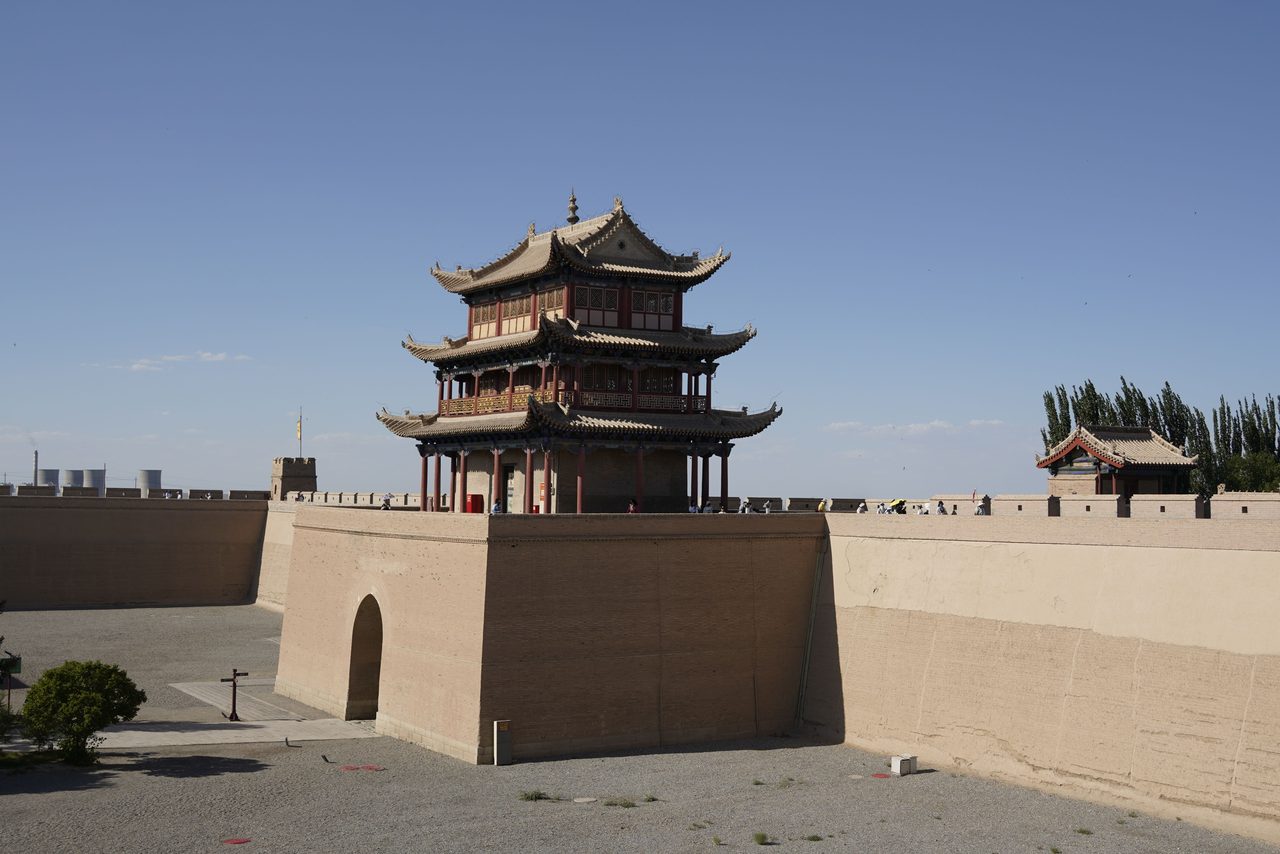
The best-preserved Ming-dynasty fortress pass at the western end of the Great Wall, built from 1372 between the Qilian Mountains and the Heishan range.
Pick a length, follow the route. Each itinerary balances headline sights with breathing room.
Three tiers, every traveller covered — from cost-conscious to flagship hotels.
Hostels, budget hotels, and guesthouses offer affordable stays without sacrificing experience.
Boutique hotels and well-located accommodations provide comfort and convenience at reasonable prices.
World-class resorts and premium hotels deliver unforgettable experiences.
Five-star riverside hotel in central Lanzhou with views over the Yellow River, a short taxi ride from the Zhongshan Bridge area and the Zhengning Road night market.
Check rates on Booking.comHilton-brand high-rise in the middle of Lanzhou's Chengguan district, rated 9.5/10 on Trip.com from more than 3,800 reviews, within reach of Zhongshan Road, the Gansu Provincial Museum and the night markets.
Check rates on Booking.comMarriott-brand five-star in the western Anning district, rated 9.5/10 on Trip.com; quieter than the center and best for travelers using Didi or a car, since the old town is a 25-30 minute drive.
Check rates on Booking.comUpscale IHG-brand hotel on the north bank of the Yellow River near the Gansu International Convention and Exhibition Center; separate from the Crowne Plaza New Area property, which is at 1020 Huanghe Avenue.
Check rates on Booking.comCafés, neighbourhood gems, and tasting menus worth the table reservation.
Time-honored Lanzhou beef noodle brand; the ground floor works as a lively canteen and the upstairs is an air-conditioned dining room with table service.
Main branch of a Lanzhou beef noodle shop whose noodles come in eight thicknesses; the beef-bone broth is simmered around the clock.
Beef noodle shop at the east exit of the Zhengning Road night market, praised for good value and for its pickled radish side dish.
Popular halal beef noodle shop next to Zhengning Road Primary School, open late and known for its self-serve side-dish bar; a step above the street stalls in price.
Sit-down restaurant serving Lanzhou braised beef and hand-pulled noodles together with Cantonese and Sichuan dishes; picture menu in Chinese, plain English menu available.
Lanzhou's best-known night market, a long strip of stalls selling beef noodles, mutton skewers, gray bean jelly, sweet fermented rice and other snacks, next to Nanguan Ethnic Favor Street.
Book a food tour in Gansu We may earn a commission from bookings made through this link.
Gansu's transport spine runs northwest from Lanzhou along the Hexi Corridor through Wuwei, Zhangye, Jiayuguan and Dunhuang. Lanzhou Zhongchuan International Airport (LHW) is the main gateway, and four regional airports (Dunhuang, Jiayuguan, Zhangye and Gannan Xiahe) plus Tianshui serve the rest. High-speed rail connects Lanzhou West with Xining, Xi'an and the Hexi Corridor cities as far as Liuyuan, while buses, chartered cars and tourist shuttles cover the last leg to Bingling Temple, Labrang Monastery, the Danxia landforms and the Dunhuang desert sites.
Daily spend by tier in CNY, broken out by category.
| Category | Budget | Mid-range | Luxury |
|---|---|---|---|
| Accommodation | CNY 100 (about $15) | CNY 300 (about $44) | CNY 900 (about $133) |
| Food (per day) | CNY 70 (about $10) | CNY 150 (about $22) | CNY 400 (about $59) |
| Transportation | CNY 60 (about $9) | CNY 100 (about $15) | CNY 250 (about $37) |
| Activities | CNY 70 (about $10) | CNY 150 (about $22) | CNY 250 (about $37) |
| Daily total | CNY 300 (about $44) | CNY 700 (about $104) | CNY 1,800 (about $267) |
Best time Shoulder Worth avoiding
Average daytime temperature in °C. Figures are for Gansu.
The best time to visit Gansu is May-June and September-early October, when most of the province is warm but not extreme and skies are clear; Gannan is best June-September.
Desert regions have large daily temperature swings; even in summer evenings in Dunhuang and Gannan can feel cold, so pack layers year-round
Gansu is a very safe province for visitors with low violent crime; the practical concerns are altitude in Gannan and Tibetan areas, desert sun and dryness, long road distances, and standard China-wide rules on registration, payments and internet access.
Altitude: Xiahe sits at roughly 2,900-3,000 m, Langmuxi and the Sangke and Gahai grasslands are higher, and passes in Gannan exceed 3,500 m. Ascend gradually, drink plenty of water, avoid alcohol on the first night, and descend if headache, nausea or breathlessness worsens.
Carry your passport at all times; it is required for hotel check-in, train tickets, Mogao Caves entry, museum reservations and occasional police or checkpoint checks, especially on roads in Gannan and near Jiayuguan.
Hotels register foreign guests with the local police at check-in, so some budget guesthouses without a foreigner license will refuse foreign guests; confirm on Trip.com or by phone before traveling to Xiahe or smaller towns.
Gansu is very dry and sunny: use SPF 50 sunscreen, lip balm, sunglasses and a hat, and drink at least 2 liters of water per day in Dunhuang, Zhangye and Jiayuguan.
In Tibetan areas respect local customs: walk clockwise around monasteries, do not touch religious objects or photograph inside halls without permission, and never take photos of police, military or protest scenes.
Use only official ticket windows or the official WeChat and web channels for Mogao Caves; the caves cap daily visitors and tickets cannot be bought on the day in peak season.
Pedestrians do not always have priority; e-bikes and scooters are silent and use sidewalks, so look both ways even on green signals.
Tap water is not safe to drink untreated; use bottled or boiled water, and choose busy halal restaurants and freshly cooked food.
Winter from December to February is very cold and dry across the province, with temperatures well below freezing in Xiahe, Jiayuguan and Dunhuang; carry layers, and check road conditions before driving mountain passes.
China's firewall blocks Google, WhatsApp and many foreign services; set up a roaming eSIM or VPN and download offline maps (Amap or Baidu Maps) before arrival because VPN sites are blocked inside China.
Entry requirements follow mainland China's national rules. Most visitors need a Chinese visa obtained in advance, though some nationalities qualify for visa-free entry or visa-free transit of up to 240 hours at designated ports if continuing to a third country. Check requirements with the nearest Chinese embassy or consulate before travelling. No separate permit is normally needed for Gansu's tourist sites.
May-June and September to early October are best for the Hexi Corridor and Dunhuang, avoiding midsummer heat, winter cold and the busy holiday weeks. The Tibetan plateau around Xiahe and Langmusi is best from June to September.
A Lanzhou-Zhangye-Jiayuguan-Dunhuang route needs 7-10 days by train. Add 3-4 days for Xiahe and Bingling Temple, and a few more for Tianshui and Pingliang.
The top attractions are the Mogao Caves and Mingsha dunes at Dunhuang, Jiayuguan Fort, Zhangye Danxia, Labrang Monastery in Xiahe, Bingling Temple and Maijishan Grottoes. Together they cover Silk Road Buddhist art, Great Wall history, striking landforms and Tibetan culture.
The cities below have their own guides — hotels, attractions and where to eat, in depth.