Alentejo · 25 Places · Best March-May and September-October
Alentejo
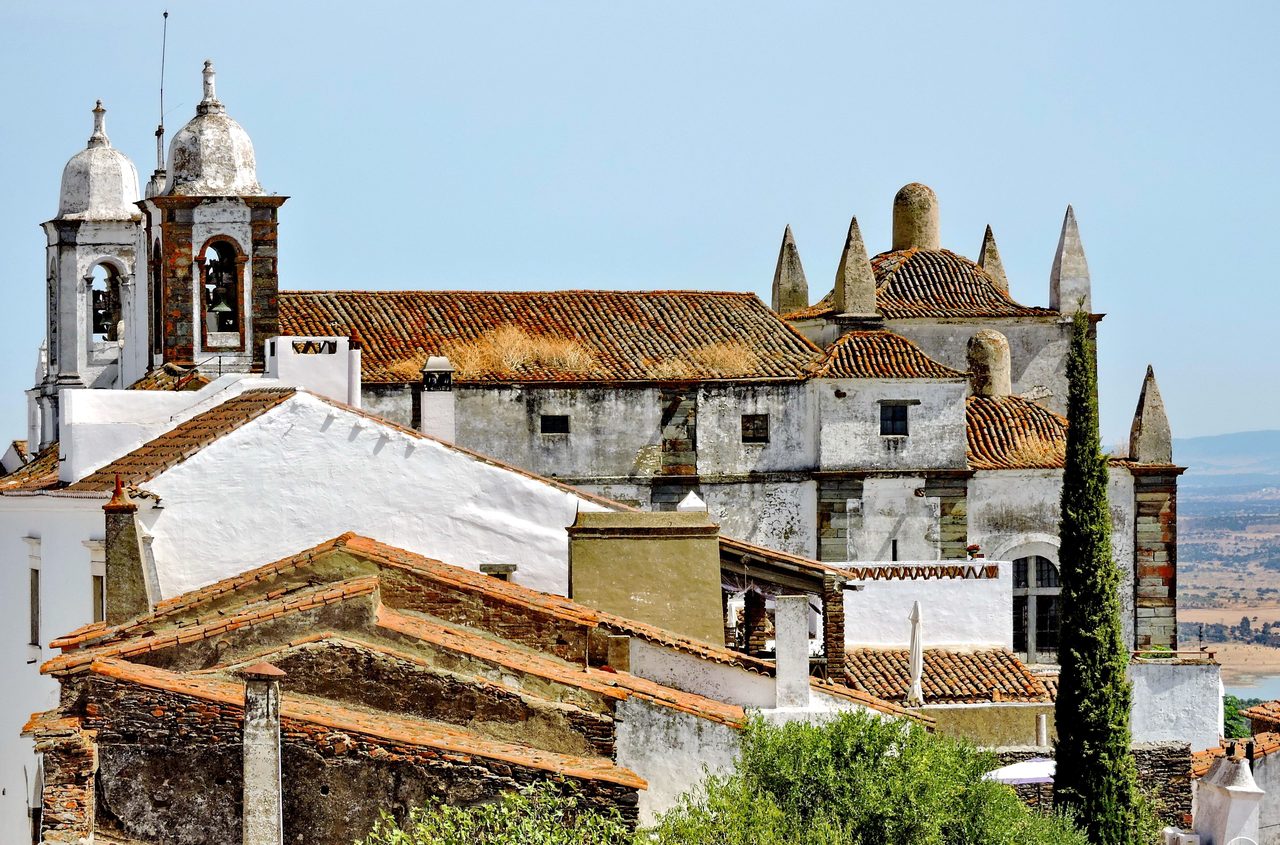
Alentejo is Portugal's largest region, a vast plain of cork oak forests, whitewashed hilltop villages, and rolling vineyards stretching from the Spanish border to the Atlantic coast. Home to the UNESCO World Heritage city of Évora, the megalithic stone circle of Cromeleque dos Almendres, and the walled fortress towns of Elvas and Marvão, Alentejo pairs deep history with one of Europe's leading wine regions, the world's largest cork production, and the wild, undeveloped beaches of the Costa Vicentina.
Alentejo occupies roughly a third of mainland Portugal, south of the Tagus River, and is divided into four sub-regions: Alto Alentejo in the north near the Spanish border, Alentejo Central around Évora, Baixo Alentejo to the south, and Alentejo Litoral along the wild Atlantic coast. The region is Portugal's breadbasket and its cork and wine heartland, with vast dehesa-style plains dotted with cork oaks and historic latifundio estates now converted into wine quintas. Évora's Roman temple, medieval walls, and eerie Capela dos Ossos anchor a region rich in megalithic monuments predating Stonehenge, while fortified towns like Elvas, Estremoz, Monsaraz, and Marvão preserve centuries of border warfare with Spain. Alqueva, Western Europe's largest artificial lake, has become a certified Dark Sky destination for stargazing, while the Rota Vicentina trail along the Alentejo and Costa Vicentina coastline links wild beaches and fishing villages largely untouched by mass tourism.
The 25 destinations our editors recommend — from iconic landmarks to under-the-radar finds.
Templo de Diana (Temple of Diana)
The Roman Temple of Diana is Évora's most iconic monument and the best-preserved Roman temple in Portugal, its fourteen granite Corinthian columns standing on a raised platform in the heart of the UNESCO-listed old town. Built in the 1st century AD, likely honouring the imperial cult rather than the goddess Diana, the temple survived centuries of reuse as a slaughterhouse and fortress before restoration in the 19th century revealed its original form. It sits in a small garden square beside the cathedral and city museum, forming the postcard image of Évora.
Sé de Évora (Évora Cathedral)
Évora's granite cathedral, begun in 1186 and consecrated in 1204, is the largest medieval cathedral in Portugal and blends late-Romanesque and early-Gothic styles. Twin crenellated towers flank the west facade, and visitors can climb to the rooftop terraces between the towers for sweeping views over the whitewashed old town. The cloister and Sacred Art Museum hold an important collection of gilded reliquaries, including the 13th-century ivory Virgin of Évora.
Capela dos Ossos (Chapel of Bones)
Attached to the Church of São Francisco, the Chapel of Bones is one of Portugal's most striking curiosities: its interior walls and columns are entirely lined with the skulls and bones of an estimated 5,000 monks, exhumed from overflowing cemeteries in the 16th century. An inscription over the entrance reads 'Nós ossos que aqui estamos, pelos vossos esperamos' ('We bones that are here, await yours'), a memento mori intended to prompt reflection on mortality. The adjoining Gothic church has an elaborately gilded Baroque interior.
Cromeleque dos Almendres (Almendres Cromlech)
The Almendres Cromlech is the largest and most important megalithic stone circle complex on the Iberian Peninsula, comprising around 95 granite monoliths arranged in an elliptical formation dating from between 6000 and 3000 BC — older than Stonehenge. Set among cork oaks on a remote hillside outside Évora, many stones carry faint carved symbols thought to relate to solar and lunar alignments. The site is unfenced and free to explore at any hour, offering a rare direct encounter with European prehistory.
Menir dos Almendres (Almendres Menhir)
A short walk from the main cromlech, the solitary Almendres Menhir is a nearly 4-metre granite standing stone erected as part of the same Neolithic ritual landscape. Positioned on a rise with wide views over the Alentejo plains, the menhir is believed to have functioned as a solstice marker in alignment with the stone circle. It is one of several megaliths scattered across the Évora countryside that together form the densest concentration of megalithic monuments in the Iberian Peninsula.
Praça do Giraldo
Praça do Giraldo is Évora's grand central square and the social heart of the city, framed by whitewashed arcaded buildings, pavement cafés and the twin-domed Church of Santo Antão. The square takes its name from Geraldo Geraldes, a 12th-century knight who helped reconquer the city from the Moors, and it was also the site of Inquisition executions in the 16th and 17th centuries. Today it hosts markets, festivals and the daily rhythm of Alentejo life.
Recommended itineraries
Pick a length, follow the route. Each itinerary balances headline sights with breathing room.
5-Day Alentejo Explorer
Day 1Arrive in Alentejo, explore city center
Day 2Visit top attractions and museums
Day 3Day trip to nearby highlights
Day 4Local markets and hidden gems
Day 5Final sightseeing, departure
7-Day Classic Alentejo
Days 1-2Alentejo city highlights
Days 3-4Regional exploration
Days 5-6Cultural immersion and local experiences
Day 7Return and departure
14-Day Ultimate Alentejo
Days 1-3Alentejo comprehensive city tour
Days 4-6Northern region exploration
Days 7-9Eastern highlights
Days 10-12Southern attractions
Days 13-14Return to Alentejo, departure
Where to stay in Alentejo
Three tiers, every traveller covered — from cost-conscious to flagship hotels.
Budget €45 ($52)
Hostels, budget hotels, and guesthouses offer affordable stays without sacrificing experience.
Mid-range €100 ($116)
Boutique hotels and well-located accommodations provide comfort and convenience at reasonable prices.
Luxury €320 ($371)
World-class resorts and premium hotels deliver unforgettable experiences.
Torre de Palma Wine Hotel
Monforte, Alto Alentejo · $$$$
A 19th-century agricultural estate turned design boutique hotel among the vineyards outside Monforte, built around a working winery, an equestrian centre and a spring-fed pool set in the former stables courtyard.
A restored 780-hectare agricultural estate near Monsaraz, converted from a cluster of farmhouses into a Leading Hotels of the World property with a working farm, vineyard, orchards and an architect-designed spa.
A pine-forest retreat and spa in the Comporta dunes, built with reclaimed wood and thatched roofs in the local rice-country vernacular, with a beach shuttle to the wild Atlantic sands nearby.
A modernist design hotel set among the vines of the Herdade das Valadas estate outside Montemor-o-Novo, known for its glass-walled suites with private plunge pools, vinotherapy spa and the MAPA fine-dining restaurant.
Cafés, neighbourhood gems, and tasting menus worth the table reservation.
Restaurante Fialho
Traditional Alentejo · €30-50 ($35-58) per person
An Évora institution run by the same family since 1945, Fialho is the benchmark for classic Alentejo cooking in the region's capital. The dining room is hung with decades of awards and the kitchen is known for game dishes, slow-roasted lamb and an encyclopaedic list of regional starters brought to the table before the meal begins.
Botequim da Mouraria
Traditional Alentejo · €25-40 ($29-46) per person
A tiny counter-and-stools restaurant in Évora's Mouraria quarter that has operated continuously since the 1940s and is considered one of Portugal's most legendary regional dining rooms. There are no tables, only a long counter, and the daily blackboard menu of açorda, migas and porco preto changes with what the market offers that morning.
O Templo
Traditional Portuguese · €18-30 ($21-35) per person
A welcoming restaurant near Évora cathedral serving generous plates of Alentejo classics alongside broader Portuguese dishes. The cosy stone-walled dining room and friendly service make it a reliable choice for visitors exploring the historic centre.
Café Alentejo
Traditional Alentejo · €20-32 ($23-37) per person
A long-standing Évora address serving hearty, home-style Alentejo cooking in a rustic dining room decorated with regional crafts. The kitchen leans on bread-based soups, black pork and regional cheeses, making it a dependable stop for a first taste of the region's cuisine.
Dona Laura
Traditional Alentejo · €15-25 ($17-29) per person
A modest, family-run restaurant tucked into an Évora side street, prized by locals for unfussy Alentejo comfort food at fair prices. Portions are generous and the daily specials chalked on a board are usually the best order.
Vinho e Noz
Contemporary Alentejo · €28-45 ($32-52) per person
A stylish Évora restaurant that reworks Alentejo classics with modern technique and presentation, paired with a well-curated list of Alentejo DOC wines including Cartuxa and Esporão labels. The setting is more refined than the average tasca while keeping the region's flavours front and centre.
Alentejo is Portugal's largest and least densely served region by public transport, so a rental car is strongly recommended for exploring beyond Évora. CP intercity trains link Lisbon to Évora and, via a combined train-and-bus service, to Beja. Rede Expressos coaches cover the main towns, but many rural villages, day-trip destinations, and Alentejo Litoral beaches have no rail service at all and only sparse or seasonal bus connections.
Rental Car
The only practical way to reach Monsaraz, Estremoz, the Alqueva reservoir, and most Alentejo Litoral beaches. Agencies operate at Lisbon Portela Airport and in Évora.
Cost: €28-50/day (€32-58 USD)
CP Intercidades Train (Lisboa-Évora)
Direct intercity trains from Lisboa Oriente and Sete Rios to Évora, roughly every 2-3 hours
Cost: €12-13 2nd class (€14-15 USD)
CP Train+Bus (Lisboa-Beja)
Combined rail-and-coach service to Beja; the direct rail line has reduced frequency so CP substitutes a bus for part of the journey
Cost: €14-18 (€16-21 USD)
Rede Expressos Bus
Long-distance coaches from Lisboa (Sete Rios) to Évora, Beja, Estremoz, Portalegre and other Alentejo towns
Cost: €12-18 (€14-21 USD)
Bolt / Uber
Available in Évora and Beja town centres; coverage thins out quickly outside the main towns and is largely absent on the coast
Cost: €4-12 (€5-14 USD)
Local/Regional Buses
Rodoviária do Alentejo and municipal services connect smaller towns but run infrequently, often only on weekday school/market schedules
Cost: €2-8 (€2-9 USD)
Taxi
Available at ranks in Évora, Beja and Estremoz; must usually be booked by phone in smaller towns
Cost: €8-40 (€9-46 USD)
Budget breakdown
Daily spend by tier in EUR, broken out by category.
Category
Budget
Mid-range
Luxury
Accommodation
€18 ($21)
€65 ($75)
€220 ($255)
Food (per day)
€12 ($14)
€22 ($26)
€60 ($70)
Transportation
€7 ($8)
€13 ($15)
€40 ($46)
Activities
€8 ($9)
€20 ($23)
€60 ($70)
Daily total
€45 ($52)
€100 ($116)
€320 ($371)
Best time to visit Alentejo
Weather through the year in Portugal
Best timeShoulderWorth avoiding
Average daytime temperature in °C. Figures are for Portugal.
Alentejo's summer heat is more intense than almost anywhere else in Portugal, so travelers uncomfortable with sustained 35°C+ days should favor the shoulder seasons; winter is mild enough for sightseeing but wetter and with shorter daylight hours
Essential travel tips
Rent a car to reach Marvão, Monsaraz, and the megalithic sites, none of which are well served by public transport
Visit Évora's Capela dos Ossos and cathedral early in the morning to avoid tour-bus crowds
Base in Évora for culture and wine, or Vila Nova de Milfontes for the Atlantic coast
Book a Dark Sky stargazing tour around Alqueva Lake — Alentejo's clear inland skies are ideal for astrophotography
Sample Alentejo DOC wines directly at herdade wine estates, many of which offer tastings and tours
Hidden gems
Off-the-beaten-path corners most travellers miss.
Cromeleque dos Almendres
A circle of nearly 100 monoliths predating Stonehenge, set among cork oaks a short drive from Évora
Near Évora, Alentejo Central
Vila Nova de Milfontes
Laid-back Atlantic river-mouth town on the Costa Vicentina with quiet beaches and low-rise development
Alentejo Litoral
Monsaraz
Tiny walled village of whitewashed houses overlooking Alqueva Lake, largely free of mass tourism
Alentejo Central, near the Spanish border
Zambujeira do Mar
Clifftop fishing village with wild beaches on the Rota Vicentina hiking trail
Alentejo Litoral
Safety information
INFO
Alentejo is one of the safest rural regions in Europe; petty theft is rare and mostly limited to crowded events in Évora during peak season
INFO
Summer heat is the single biggest hazard — inland towns such as Évora and Beja regularly reach 35-40°C (95-104°F) in July and August, some of the hottest readings recorded anywhere in Portugal
INFO
Carry water on any daytime walk in summer, avoid strenuous outdoor activity between noon and 4PM, and wear a wide-brimmed hat and SPF 30+ sunscreen
INFO
Rural roads connecting villages like Monsaraz, Marvão and Estremoz are narrow and often unlit at night; drive with care and reduce speed around blind curves
INFO
Wildfire risk rises sharply in the dry cork-oak montado countryside during July and August; never discard cigarettes and follow any posted fire warnings
INFO
Swim only in marked, supervised areas of the Alqueva reservoir and at the Atlantic beaches near Vila Nova de Milfontes and Comporta, since the west coast is exposed to stronger currents than the calm lake
INFO
Keep valuables out of sight in parked cars, particularly at rural trailheads and remote viewpoints where break-ins occasionally target tourist vehicles
INFO
Alentejo's public transport between small villages is limited; confirm bus schedules in advance or rent a car, since being stranded after dark in a small village is inconvenient rather than dangerous but best avoided
Frequently asked questions
Is Alentejo safe to visit in 2026?
Alentejo is one of the lowest-crime regions in Portugal, itself among the safest countries in Europe. Violent crime targeting tourists is extremely rare; the main precautions involve petty theft in busier towns, summer heat, and rural road conditions. Emergency services: police, ambulance, and fire are all reached at 112.
What is the best time to visit Alentejo?
The best time to visit Alentejo is March through May or September through November. Spring brings mild temperatures and wildflower-covered plains, while autumn brings the wine harvest and warm, comfortable weather. Summer (July–August) can bring extreme heat inland, often above 35°C, while winter is cool and rainy.
Do I need a visa to visit Alentejo?
Entry requirements follow Portugal/Schengen rules. EU/EEA citizens enter with a national ID card. Non-EU visitors from visa-exempt countries (USA, Canada, Australia, UK) may stay up to 90 days in any 180-day period. Others require a Schengen visa. Requirements vary by nationality, so check with the nearest embassy or official immigration website before traveling.
What currency is used in Alentejo?
The currency in Alentejo is the Euro (EUR). ATMs are available in Évora and larger towns, though cash is recommended for small villages, local markets, and family-run tascas that may not accept cards.
What language is spoken in Alentejo?
The main language spoken in Alentejo is Portuguese. English is understood in hotels and tourist-oriented restaurants in Évora, but less so in small rural villages, where basic Portuguese phrases are helpful.
What are the top attractions in Alentejo?
The top attractions in Alentejo include Évora's UNESCO-listed historic center, the Cromeleque dos Almendres megalithic stone circle, the fortified town of Elvas, the hilltop village of Marvão, and Alqueva Lake, a certified Dark Sky destination for stargazing.