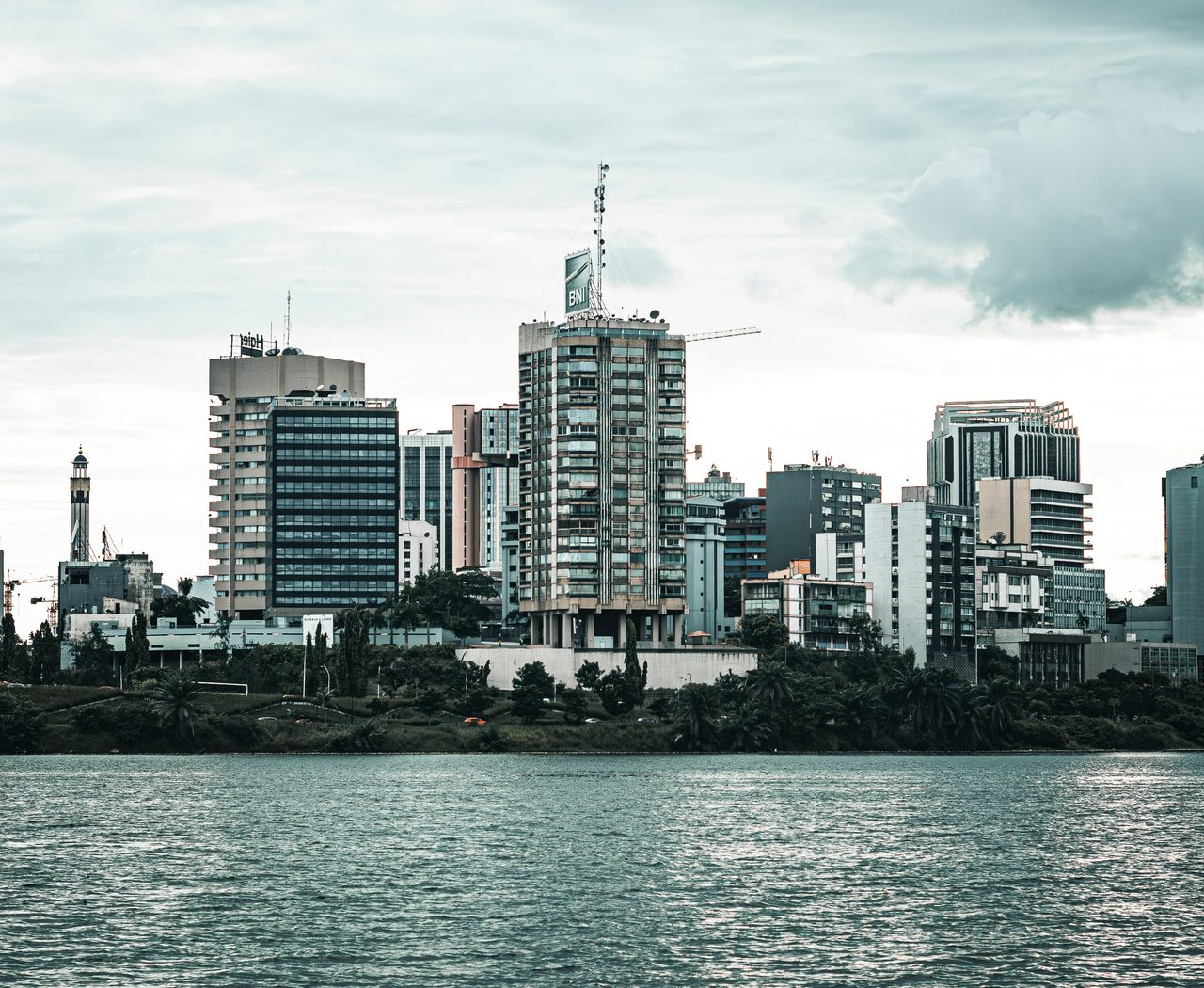
Abidjan is the largest city in Ivory Coast and the commercial capital of French-speaking West Africa, a metropolis of roughly 6.3 million people built across and around the Ebrie Lagoon on the Gulf of Guinea. Its thirteen communes range from the high-rise banking district of Plateau and the villa quarters of Cocody to the vast working neighbourhoods of Abobo, Adjame and Yopougon, linked by bridges, shared taxis and lagoon boats.
Abidjan is the economic capital of Ivory Coast and the seat of most ministries and embassies; Yamoussoukro, 240 km north-west, is the official political capital
Currency
West African CFA franc (XOF); 1 USD = 570 XOF. The CFA franc is pegged to the euro at the fixed rate of 655.957 XOF = 1 EUR
Language
French (official and the language of all signage, government and business); Dioula widely used as a market lingua franca; Baoule, Bete, Attie, Abidji and dozens of other Ivorian languages spoken at home; English is limited to international hotels, airline desks and some business offices
Time zone
Greenwich Mean Time (GMT, UTC+0); no daylight saving, so Abidjan matches London in winter and is one hour behind it in summer
Abidjan grew from a small lagoon settlement into a port city when the Vridi Canal was cut through the coastal sandbar in 1950, opening the Ebrie Lagoon to ocean shipping and turning Abidjan into the busiest port in West Africa after Lagos. It served as the national capital from independence in 1960 until 1983, when the capital was formally transferred to Yamoussoukro, and it has remained the country's economic engine regardless. The Plateau district holds the towers built during the 1970s cocoa boom, including the pyramid-shaped La Pyramide and the CCIA tower, alongside the elephant-shaped Saint Paul's Cathedral completed in 1985 to a design by the Italian architect Aldo Spirito. South across the Houphouet-Boigny bridge lies Treichville with its huge covered market and the bar-lined streets of Zone 4 in neighbouring Marcory; north-east across the lagoon is Cocody, where the Sofitel Hotel Ivoire, the Universite Felix Houphouet-Boigny and most embassies sit. Attecoube holds the Parc National du Banco, a 30-square-kilometre block of primary rainforest inside the city limits. The city's food culture runs from roadside garba stands selling attieke with fried tuna to lagoon-side seafood restaurants, and its nightlife, built on coupe-decale and zouglou music, is among the most energetic on the continent. Felix Houphouet-Boigny International Airport at Port-Bouet is the regional hub for Air Cote d'Ivoire and connects Abidjan to Europe, North Africa and most of West Africa.
Capital
Abidjan is the economic capital of Ivory Coast and the seat of most ministries and embassies; Yamoussoukro, 240 km north-west, is the official political capital
Largest city
Abidjan
Population
6,321,017 in the Abidjan Autonomous District (2021 national census); around 6.3 million in 2026
Languages
French (official and the language of all signage, government and business); Dioula widely used as a market lingua franca; Baoule, Bete, Attie, Abidji and dozens of other Ivorian languages spoken at home; English is limited to international hotels, airline desks and some business offices
Currency
West African CFA franc (XOF); 1 USD = 570 XOF. The CFA franc is pegged to the euro at the fixed rate of 655.957 XOF = 1 EUR
Time zone
Greenwich Mean Time (GMT, UTC+0); no daylight saving, so Abidjan matches London in winter and is one hour behind it in summer
The 19 destinations our editors recommend — from iconic landmarks to under-the-radar finds.
Cathédrale Saint-Paul du Plateau
The seat of the Archdiocese of Abidjan is the city's boldest piece of modern architecture, designed by the Italian architect Aldo Spirito and built between 1980 and its dedication on 10 August 1985 at the initiative of President Félix Houphouët-Boigny. The triangular 4,200 m² building, a reference to the Trinity, is suspended from steel cables anchored in a figure that reads as Saint Paul stooping over the lagoon, and its cross rises about 70 metres. Inside, some 370 m² of stained glass traces the history of the Catholic Church in Côte d'Ivoire, and the gardens hold a Way of the Cross in ceramic bas-relief.
Musée des Civilisations de Côte d'Ivoire
Founded in 1942 as the Musée d'Art Indigène, the national museum holds the country's reference collection of masks, statuary, gold weights, loom-woven cloth, pottery and musical instruments drawn from the Baoulé, Senoufo, Dan, Guro, Akan and Lagoon peoples. Displays are arranged by material and by function rather than by tribe, and the archive holds photographs and documents on Ivorian cultural heritage. It is the single best introduction to the art traditions that later fed Abidjan's contemporary galleries.
Parc National du Banco
Banco is one of very few blocks of primary tropical rainforest left inside a major city, roughly 3,440 hectares protected as a forestry station from 1926 and declared a national park in 1953. Its 600-hectare core holds mahogany and avodiré, and the wildlife includes harnessed bushbuck, several monkey species, a small population of chimpanzees and a long list of forest birds. Marked trails and a colonial-era arboretum run from the entrance, and the park's aquifer supplies a large share of Abidjan's drinking water. Just inside the gate the Banco river holds the famous fanico laundry, where launderers wash by hand on half-buried tyres.
La Pyramide
Designed by the Italian architect Rinaldo Olivieri and built between 1970 and 1973, La Pyramide is the most quoted building of African modernism in Abidjan: a stepped concrete pyramid of tiered balconies balanced on a massive cubic plinth, with a commercial hall at street level and apartments above. It was intended as a covered market and business centre for the newly independent capital. The building emptied during the political troubles of the 1990s and has stood largely derelict since, closed to visitors, but the exterior remains one of the Plateau's defining silhouettes.
Mosquée Salam du Plateau (Grande Mosquée du Plateau)
The Plateau's principal mosque is instantly recognisable from the deep blue dome and a minaret of about 65 metres that stands over the bus terminal. Covering some 7,500 m² and able to hold around 6,500 worshippers, it was begun in 1996 under President Henri Konan Bédié, stalled for years during the crisis decade, and completed with Saudi funding. Modest dress is required, shoes come off at the carpet line, and women should cover their hair; the courtyard and the exterior are the parts most visitors see.
Grande Mosquée de la Riviera
The Riviera mosque serves eastern Cocody and is set back in a walled compound off Boulevard Mitterrand, away from the noise of the Plateau. Its white walls, arcaded courtyard and slender minaret make it one of the more photogenic religious buildings in the district, and the staff are used to receiving non-Muslim visitors outside prayer hours. Shoes are removed at the threshold, shoulders and knees must be covered, and women are asked to cover their hair.
Recommended itineraries
Pick a length, follow the route. Each itinerary balances headline sights with breathing room.
5-Day Abidjan Explorer
Day 1Arrive in Abidjan, explore city center
Day 2Visit top attractions and museums
Day 3Day trip to nearby highlights
Day 4Local markets and hidden gems
Day 5Final sightseeing, departure
7-Day Classic Abidjan
Days 1-2Abidjan city highlights
Days 3-4Regional exploration
Days 5-6Cultural immersion and local experiences
Day 7Return and departure
14-Day Ultimate Abidjan
Days 1-3Abidjan comprehensive city tour
Days 4-6Northern region exploration
Days 7-9Eastern highlights
Days 10-12Southern attractions
Days 13-14Return to Abidjan, departure
Where to stay in Abidjan
Three tiers, every traveller covered — from cost-conscious to flagship hotels.
Budget 18,000-47,000 XOF (~$31.58-82.46)
Hostels, budget hotels, and guesthouses offer affordable stays without sacrificing experience.
Mid-range 88,000-190,000 XOF (~$154.39-333.33)
Boutique hotels and well-located accommodations provide comfort and convenience at reasonable prices.
Luxury 275,000-680,000 XOF (~$482.46-1,192.98)
World-class resorts and premium hotels deliver unforgettable experiences.
Sofitel Abidjan Hôtel Ivoire
Cocody lagoon shore, about 10 minutes by car from Plateau, with its own marina and gardens on the Ébrié Lagoon · 115,000-154,000 XOF (~$202-$271) per night
The 1963 lagoon-side landmark of Ivorian hospitality, rebuilt and run by Sofitel, with 426 rooms, a large conference complex and the panoramic restaurant Le Toit d'Abidjan on its top floor.
Northern edge of Plateau facing the lagoon, a few minutes on foot from the ministries and the Cathédrale Saint-Paul · 111,000-268,000 XOF (~$195-$470) per night
A contemporary five-star tower on the lagoon side of Plateau, with a rooftop pool and bar over the business district and conference space aimed at corporate guests.
Deux Plateaux, on Rue des Jardins near Carrefour Duncan, in the middle of Cocody's restaurant and gallery district · 113,000-182,000 XOF (~$198-$320) per night
A design-led boutique hotel in Deux Plateaux classified five-star and admitted to Design Hotels, built around courtyards and a pool rather than a tower footprint.
Central Plateau beside the banking district, a short walk from the Cathédrale Saint-Paul and the lagoon promenade · 87,000-127,000 XOF (~$152-$223) per night
Accor's flagship business hotel in Plateau, with meeting rooms, a business centre and a pool deck a few steps from the banks and ministries.
Cafés, neighbourhood gems, and tasting menus worth the table reservation.
Saakan
Modern Ivorian / West African · Around 35,000 XOF / USD 61.40 per person
A modern Ivorian dining room on Avenue Chardy in Plateau, working local sauces, spice rubs and lagoon fish into plated courses rather than maquis bowls. It carries a 4.7 rating and sits at the top of the city's TripAdvisor ranking, with two fixed services a day.
Aboussouan
Ivorian / West African · Around 20,000 XOF / USD 35.09 per person, excluding wine
An Ivorian institution in Treichville open since 1978, whose name means family in Agni. The menu lists dishes by their region of origin, from Banfora mutton and Ferké guinea fowl to Grand-Béréby lobster, and the cellar and wine list are part of its reputation.
Le Toit d'Abidjan
French · Around 40,000 XOF / USD 70.18 per person, within a 25,000–60,000 XOF / USD 43.86–105.26 span
The top-floor French dining room of the Sofitel Abidjan Hôtel Ivoire, opening for dinner only with views over the lagoon and the Plateau skyline. It is the most formal room in the city and works on reservations.
Le Grand Large
Italian / European seafood · Around 35,000 XOF / USD 61.40 per person
A long-standing seafood dining room on Boulevard de Marseille in Zone 4, working Italian and European treatments of Atlantic fish and shellfish. Lunch runs only two and a half hours on weekdays and the restaurant closes on Sundays.
Le Pêcheur
French / seafood · Around 30,000 XOF / USD 52.63 per person
A French seafood restaurant at the Biétry end of Boulevard de Marseille, running two services a day and closed on Mondays. It holds a 4.5 rating from over 500 reviews, among the strongest in the Zone 4 dining strip.
Five Abidjan
French gastronomic · Around 25,000 XOF / USD 43.86 per person
A French gastronomic dining room on Rue des Jardins in 2 Plateaux Vallons, serving lunch and a late dinner service that runs to midnight. It sits among the cluster of Cocody restaurants that draw the district's business trade.
Getting around Abidjan
Visitors do not need to drive in Abidjan. Yango is the dominant ride-hailing app and gives a fixed fare in advance, Uber and inDrive both operate, and a hired car with driver is the standard solution for a full day or a trip out of the city. Self-driving is possible but unrewarding: traffic on the bridges and at the Adjamé and Yopougon junctions is heavy from 06:30 to 09:30 and again from 16:30 to 20:00, street parking in Plateau is scarce, and an International Driving Permit alongside the home licence is expected. Walking works inside Plateau by day and along the Cocody and Zone 4 boulevards, but distances between communes are long and pavements disappear on the main arteries. The lagoon boats are the one part of the network that is immune to traffic.
Budget breakdown
Daily spend by tier in XOF (1 USD = 570 XOF), broken out by category.
Category
Budget
Mid-range
Luxury
Accommodation
12,000-30,000 XOF (~$21.05-52.63) for a guesthouse or simple hotel room in Treichville, Marcory or Yopougon
55,000-110,000 XOF (~$96.49-192.98) for a business hotel in Plateau, Marcory Zone 4 or Cocody
140,000-350,000 XOF (~$245.61-614.04) for the Sofitel Hotel Ivoire, Noom Plateau or Radisson Blu Airport
Food (per day)
3,000-8,000 XOF (~$5.26-14.04) eating garba, attieke and grilled fish at maquis and street stalls
15,000-35,000 XOF (~$26.32-61.40) mixing maquis lunches with sit-down restaurant dinners
45,000-110,000 XOF (~$78.95-192.98) at lagoon-side and hotel restaurants with wine
Transportation
1,000-3,000 XOF (~$1.75-5.26) using SOTRA buses at 200-500 XOF, bateau-bus crossings at 200 XOF and shared woro-woro taxis
8,000-20,000 XOF (~$14.04-35.09) using the Yango app and metered orange taxis
50,000-100,000 XOF (~$87.72-175.44) for a private car and driver for the day
Activities
2,000-6,000 XOF (~$3.51-10.53) covering a museum entry and a park walk
10,000-25,000 XOF (~$17.54-43.86) covering museums, a Grand-Bassam day trip share and a lagoon boat
40,000-120,000 XOF (~$70.18-210.53) for private excursions to Grand-Bassam, Assinie or Ile Boulay
Daily total
18,000-47,000 XOF (~$31.58-82.46)
88,000-190,000 XOF (~$154.39-333.33)
275,000-680,000 XOF (~$482.46-1,192.98)
Best time to visit Abidjan
Weather through the year in Abidjan Autonomous District
Best timeShoulderWorth avoiding
Average daytime temperature in °C. Figures are for Abidjan Autonomous District.
Abidjan is warm every day of the year, so the question is rain rather than temperature: visit between December and February for dry bright weather and Harmattan skies, in August and September for the coolest and cheapest conditions under heavy overcast, and expect serious flooding and traffic collapse if arriving in May or June.
Rain in Abidjan generally comes in short violent bursts rather than all-day drizzle, so even wet-season days usually have workable hours. Drainage is the real problem, not the rainfall: an hour of hard rain can leave standing water on the Boulevard Valery Giscard d'Estaing and the Abobo and Yopougon approaches, and traffic across the three lagoon bridges can seize completely. The Harmattan haze of December and January irritates contact-lens wearers and anyone with asthma. Abidjan is on the equatorial side of the tropics, so daylight varies little: sunrise is around 06:00-06:30 and sunset around 18:00-18:30 all year, and dusk lasts barely twenty minutes.
Essential travel tips
The e-visa is issued only through snedai.com/e-visa at EUR 73 (about 47,900 XOF / USD 84) and is valid only for arrival by air at Abidjan; biometric enrolment happens at the airport counters before the immigration desk
A yellow fever vaccination certificate is mandatory and is inspected on arrival; without one, vaccination is administered at the airport for roughly 7,000 XOF (about USD 12)
Abidjan is a cash city below the level of hotels and supermarkets. Bank ATMs at SGBCI, Ecobank, NSIA and Societe Generale branches dispense XOF, usually to a limit of 200,000-400,000 XOF (about USD 351-702) per withdrawal
Mobile money runs the economy: Orange Money, MTN MoMo and Wave are accepted by taxis, small shops and market traders, and a local SIM makes daily payments far easier
Local SIM cards from Orange, MTN or Moov cost around 1,000 XOF (about USD 1.75) with passport registration, and a monthly data bundle runs 5,000-15,000 XOF (about USD 8.77-26.32)
French is essential. Almost nothing outside international hotels is signed or explained in English, and taxi drivers, market traders and police rarely speak it
Tipping is not obligatory; rounding a restaurant bill up or leaving 1,000-2,000 XOF (about USD 1.75-3.51) is normal, and 500-1,000 XOF is usual for porters and parking attendants
Photographing government buildings, bridges, the port, airport and any uniformed personnel is prohibited and is enforced; ask before photographing people anywhere
Hidden gems
Off-the-beaten-path corners most travellers miss.
Safety information
INFO
Petty theft is opportunistic and concentrated in crowded places — Marché d'Adjamé, the transport gares, Plateau streets at rush hour. Carry one card and one day's cash, keep the phone out of sight and leave the rest in the hotel safe.
INFO
Use Yango or TaxiJet rather than street taxis, particularly at night. The fare is fixed in the app and the car is traceable, which is worth the 1,000 XOF difference.
INFO
Avoid unmarked woro-woro minivans near markets and gares. They run informal routes for people who know them and will overcharge anyone who hesitates.
INFO
Do not walk between districts after dark. Abidjan's cheap attractions are spread across two shores and the right way to move at 22:00 is an app car.
INFO
Withdraw cash from ATMs inside bank lobbies or shopping centres during the day, and never count money in the open at a market.
INFO
Photographing the airport, bridges, the port, military or police installations and government buildings is prohibited and can end in a detention that costs a day.
INFO
Traffic is the leading physical risk. Pavements disappear, motorbikes use them where they exist and marked crossings are rare — cross in one deliberate movement and treat dual carriageways as two crossings.
INFO
Malaria is present year-round and the prime biting hours are exactly the outdoor eating hours. Prophylaxis, repellent at dusk, long sleeves, and air conditioning or a net at night.
INFO
Street food is safe on one rule: eat what comes off a hot grill or out of hot oil in front of you, and skip anything sitting at ambient temperature.
INFO
Atlantic swimming at Grand-Bassam, Assinie and Port-Bouët involves a strong undertow with no general lifeguard cover. Swim only where a beach hotel supervises a stretch.
INFO
Emergency numbers are 110 for police, 180 for the fire brigade and 185 for SAMU ambulance. Polyclinique Internationale Sainte Anne-Marie on Boulevard de la Corniche in Cocody is the private hospital used by embassies; travel insurance with medical evacuation cover is not optional in this region.
Frequently asked questions
Is Abidjan safe to visit in 2026?
Abidjan is a functioning, confident commercial capital, and most visits pass without incident. The risks are concentrated rather than general: opportunistic and sometimes armed street crime after dark, particularly in Adjame, Abobo, Yopougon and around Treichville market; hold-ups at stopped vehicle
What is the best time to visit Abidjan?
The best time to visit Abidjan is December. Abidjan has a tropical wet-and-dry climate on the Gulf of Guinea coast, with an annual mean of about 26°C / 79°F and roughly 1,500 mm of rain a year. Unlike most of West Africa it runs on four seasons
Do I need a visa to visit Abidjan?
Most non-African nationalities, including US, UK, Canadian and Australian citizens, need a visa. The e-visa is applied for online at snedai.com/e-visa and costs EUR 73 (about 47,900 XOF / USD 84), is valid for three months with multiple entries, and normally returns a decision in three to four working days. The e-visa is only valid for arrival by air at Felix Houphouet-Boigny International Airport in Abidjan, where biometric enrolment is completed at the SNEDAI counters in the arrivals hall before immigration. Citizens of ECOWAS member states enter without a visa. A passport valid at least six months beyond arrival is required, and a yellow fever vaccination certificate is checked at the airport for every arriving passenger; travellers without one are vaccinated on the spot for a fee of roughly 7,000 XOF (about USD 12). Requirements vary by nationality, so check with your nearest embassy or the official immigration website before traveling.
What currency is used in Abidjan?
The currency in Abidjan is the West African CFA franc (XOF); 1 USD = 570 XOF. The CFA franc is pegged to the euro at the fixed rate of 655.957 XOF = 1 EUR (XOF). ATMs are widely available in cities and tourist areas. Credit cards are accepted at most hotels and restaurants, but carry cash for markets and smaller establishments.
What language is spoken in Abidjan?
The main language(s) spoken in Abidjan: French (official and the language of all signage, government and business); Dioula widely used as a market lingua franca; Baoule, Bete, Attie, Abidji and dozens of other Ivorian languages spoken at home; English is limited to international hotels, airline desks and some business offices. In tourist areas, English is generally understood. Learning a few basic phrases in the local language is appreciated by locals.
What are the top attractions in Abidjan?
The top attractions in Abidjan include Cathédrale Saint-Paul du Plateau, Musée des Civilisations de Côte d'Ivoire, Parc National du Banco, La Pyramide, and Mosquée Salam du Plateau (Grande Mosquée du Plateau). Each offers a unique experience, from historic landmarks to natural wonders.