
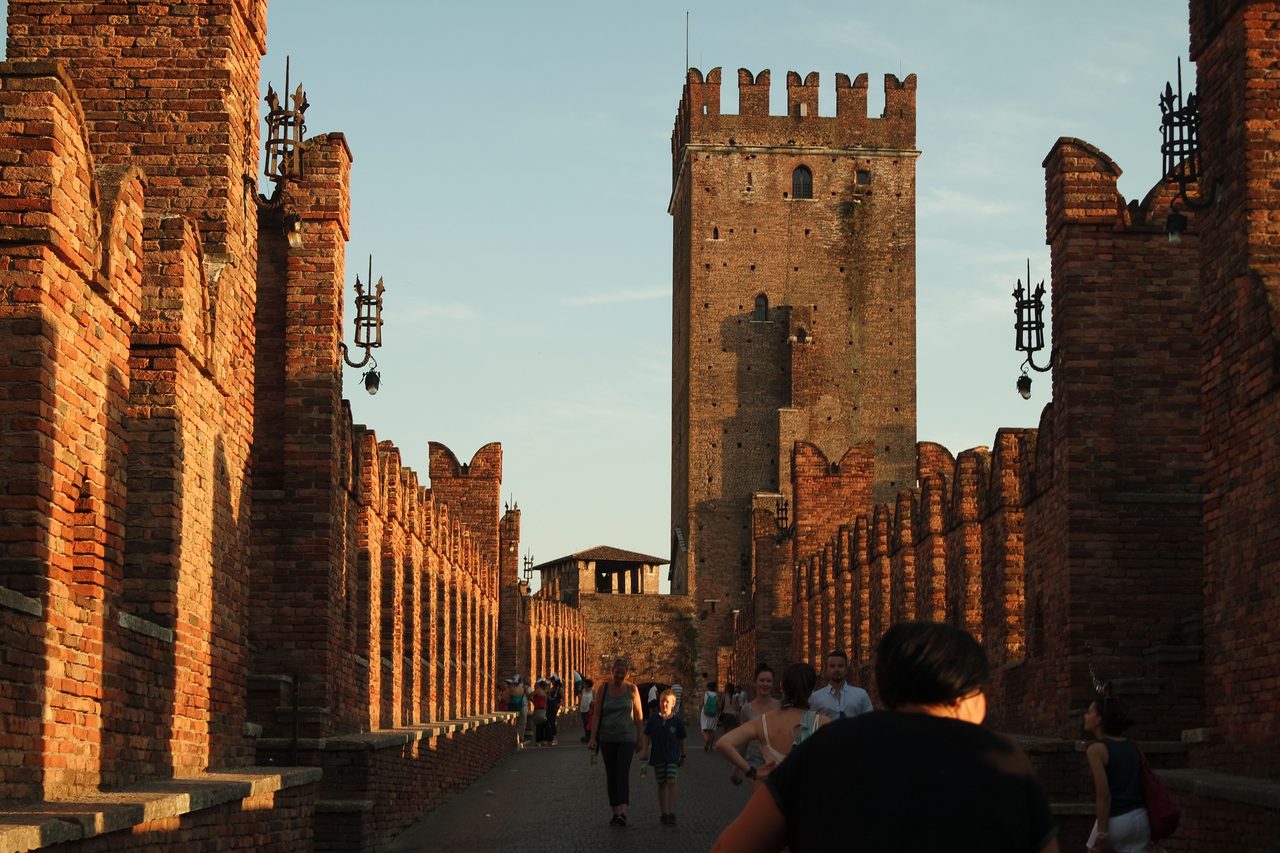
14th-century Scaliger fortress converted into an art museum by architect Carlo Scarpa, holding Veronese painting, sculpture and the equestrian statue of Cangrande I. The crenellated Ponte Scaligero crosses the Adige beside it.
The Museo di Castelvecchio occupies a fourteenth-century fortress on Corso Castelvecchio beside the Adige in Verona, in Italy's Veneto region. The castle was built in the 1350s for Cangrande II della Scala, ruler of Verona, as both a residence and a defensive stronghold, with a fortified bridge, the Ponte Scaligero, allowing escape across the river. In the twentieth century the architect Carlo Scarpa converted the building into an art museum between 1957 and 1975, and his careful design is considered a landmark of modern museum architecture. Scarpa opened up the rooms, exposed layers of the building's history, and set sculptures on specially designed supports so that works can be seen from unusual angles. The collection covers Veronese art from the Middle Ages to the eighteenth century: Romanesque and Gothic sculpture, painted crosses, Renaissance paintings by artists such as Pisanello, Mantegna, Veronese and Tintoretto, as well as medieval jewellery, weapons and ceramics. The star exhibit is the equestrian statue of Cangrande I della Scala, placed on a raised concrete platform in the courtyard-side hall so that visitors can see its smiling face at close range. A visit takes about one and a half to two hours. Visitors can also walk along the ramparts and the crenellated Ponte Scaligero, a brick-and-marble bridge with three arches that offers views up and down the river and back toward the castle's towers. Golden hour gives the best photo light on the bridge and brickwork. Crowds are modest even in high season, and weekday mornings are the quietest time, while special exhibitions may bring more people. Mondays open only in the afternoon. The museum is a 20-minute walk from Piazza Bra along Corso Cavour, and the Arco dei Gavi stands right beside it, so the two combine well. The museum is included in the Verona Card.
| Admission | Adult About EUR 6-9 (~$6.90-$10.35); reduced EUR 4.50 (~$5.18) · Child Children 8-14 about EUR 1 (~$1.15) |
|---|---|
| Hours | Tue-Sun about 8:30AM-7:30PM, Mon 1:30PM-7:30PM; special exhibitions can change hours (confirm at museiverona.com) |
| Typical visit | 1.5-2 hours |
| Best time | Weekday mornings; the ramparts and bridge are best at golden hour |
| Getting there | 20 min walk from Piazza Bra via Corso Cavour; bus stop Castelvecchio |
| Address | Corso Castelvecchio 2, 37121 Verona VR |
Location
Corso Castelvecchio 2, 37121 Verona VR
45.4400, 10.9878 View on map
Highlights
- Carlo Scarpa's modern museum design inside a medieval fortress
- Equestrian statue of Cangrande I della Scala
- Paintings by Pisanello, Mantegna, Veronese and Tintoretto
- Ponte Scaligero over the Adige
- Rampart walks with views of the river
Tips for visiting
- Check hours before visiting, as Monday opens only in the afternoon.
- Walk the ramparts and bridge for the best views.
- Visit on a weekday morning for a quiet experience.
- Pair the visit with the Arco dei Gavi next door.
- Consider the Verona Card if visiting several museums.
When to visit
Weekday mornings are the quietest, while the ramparts and bridge are most attractive at golden hour. Special exhibitions may increase crowds.
Accessibility
The museum has lifts and ramps in parts, but the historic layout includes steps and uneven floors, and the ramparts are not fully accessible. Visitors with mobility needs should confirm access at the ticket office.
Visit, book or contact
Frequently asked questions
How long does a visit to Castelvecchio take?
A visit usually takes 1.5 to 2 hours. Art enthusiasts may want longer.
Is it worth it for kids?
Older children often enjoy the castle, ramparts and bridge, and children aged 8 to 14 pay a reduced fee. Younger children may find the art galleries less engaging.
Is photography allowed?
Photography without flash is generally permitted for personal use, though temporary exhibitions may have restrictions.
What is the Ponte Scaligero?
It is a fortified medieval bridge beside the castle, rebuilt after the Second World War, which offers views over the Adige.