
Huangguoshu Waterfall
China's largest waterfall by width, the Dapubu falls drop about 74 m and span about 81 m, with the Water Curtain Cave behind the fall.
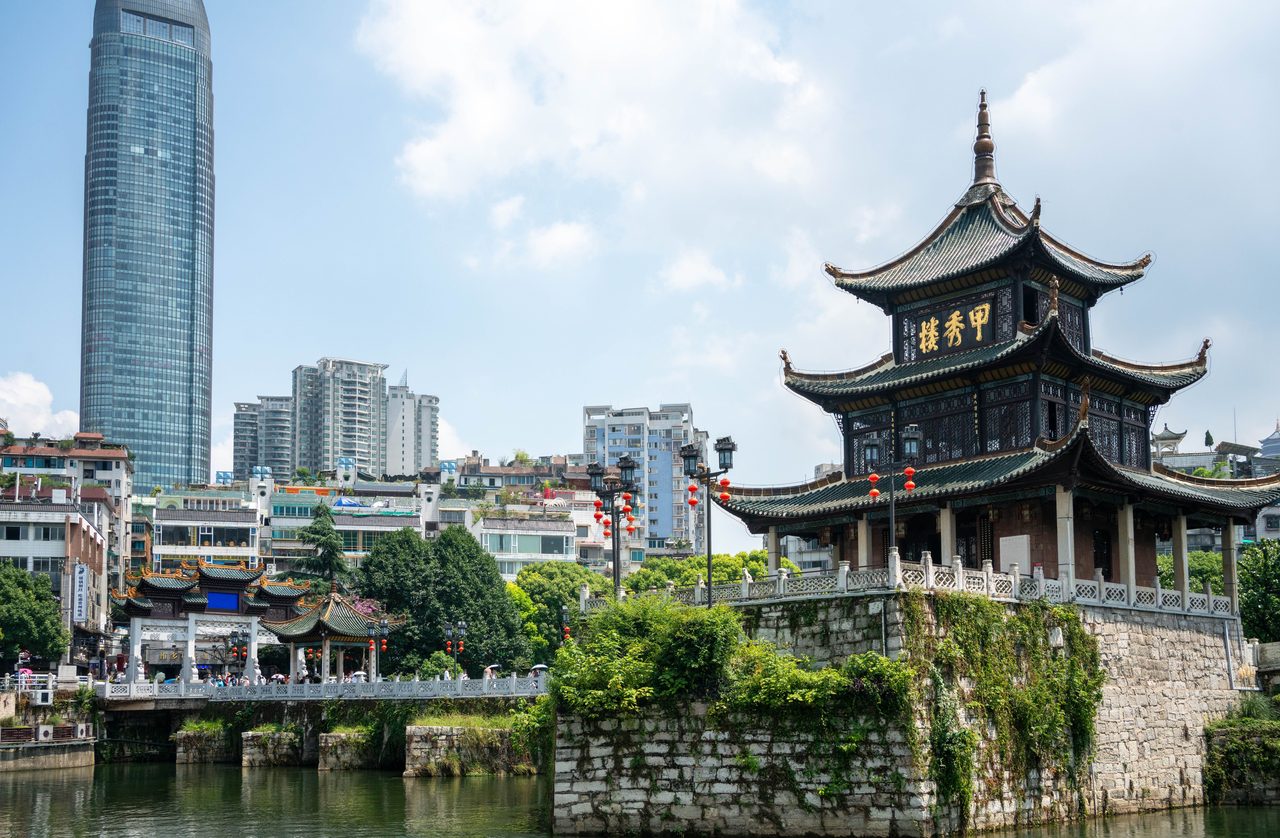
Guizhou · 20 Places · Best April-June and September-October
Guizhou is a mountainous province in southwest China, known for the Huangguoshu Waterfall, karst landscapes, and the most diverse ethnic minority culture in the country, including Miao and Dong villages. Its capital Guiyang is a cool, green city and the transport hub for the province.
Guizhou sits on the Yunnan-Guizhou Plateau in southwest China, a province of limestone karst, deep gorges, and terraced valleys. Its headline sight is Huangguoshu Waterfall near Anshun, one of the widest waterfalls in Asia, alongside the Dragon Palace caves and the Tiantai Mountain scenery. In the southeast, the Qiandongnan prefecture holds Xijiang Qianhu Miao Village and the Dong wooden drum towers and wind-and-rain bridges of Zhaoxing, while Libo and Xiaoqikong offer forest lakes and the UNESCO-listed South China Karst. Zhenyuan Ancient Town is a river town of lanterns and cliffside temples, Fanjingshan near Tongren is a UNESCO World Heritage mountain, and Chishui in the north is famed for Danxia red-rock canyons and bamboo forests. The province is also the home of Maotai baijiu and spicy sour-soup fish. Summers are mild compared with the rest of China, making Guizhou a popular escape from the heat.
Jump straight to the experience you're planning.
The 20 destinations our editors recommend — from iconic landmarks to under-the-radar finds.
China's largest waterfall by width, the Dapubu falls drop about 74 m and span about 81 m, with the Water Curtain Cave behind the fall.
One of China's largest karst caves, a UNESCO Global Geopark site with huge halls, stalagmite forests and a visitor route of several kilometres.
The largest Miao village in China, with over a thousand households of stilted wooden houses climbing a valley, and daily song-and-dance performances.
A well-preserved Miao village known for its welcome ceremony with drinking-horn toasts and a traditional gate performance.
An ancient river town laid out along an S-curve of the Wuyang River, with Ming-Qing streets and the cliff-hanging Qinglong Cave temples.
A Ming-dynasty cliffside temple complex of Buddhist, Taoist and Confucian halls, with wooden structures built into the rock face above the river.
Pick a length, follow the route. Each itinerary balances headline sights with breathing room.
Three tiers, every traveller covered — from cost-conscious to flagship hotels.
Hostels, budget hotels, and guesthouses offer affordable stays without sacrificing experience.
Boutique hotels and well-located accommodations provide comfort and convenience at reasonable prices.
World-class resorts and premium hotels deliver unforgettable experiences.
Part of the Guiyang International Conference and Exhibition Centre complex, the Hyatt Regency Guiyang has 366 rooms and suites, an indoor heated pool, fitness centre and spa.
Check rates on Booking.comThe Sheraton Guiyang lists 343 rooms and suites and three on-site restaurants in the central Dananmen business area beside the Nanming River.
Check rates on Booking.comA five-star Kempinski property in Guiyang, positioned for business and leisure visitors seeking international-standard luxury.
Check rates on Booking.comAn Accor-operated upscale hotel in Guiyang that suits business travellers and city-break visitors.
Check rates on Booking.comCafés, neighbourhood gems, and tasting menus worth the table reservation.
A well-known sour soup fish restaurant on Shengfu Road in central Guiyang, serving fresh fish cooked tableside in a tomato-based sour broth in the style of Kaili. It is one of the most accessible branches for visitors staying near the city centre, with an average spend of roughly CNY 80-130 (USD 12-19) per person.
A branch of the Old Kaili sour soup fish restaurant near the Zhongtian Exhibition City in Guanshanhu District, convenient for visitors based in the new western part of Guiyang. The tableside fish pot with tomato and fermented chili broth is the main order.
A multi-branch Guizhou restaurant with a broad menu covering sour soup fish, spicy chicken and regional classics, located near the Novotel on Zhonghua South Road. Suited to travellers who want a wide sampling of Guizhou dishes in one sitting.
A Dong-ethnic restaurant on Beijing Road known for pickled fish, cured meat and Dong Sanbao, a combination of sour fish, duck and pork. It offers a window into the sour and fermented cooking of the Dong communities of southeast Guizhou without leaving Guiyang.
A Guiyang noodle shop specialising in Huaxi-style beef rice noodles, a breakfast and quick-lunch staple of the city. Bowls arrive in a savoury beef broth with chili oil, pickles and crisp toppings.
A noodle restaurant devoted to changwang mian, the Guiyang breakfast dish of wheat noodles in a broth of pork intestine and pork blood with crispy fried pork cubes, chili oil and scallion. The name is a homophone for prosperity, which is why locals eat it first thing in the morning.
Book a food tour in Guizhou We may earn a commission from bookings made through this link.
Guizhou is well connected by air and high-speed rail, with the main hub at Guiyang. Fast trains reach Anshun (Huangguoshu), Kaili (Xijiang), Libo and Tongren, and several regional airports serve scenic areas. Within cities, metro, bus, taxi and Didi are cheap, while rural sights require buses or chartered cars.
Daily spend by tier in CNY, broken out by category.
| Category | Budget | Mid-range | Luxury |
|---|---|---|---|
| Accommodation | ¥100 ($15) | ¥300 ($44) | ¥800 ($118) |
| Food (per day) | ¥70 ($10) | ¥150 ($22) | ¥350 ($51) |
| Transportation | ¥40 ($6) | ¥80 ($12) | ¥200 ($29) |
| Activities | ¥30 ($4) | ¥90 ($13) | ¥150 ($22) |
| Daily total | ¥240 ($35) | ¥620 ($91) | ¥1,500+ ($220+) |
Best time Shoulder Worth avoiding
Average daytime temperature in °C. Figures are for Guizhou.
Guizhou has a mild, humid subtropical climate with cool summers and frequent cloud and drizzle. Spring and early autumn give the best balance of comfortable temperatures and good waterfall flow.
Huangguoshu Waterfall is at its fullest in the rainy season, June-September. The Miao Sisters' Meal Festival in Taijiang and the Lusheng festivals in Kaili area are held in spring and autumn; confirm dates locally.
Guizhou is one of the safer provinces in China for visitors; violent crime against foreigners is rare and the main issues are petty theft on crowded buses and trains, overpriced tours, and natural hazards at waterfalls and karst caves
Carry passports at all times: foreigners must show them to enter museums, buy train tickets, and check into hotels, and police may spot-check identification
Roads in the mountainous south and east have steep drops and frequent fog; prefer high-speed rail over night buses, and avoid long-distance driving on rural roads after dark
Heavy rains between May and August can trigger flash floods and landslides in the karst gorges, closing roads and trails; check scenic area announcements before departure
Wet stone steps at Huangguoshu, Xiaoqikong, and Dragon Palace are slick; wear shoes with grip and keep children close to the water
Guiyang sits at about 1,100 m and western Guizhou (Weining, Hezhang) exceeds 2,200 m; the effect is mild but visitors with heart or lung conditions should take it easy on the first day
Tap water is not safe to drink; use bottled or boiled water and avoid ice from street vendors
Official travel advisory levels change; check the latest US State Department, UK FCDO, and Australian Smartraveller notices before departure
Guizhou is a low-risk destination for tourists. Violent crime against visitors is rare, and the main concerns are pickpocketing in crowded stations and festival crowds, overcharging by unlicensed taxis and tour sellers, slippery trails near waterfalls, and seasonal flooding in the karst gorges. Stan Emergency services: police at 110 (Police), medical at 120 (Ambulance).
The best time to visit Guizhou is April-June and September-October. Guizhou has a humid subtropical highland climate shaped by the Yunnan-Guizhou Plateau, with Guiyang at roughly 1,100 m. Summers are mild (July average around 24°C) and wet, and winters are cool and da
Entry follows mainland China rules. Citizens of many countries (including France, Germany, Italy, the Netherlands, and Spain) have unilateral visa-free entry, currently extended to 31 December 2026, and nationals of 57 countries can transit visa-free for up to 240 hours with an onward ticket to a third country. Others need an L (tourist) visa from a Chinese embassy. Check the National Immigration Administration site (nia.gov.cn) before travel. Requirements vary by nationality, so check with your nearest embassy or the official immigration website before traveling.
The currency in Guizhou is the Chinese Yuan (renminbi) (CNY). ATMs are widely available in cities and tourist areas. Credit cards are accepted at most hotels and restaurants, but carry cash for markets and smaller establishments.
The main language(s) spoken in Guizhou: Mandarin Chinese (Southwestern Mandarin dialect), Miao, Buyi. In tourist areas, English is generally understood. Learning a few basic phrases in the local language is appreciated by locals.
The top attractions in Guizhou include Huangguoshu Waterfall, Zhijin Cave, Xijiang Qianhu Miao Village, Langde Upper Miao Village, and Zhenyuan Ancient Town. Each offers a unique experience, from historic landmarks to natural wonders.
The cities below have their own guides — hotels, attractions and where to eat, in depth.