
On this page
About Sarajevo
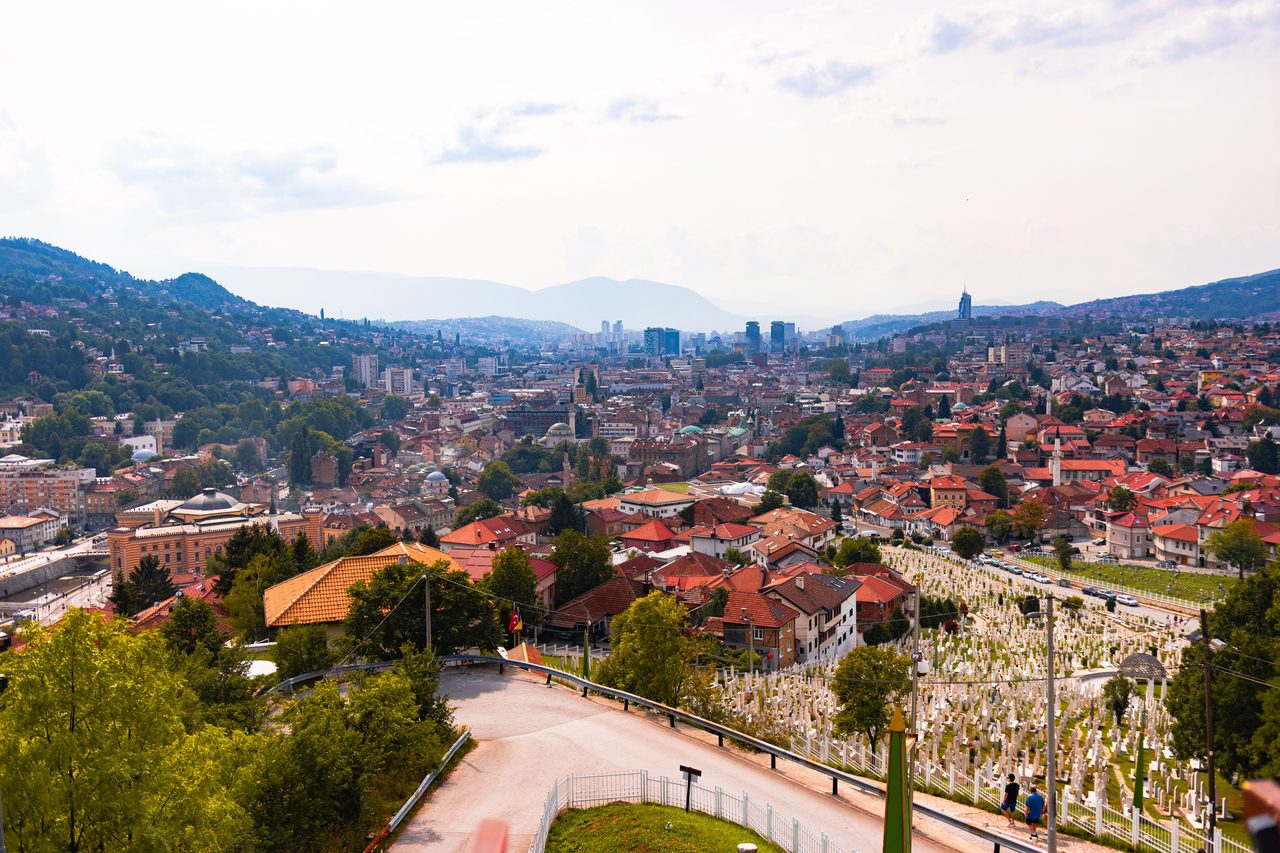
Sarajevo sits in a steep-sided valley, ringed by the Trebević, Jahorina and Bjelašnica mountains that hosted the 1984 Winter Olympics. The city has two historic halves along the Miljacka: Baščaršija, the 15th-century Ottoman bazaar around the Sebilj fountain, the Gazi Husrev-beg Mosque and the Vijećnica, and the Austro-Hungarian district west of it, with Ferhadija street, the cathedral and the Latin Bridge, where the 1914 assassination of Archduke Franz Ferdinand took place. The 1992-1996 siege shaped the modern city, and sites such as the Tunnel of Hope, the War Childhood Museum and the Sarajevo Roses memorials explain that history. Visitors spend their time over Bosnian coffee in the bazaar, eating ćevapi and burek, riding the Trebević cable car, and using the city as a base for Mostar, the Bosna spring at Vrelo Bosne and the ski resorts. Prices remain among the lowest in Europe.
- Capital
- Sarajevo (capital of Bosnia and Herzegovina and of Sarajevo Canton)
- Largest city
- Sarajevo
- Population
- About 275,000 (city, 2013 census), about 413,000 (Sarajevo Canton)
- Languages
- Bosnian, Croatian and Serbian also used, English widely spoken in tourism and by younger people, German and Turkish commonly understood
- Currency
- Convertible mark (BAM, also written KM); approx. 1 BAM = 0.56 USD (about 1.96 BAM per USD); pegged at 1.95583 BAM per euro
- Time zone
- CET (UTC+1) in winter, CEST (UTC+2) in summer; Europe/Sarajevo
Explore Sarajevo by topic
Jump straight to the experience you're planning.
Best places to visit in Sarajevo
The 16 destinations our editors recommend — from iconic landmarks to under-the-radar finds.
Sebilj Fountain
Latin Bridge
Vijećnica (Sarajevo City Hall)
Gazi Husrev-beg Mosque
Tunnel of Hope (Tunnel Museum)
Recommended itineraries
Pick a length, follow the route. Each itinerary balances headline sights with breathing room.
5-Day Sarajevo Explorer
- Day 1Arrive in Sarajevo, explore city center
- Day 2Visit top attractions and museums
- Day 3Day trip to nearby highlights
- Day 4Local markets and hidden gems
- Day 5Final sightseeing, departure
7-Day Classic Sarajevo
- Days 1-2Sarajevo city highlights
- Days 3-4Regional exploration
- Days 5-6Cultural immersion and local experiences
- Day 7Return and departure
14-Day Ultimate Sarajevo
- Days 1-3Sarajevo comprehensive city tour
- Days 4-6Northern region exploration
- Days 7-9Eastern highlights
- Days 10-12Southern attractions
- Days 13-14Return to Sarajevo, departure
Where to stay in Sarajevo
Three tiers, every traveller covered — from cost-conscious to flagship hotels.
Budget 80 KM (~$45)
Hostels, budget hotels, and guesthouses offer affordable stays without sacrificing experience.
Mid-range 220 KM (~$123)
Boutique hotels and well-located accommodations provide comfort and convenience at reasonable prices.
Luxury 560+ KM (~$314+)
World-class resorts and premium hotels deliver unforgettable experiences.
Hotel Europe
Historic 19th-century grand hotel on the edge of Baščaršija, a few steps from the pedestrian streets and the Latin Bridge.
Check rates on Booking.comSwissôtel Sarajevo
Modern five-star hotel in the Sarajevo City Center complex on the Vrbanja bridge, about 20 minutes on foot from Baščaršija.
Check rates on Booking.comHoliday Hotel Sarajevo
Large landmark hotel built for the 1984 Winter Olympics, on the main avenue near the National Museum and the Eternal Flame tram stops.
Check rates on Booking.comCourtyard by Marriott Sarajevo
International chain hotel at the Skenderija complex, about 10-15 minutes on foot from Baščaršija along the Miljacka river.
Check rates on Booking.comWhere to eat in Sarajevo
Cafés, neighbourhood gems, and tasting menus worth the table reservation.
Željo
Hodžić
Mrkva
Ćevabdžinica Saraj
Galatasaray
Inat Kuća (Spite House)
Getting around Sarajevo
Sarajevo's old town is compact and best explored on foot. The tram line runs west along the valley from Baščaršija and Vijećnica through Marijin Dvor to Ilidža, trolleybuses and buses cover the hillsides and suburbs, and Sarajevo International Airport (SJJ) lies about 12 km south-west of the centre.
Budget breakdown
Daily spend by tier in BAM / KM (approx. USD at 1 BAM = 0.56 USD), broken out by category.
| Category | Budget | Mid-range | Luxury |
|---|---|---|---|
| Accommodation | 35 KM (~$20) | 130 KM (~$73) | 330 KM (~$185) |
| Food (per day) | 25 KM (~$14) | 55 KM (~$31) | 130 KM (~$73) |
| Transportation | 5 KM (~$2.80) | 10 KM (~$5.60) | 40 KM (~$22) |
| Activities | 15 KM (~$8.40) | 25 KM (~$14) | 60 KM (~$34) |
| Daily total | 80 KM (~$45) | 220 KM (~$123) | 560+ KM (~$314+) |
Best time to visit Sarajevo
Weather through the year in Sarajevo
Best time Shoulder Worth avoiding
Average daytime temperature in °C.
Sarajevo has a humid continental climate with four distinct seasons, tempered by its mountain valley setting. May to June and September give the most comfortable sightseeing weather, while winter suits skiing on nearby Jahorina and Bjelašnica.
Winter air quality can be poor in the valley when cold air is trapped (check aqicn.org). Rain is possible in every month, with thunderstorms in summer. Check forecasts at fhmzbih.gov.ba or meteo.ba.
Essential travel tips
- Pay in KM (BAM); euros are accepted in some tourist places at about 1.96 KM per euro, but the change is given in KM
- Start the day with Bosnian coffee (about 2.50-4 KM, ~$1.40-2.20) and try ćevapi or burek for a cheap meal under 10 KM (~$5.60)
- Take tram line 3 from the Old Town to Ilidža to reach Vrelo Bosne park and the Tunnel of Hope museum area
- Dress modestly and remove shoes when entering mosques; visiting hours vary around prayer times
- Tipping about 10% is customary in restaurants; round up the bill in cafes and for taxis
- Tap water is safe to drink; the Sarajevo Tourist Information Centre is on Sarači street in the Old Town
- Day trips to Mostar and Počitelj, Jajce or Travnik are possible by bus or tour; book ahead in summer
Safety information
Landmines and unexploded ordnance remain in parts of the country, including wooded hillsides near Sarajevo. Stay on paved roads and marked trails, do not walk across fields or into woods off paths, do not enter abandoned buildings and never touch metal objects. Call 122 if you see anything suspicious.
Pickpockets and bag-snatchers operate on trams and in Baščaršija. Keep bags zipped and in front.
Thefts from parked cars are reported around Mount Trebević and tourist areas. Leave nothing visible in the car.
Use Bolt, a named taxi company, or insist on the meter. Airport and street taxis may quote inflated fares; photograph the taxi number at night and share the ride with a contact.
Political tension is sometimes visible; avoid demonstrations and monitor local news (n1info.ba, klix.ba).
Ice and snow are common from December to February, and temperature inversions make air quality poor in winter; check aqicn.org and wear shoes with grip.
On Trebević, Bjelašnica and Jahorina stay on marked paths, carry water and a charged phone, and call 112 or Gorska služba spašavanja (GSS) mountain rescue in an emergency. Use tick repellent from spring to autumn.
Carry ID. Drug possession can bring heavy fines or jail even for small amounts. Drink-drive limit is 0.03% and zero for novice drivers.
Roads are narrow and hilly with aggressive drivers; headlights must be on at all times, and winter tyres are required from 15 November to 15 April.
Frequently asked questions
Is Sarajevo worth visiting for a long weekend?
Yes. Two days cover Baščaršija, the Latin Bridge, the Vijećnica, Gazi Husrev-beg Mosque and the main museums; a third day adds the Tunnel of Hope, Vrelo Bosne or the Trebević cable car.
How do I get from Sarajevo airport to the centre?
A shuttle bus runs between the airport and the centre for about 5 KM (~$2.80) one way. Taxis cost about 20-30 KM (~$11-17) for the 12 km trip; agree the fare or insist on the meter.
How much does public transport cost in Sarajevo?
A single GRAS ticket costs about 1.60 KM at a kiosk and 1.80 KM from the driver (~$0.90-1.00); a day ticket is about 5.30 KM (~$3.00). Validate it on boarding.
Is Sarajevo safe?
Yes. Violent crime against visitors is rare; the main risks are pickpocketing in crowds, taxi overcharging and winter air pollution. Stay on marked paths in the hills because of leftover landmines. Emergency number 112.
What currency is used in Sarajevo?
The convertible mark (BAM or KM), pegged at 1.95583 per euro; 1 KM is about 0.56 USD. Carry cash for cafes, bakeries and taxis.
When is the best time to visit Sarajevo?
May-June and September are the most comfortable for walking; winter (December-March) suits skiing at Jahorina and Bjelašnica, and mid-August brings the Sarajevo Film Festival.