
Grossmünster
The Romanesque twin-towered church above the Limmat where Huldrych Zwingli launched the Swiss Reformation in 1519. Visitors can enter the nave and cloister and climb a tower for rooftop views over the old town and lake.
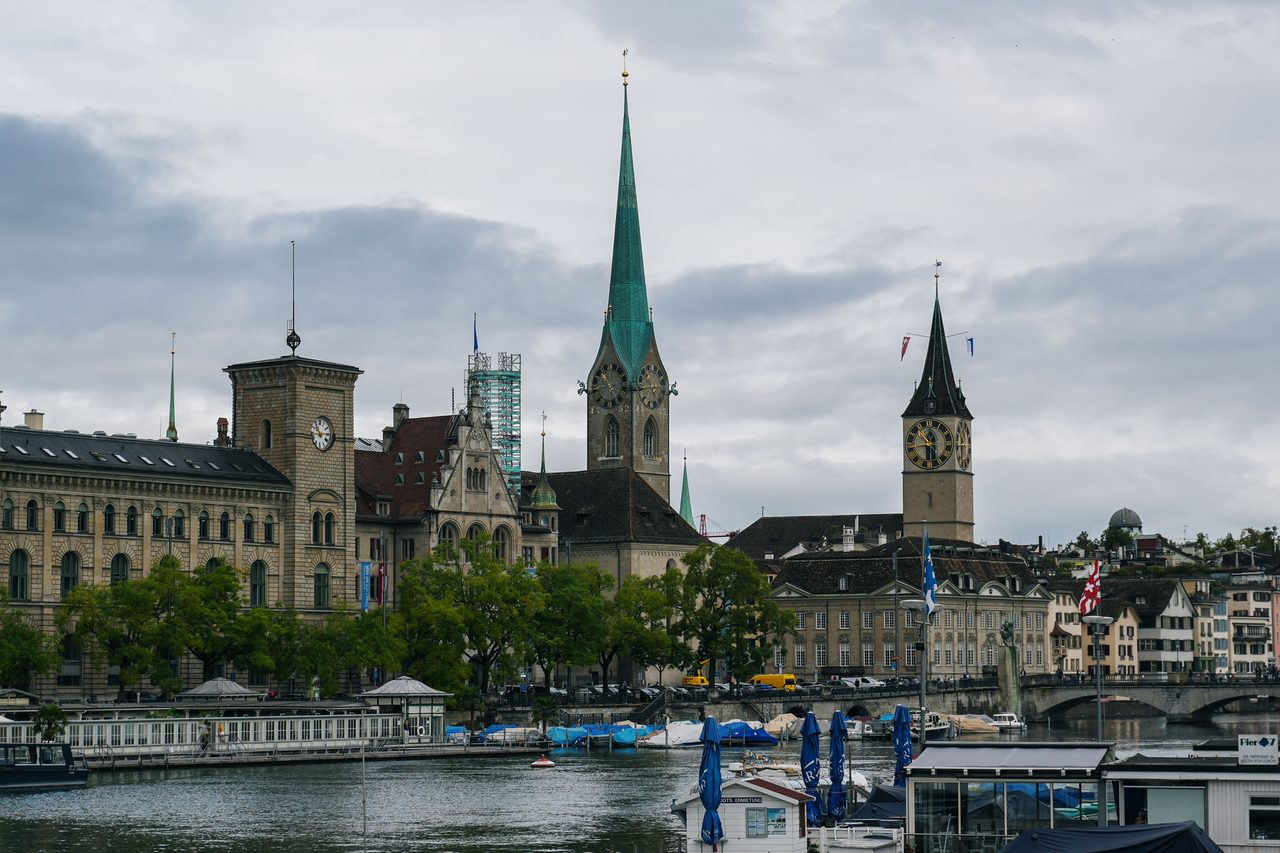
Zürich · 23 Places · Best June-September
Zürich is Switzerland's largest city and the capital of the canton of Zürich, set on the northern tip of Lake Zürich where the Limmat river leaves the lake, with the Alps visible on clear days. It combines a medieval old town, world-class museums, lakeside swimming, and the luxury shopping of Bahnhofstrasse with famously punctual public transport and very high prices.
Zürich sits on Lake Zürich, divided by the Limmat river into the Altstadt (old town) on both banks, with the Grossmünster and Fraumünster churches, the guild houses, and the Niederdorf lanes. Bahnhofstrasse, one of the world's priciest shopping streets, runs from the main station to the lake. West of the centre, Zürich-West is a converted industrial district of galleries, Im Viadukt market arches, and Frau Gerolds Garten. The city has major collections at the Kunsthaus Zürich and Swiss National Museum, and the Uetliberg offers panoramic views reached by a short train ride. In summer residents swim in the lake and the Limmat at free and paid lido-style baths such as Seebad Utoquai and Frauenbad. Zürich is also a rail hub for day trips to Lucerne, Rhine Falls, Winterthur, and the Alps. Visitors should budget carefully, as Switzerland ranks among the most expensive countries in the world.
Jump straight to the experience you're planning.
The 23 destinations our editors recommend — from iconic landmarks to under-the-radar finds.
The Romanesque twin-towered church above the Limmat where Huldrych Zwingli launched the Swiss Reformation in 1519. Visitors can enter the nave and cloister and climb a tower for rooftop views over the old town and lake.
A former abbey church on the west bank of the Limmat, home to five colourful stained-glass windows by Marc Chagall installed in 1970 and a tall Giacometti-designed window in the north transept.
Switzerland's largest cultural-history museum, housed in a fairy-tale castle-like building next to Zürich main station, with galleries covering Swiss history from prehistory to the present.
Switzerland's largest art museum, covering medieval to contemporary art with strengths in Munch, Giacometti, Impressionism and Swiss modernists, in a historic building joined to a David Chipperfield extension.
A long, tree-lined promenade along the northern end of Lake Zürich from Bürkliplatz to the Zürichhorn, with views of the Alps, swan-filled water, benches, cafés and summer lido life.
Zürich's 870-metre house mountain, reached by direct S-Bahn train, with a viewing tower at Uto Kulm looking over the city, lake and Alps.
Pick a length, follow the route. Each itinerary balances headline sights with breathing room.
Three tiers, every traveller covered — from cost-conscious to flagship hotels.
Hostels, budget hotels, and guesthouses offer affordable stays without sacrificing experience.
Boutique hotels and well-located accommodations provide comfort and convenience at reasonable prices.
World-class resorts and premium hotels deliver unforgettable experiences.
Family-run five-star hotel founded in 1844 on the Schanzengraben canal where the Bahnhofstrasse meets Lake Zürich. Parkland gardens, the Pavillon and Baur's restaurants and a spa make it the city's traditional grand address.
Check rates on Booking.comFive-star hotel on Poststrasse beside Paradeplatz, the Bahnhofstrasse's financial and shopping hub, and a few minutes' walk from the lake and the Old Town.
Check rates on Booking.comFive-star hotel with about 138 rooms on Beethovenstrasse, a short walk from Paradeplatz and the lakefront, in a contemporary stone-and-glass building.
Check rates on Booking.comLandmark five-star resort on the wooded Zürichberg above the city, in a 19th-century building extended with a modern wing, with a large spa, gardens and views over the city and lake. The Dolderbahn cog railway runs up from Römerhof.
Check rates on Booking.comCafés, neighbourhood gems, and tasting menus worth the table reservation.
Founded in 1898 and recognised by Guinness World Records as the world's oldest vegetarian restaurant, Haus Hiltl is a Zürich landmark serving a large meat-free buffet priced by weight.
Open since 1924 near Bellevue, Kronenhalle is Zürich's most famous brasserie, its walls hung with original works by Picasso, Miró, Chagall and Giacometti.
Housed in a 1487 arsenal building a few steps from Paradeplatz, Zeughauskeller serves hearty Swiss classics beneath a vaulted wooden ceiling hung with historic weapons.
The flagship of the Sprüngli family firm, founded in 1836, overlooks Paradeplatz and is the home of the Luxemburgerli, a light airy macaron-style sweet that is meant to be eaten the day it is made.
Run inside Hotel Adler in the Niederdorf since 1953, this rustic chalet-style room is one of the oldest fondue venues in Zürich's old town.
Tucked into a Niederdorf lane, Le Dézaley is a long-established Swiss-French style fondue house named after a Vaud wine, with wooden panelling and a convivial atmosphere.
Book a food tour in Zürich We may earn a commission from bookings made through this link.
Zürich is Switzerland's largest city and rail hub, and its public transport is exceptionally dense, clean and punctual. The Zürcher Verkehrsverbund (ZVV) integrates VBZ trams and buses, SBB S-Bahn trains, ZSG lake boats and mountain railways under one ticket system, so a single zone ticket works on all modes. Zürich Flughafen (ZRH) connects to the main station in about 10 minutes by train, and Zürich Hauptbahnhof (HB) is the departure point for fast InterCity trains to Basel, Bern, Lucerne, Munich and beyond. A car is unnecessary and generally a liability in the city. Fares below are approximate 2026 adult second-class prices at 1 USD = 0.80 CHF; confirm the exact fare in the ZVV or SBB app.
Daily spend by tier in CHF, broken out by category.
| Category | Budget | Mid-range | Luxury |
|---|---|---|---|
| Accommodation | CHF 50 (~$63) | CHF 180 (~$225) | CHF 450 (~$563) |
| Food (per day) | CHF 40 (~$50) | CHF 80 (~$100) | CHF 190 (~$238) |
| Transportation | CHF 15 (~$19) | CHF 25 (~$31) | CHF 40 (~$50) |
| Activities | CHF 15 (~$19) | CHF 35 (~$44) | CHF 70 (~$88) |
| Daily total | CHF 120 (~$150) | CHF 320 (~$400) | CHF 750+ (~$938+) |
Best time Shoulder Worth avoiding
Average daytime temperature in °C. Figures are for Zürich.
June-September for lake swimming and outdoor life; December for Christmas markets
Zürich is one of the safest large cities in Europe; the main risk is petty theft and pickpocketing around Zürich Hauptbahnhof, Bahnhofstrasse, the Niederdorf and crowded trams, especially during large events such as the Street Parade
Dial 112 for any emergency from any phone (works without a SIM); use 117 for police, 118 for fire and 144 for an ambulance
Buy a valid ticket before boarding trams, buses and S-Bahn trains: the ZVV network uses spot checks rather than turnstiles, and travelling without a valid ticket costs a fine of CHF 100 or more
Swiss recycling and quiet rules are enforced: avoid loud noise in residential areas after 10PM and on Sundays, and do not leave rubbish outside official bags where bags are required
Lake Zürich and the Limmat river are clean but can be dangerous: the Limmat current is strong, so swim only at marked bathing areas, never after drinking alcohol, and heed warning flags and thunderstorm sirens
Hiking on the Uetliberg and Albis ridges is easy, but weather can change quickly; carry water and wear proper shoes, and stay on marked paths
Winter brings ice and snow on pavements and tram tracks; wear shoes with grip and watch for cyclists in bike lanes
Tick bites occur in woods and meadows in the canton from spring to autumn; wear long trousers on forest walks and check skin afterwards. Tick-borne encephalitis vaccination is recommended for frequent hikers
Switzerland is in the Schengen Area. EU and EFTA citizens need only an ID card or passport; visitors from many countries, including the US, UK, Canada, and Australia, may stay visa-free for up to 90 days in any 180-day period, while others need a Schengen visa. Requirements vary by nationality, so check with the nearest Swiss embassy or the official State Secretariat for Migration website before traveling.
Yes. Zürich is among the most expensive cities in the world. A budget traveller can manage on about CHF 120 (~$150) per day using hostels, supermarket meals, and public transport, while mid-range travel costs about CHF 320 (~$400) per day. Public fountains provide free drinking water, and the ZVV day pass or Zürich Card helps control transport and museum costs.
Zürich Airport (ZRH) is connected to Zürich Hauptbahnhof by frequent trains taking about 10 to 12 minutes. A single ticket costs about CHF 7 (~$9), and tickets can be bought at station machines or in the SBB Mobile app. Trams 10 and 12 also serve the airport.
The top attractions in Zürich include the Old Town with the Grossmünster and Fraumünster, Bahnhofstrasse, Lake Zürich, Kunsthaus Zürich, the Swiss National Museum, Uetliberg viewpoint, and the Lindt Home of Chocolate. Many can be reached on foot or by tram within a few minutes of Hauptbahnhof.
Zürich is known for Zürcher Geschnetzeltes (sliced veal in cream and mushroom sauce, served with rösti), cheese fondue and raclette, and Luxemburgerli macarons from Sprüngli. The city is also known for vegetarian dining, led by Haus Hiltl, the oldest vegetarian restaurant in the world.
The cities below have their own guides — hotels, attractions and where to eat, in depth.