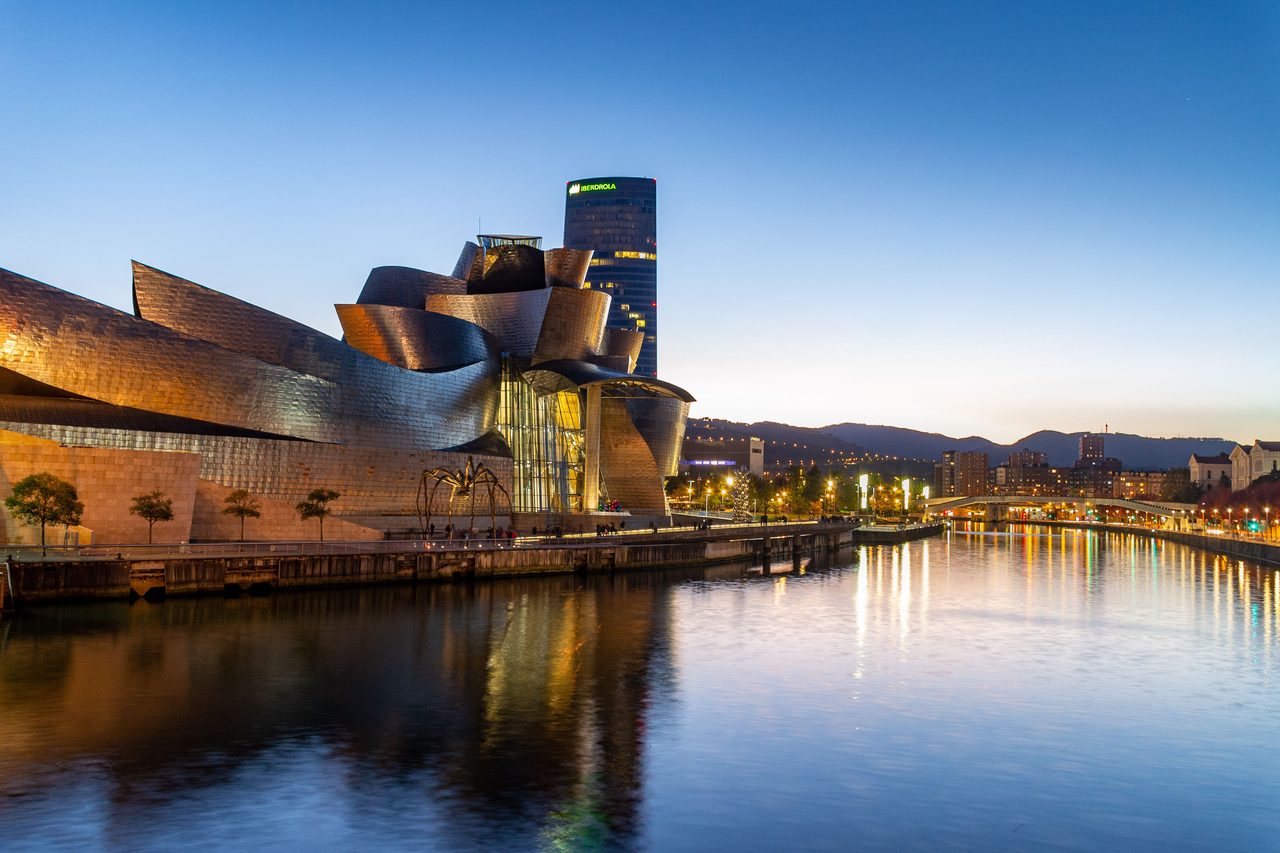
Bilbao is the largest city of the Basque Country and the capital of the province of Biscay (Bizkaia), with about 346,000 residents (INE, 2024) and roughly one million in the wider metropolitan area. It lies on the Nervion river about 15 km from the Bay of Biscay, and was chartered on 15 June 1300. Its medieval core, Casco Viejo with the Siete Calles, the Cathedral of Santiago, Plaza Nueva and the Mercado de la Ribera, sits on the right bank, while the Guggenheim Museum, opened on 18 October 1997, anchors the modern Abandoibarra riverside. The Funicular de Artxanda climbs to a city viewpoint, and Metro Bilbao, Bilbobus, Bizkaibus and the Euskotren tram link the centre with Bilbao Airport (BIO) at Loiu, the Vizcaya Bridge between Portugalete and Getxo (UNESCO since 2006), the beaches of Getxo, Sopelana and Bakio, and the coastal hermitage of San Juan de Gaztelugatxe. Bilbao is a centre of Basque pintxos culture, and the Basque and Spanish languages are both official. The climate is mild and oceanic: July highs near 25 C (77 F), January highs near 12 C (54 F), and rain falls in every season.
Capital
Bilbao is the capital of the province of Biscay; the Basque Country's government seat is Vitoria-Gasteiz
Largest city
Bilbao
Population
Approximately 346,000 (Bilbao municipality, INE 2024); wider metropolitan area about 1 million
Languages
Spanish (Castilian), Basque (Euskara)
Currency
Euro (EUR)
Time zone
CET (UTC+1) / CEST (UTC+2) in summer (Europe/Madrid)
The 23 destinations our editors recommend — from iconic landmarks to under-the-radar finds.
Guggenheim Museum Bilbao
Frank Gehry's titanium-clad museum of modern and contemporary art, opened on 18 October 1997 beside the Nervion river. Exterior art includes Jeff Koons's Puppy, Louise Bourgeois's Maman spider and Anish Kapoor's Tall Tree and the Eye.
Casco Viejo and the Siete Calles
The medieval core of Bilbao, laid out around the seven original streets (Somera, Artekale, Tendería, Belostikale, Carnicería Vieja, Barrenkale and Barrenkale Barrena) on the right bank of the Nervion. Today it is a pedestrian district of pintxo bars, small shops and the Cathedral of Santiago.
Cathedral of Santiago (Catedral de Santiago)
The Gothic cathedral and parish church of Casco Viejo, begun in the 14th century and dedicated to Santiago (Saint James), on the pilgrim route known as the Camino del Norte. Its neo-Gothic spire and west front date from the 19th century.
Plaza Nueva (Plaza Barria)
A neoclassical arcaded square completed in 1821 and the social centre of Casco Viejo, home to some of the city's best-known pintxo bars and, each 21 December, the Santo Tomas market.
Mercado de la Ribera
An Art Deco covered market opened in 1929 on the riverside of Casco Viejo, widely described as one of the largest covered food markets in Europe, with fish, meat and produce stalls and a food hall.
Funicular de Artxanda and Artxanda Viewpoint
Bilbao's historic funicular, opened in 1915, climbs Mount Artxanda to a hilltop viewpoint with panoramic views of the Nervion valley, the Guggenheim and the old town.
Recommended itineraries
Pick a length, follow the route. Each itinerary balances headline sights with breathing room.
5-Day Bilbao Explorer
Day 1Arrive in Bilbao, explore city center
Day 2Visit top attractions and museums
Day 3Day trip to nearby highlights
Day 4Local markets and hidden gems
Day 5Final sightseeing, departure
7-Day Classic Bilbao
Days 1-2Bilbao city highlights
Days 3-4Regional exploration
Days 5-6Cultural immersion and local experiences
Day 7Return and departure
14-Day Ultimate Bilbao
Days 1-3Bilbao comprehensive city tour
Days 4-6Northern region exploration
Days 7-9Eastern highlights
Days 10-12Southern attractions
Days 13-14Return to Bilbao, departure
Where to stay in Bilbao
Three tiers, every traveller covered — from cost-conscious to flagship hotels.
Budget EUR 63-138 (about USD 72.45-158.7)/day
Hostels, budget hotels, and guesthouses offer affordable stays without sacrificing experience.
Bilbao is compact and mostly flat along the Nervión river, so the Casco Viejo, Abando, the Guggenheim and the riverside are all walkable. Public transport is integrated through the Barik card: Metro Bilbao (lines L1, L2 and L3), the Euskotren tram along the river, Bilbobus city buses, the Artxanda funicular, Bizkaibus intercity buses and Euskotren and Renfe Cercanías trains. Metro L1 and L2 share the central stations Abando, Moyúa, Indautxu and Casco Viejo, and L1 continues to Getxo and the beaches at Plentzia.
Budget breakdown
Daily spend by tier in EUR, broken out by category.
Category
Budget
Mid-range
Luxury
Accommodation
EUR 35-70 (about USD 40.25-80.5)/night hostel dorm or basic guesthouse
EUR 110-200 (about USD 126.5-230)/night 3-4-star hotel
EUR 300-600 (about USD 345-690)/night 5-star hotel or suite
Food (per day)
EUR 25-40 (about USD 28.75-46)/day using pintxos and a menu del dia
EUR 50-90 (about USD 57.5-103.5)/day pintxo crawl and restaurant dinners
EUR 120-250 (about USD 138-287.5)/day tasting menus and wine
Transportation
EUR 3-8 (about USD 3.45-9.2)/day on Metro and Bilbobus with a Barik card
EUR 5-15 (about USD 5.75-17.25)/day Metro, Bilbao Card and occasional taxi
EUR 30-100 (about USD 34.5-115)/day private transfers and taxis
Activities
EUR 0-20 (about USD 0-23)/day on free sights and one museum
EUR 20-50 (about USD 23-57.5)/day Guggenheim, a funicular ride and a day trip
EUR 60-200 (about USD 69-230)/day private tours and guided visits
Daily total
EUR 63-138 (about USD 72.45-158.7)/day
EUR 185-355 (about USD 212.75-408.25)/day
EUR 510-1150 (about USD 586.5-1322.5)/day
Best time to visit Bilbao
Weather through the year in Basque Country
Best timeShoulderWorth avoiding
Average daytime temperature in °C. Figures are for Basque Country.
May to June and September to early October
May, June and September combine mild temperatures, longer light and fewer showers than autumn and winter. Bilbao is a year-round city: museums, pintxo bars and indoor sights work in any weather, but a rain jacket is needed in every season. Beaches near Bilbao are best from late June to early September. These are long-term normals; confirm the forecast at aemet.es before travel.
Essential travel tips
Order pintxos at the bar and pay at the end; ask for the bill with 'la cuenta, por favor'
Buy a Barik card at Metro stations or Bilbao Turismo to cut single-ride fares
Many museums close on Mondays or Tuesdays; confirm each one before the visit
Lunch is served from about 13:30 and dinner from about 21:00; the main shops close from about 14:00 to 17:00
Book Gaztelugatxe in advance through the Biscay provincial site; access is by reservation only
Hidden gems
Off-the-beaten-path corners most travellers miss.
Safety information
INFO
Keep wallet and phone in front pockets or zipped bags in the Casco Viejo, on the Metro, in markets and during festivals
INFO
Carry ID or a copy of your passport; Spanish law requires identification to be carried
INFO
Use the official airport taxi rank or call a radio taxi (for example Radio Taxi Bilbao +34 94 444 88 88; confirm before relying on it) and check the meter is running
INFO
Never leave bags or phones on a bar or terrace table while ordering pintxos
INFO
Wear shoes with grip, because wet pavements are slippery, and carry an umbrella
INFO
Follow Euskalmet alerts for heavy rain, wind or flooding and avoid river paths during alerts
INFO
Report theft on 112 or online at denuncias.policia.es and keep the report for insurance claims
INFO
Swim only at beaches with a lifeguard and a green flag
INFO
Late at night, stay on busy streets and avoid isolated parts of Bilbao La Vieja and the river paths
Frequently asked questions
Is Bilbao safe to visit in 2026?
Bilbao is a clean, orderly Basque city with a visible police presence from the Ertzaintza (Basque regional police) and the Policía Municipal. The realistic risks are opportunistic theft in the Casco Viejo, around Plaza Nueva, La Ribera market, Plaza Moyúa and the Guggenheim riverside, on busy Metro
What is the best time to visit Bilbao?
The best time to visit Bilbao is May. Bilbao has an oceanic climate with mild winters, warm but not hot summers, and rain in every season. Annual rainfall is roughly 1,200 mm (about 125 rainy days), with July the driest month and November
Do I need a visa to visit Bilbao?
EU/EEA/Swiss citizens: no visa. US, UK, Canadian and Australian citizens: visa-free for up to 90 days in any 180 days under Schengen rules. Check the current status of the EU ETIAS travel authorisation before travel. Requirements vary by nationality, so check with your nearest embassy or the official immigration website before traveling.
What currency is used in Bilbao?
The currency in Bilbao is the Euro (EUR) (EUR). ATMs are widely available in cities and tourist areas. Credit cards are accepted at most hotels and restaurants, but carry cash for markets and smaller establishments.
What language is spoken in Bilbao?
The main language(s) spoken in Bilbao: Spanish (Castilian), Basque (Euskara). In tourist areas, English is generally understood. Learning a few basic phrases in the local language is appreciated by locals.
What are the top attractions in Bilbao?
The top attractions in Bilbao include Guggenheim Museum Bilbao, Casco Viejo and the Siete Calles, Cathedral of Santiago (Catedral de Santiago), Plaza Nueva (Plaza Barria), and Mercado de la Ribera. Each offers a unique experience, from historic landmarks to natural wonders.