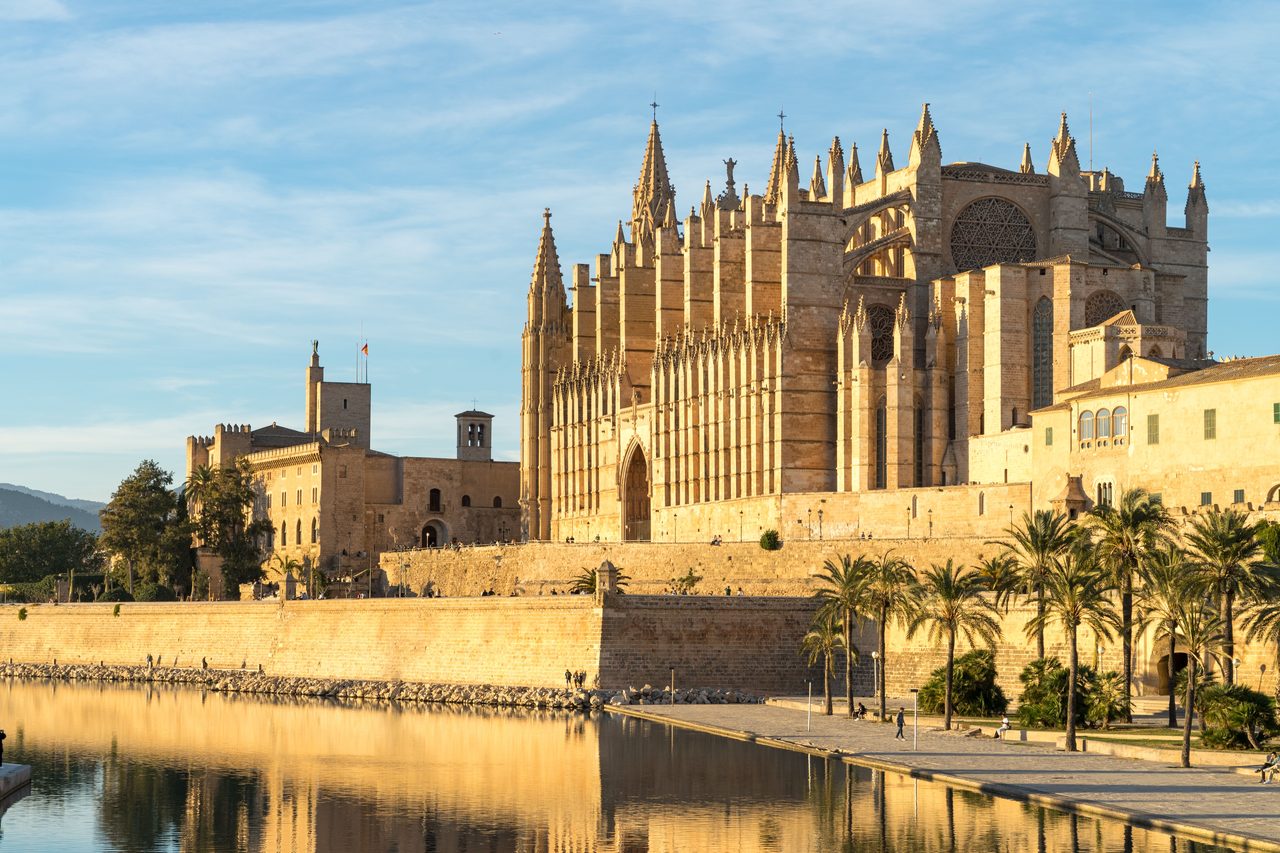
Palma is the capital of the Balearic Islands and of Mallorca, a port city of about 443,000 residents (INE, 1 January 2025) on the Bay of Palma, on the south-west coast of the island. It began as a Roman foundation in 123 BCE, became the Islamic port of Madina Mayurqa and was taken by Jaume I of Aragon on 31 December 1229. Its Gothic cathedral La Seu stands on the seafront next to the Royal Palace of La Almudaina, with Sa Llotja, the Arab Baths and the old-town lanes within a short walk. Bellver Castle, a round Gothic fortress built for Jaume II, overlooks the bay, and Es Baluard and the Fundació Pilar i Joan Miró cover modern art. The old town is compact and walkable, with tree-lined Passeig des Born, the Mercat de l'Olivar and the Santa Catalina neighbourhood for food. Palma Airport (PMI, Son Sant Joan) is about 8 km east of the centre, the Sóller tourist train leaves from beside Plaça d'Espanya, and the Serra de Tramuntana mountains are an easy day trip. Summers are hot (July highs near 32 °C / 90 °F) and winters mild (January highs near 16 °C / 61 °F); Sant Sebastià in January, Semana Santa and the 31 December Estendard festival are the main events.
Capital
Palma is the capital of the Balearic Islands autonomous community and of Mallorca
Largest city
Palma
Population
Approximately 443,000 (city proper, INE 1 January 2025); Mallorca island about 971,000
Languages
Spanish (Castilian), Catalan (Mallorcan variety)
Currency
Euro (EUR)
Time zone
CET (UTC+1) / CEST (UTC+2) in summer (Europe/Madrid)
The 13 destinations our editors recommend — from iconic landmarks to under-the-radar finds.
Palma Cathedral (La Seu)
A Gothic cathedral begun in 1229 after the Catalan conquest and finished in 1601, standing on the seafront above Parc de la Mar. It has one of the largest rose windows in Gothic architecture, a nave with some of the tallest Gothic columns in Europe, and interior work by Antoni Gaudí from 1904–1914. The Museum of Sacred Art is included in the general ticket.
Royal Palace of La Almudaina
A former Moorish fortress converted into a Gothic royal palace in the 14th century. It is the official Mallorca residence of the Spanish royal family for ceremonial use and houses state rooms, a Gothic hall with huge arches, a royal chapel (Capella de Santa Anna) and tapestries. The palace stands directly across the Parc de la Mar terrace from the cathedral.
Bellver Castle (Castell de Bellver)
A circular Gothic castle built in the early 14th century for King Jaume II of Mallorca, on a 112 m hill 3 km west of the old town. It has a round central courtyard on two levels, a detached round tower and a rooftop with panoramic views of the bay, the city and the Serra de Tramuntana. It later served as a prison and now houses the Palma City History Museum.
Sa Llotja (La Llotja de Mallorca)
A Gothic civil building designed by the architect Guillem Sagrera and built between 1426 and 1447 as a merchants' exchange. Its interior has a large hall with slender twisted columns that rise into the vaults. It stands at the head of the Passeig de Sagrera waterfront and is the best surviving example of Mallorcan late Gothic civil architecture.
Arab Baths (Banys Àrabs)
One of the few remaining structures of Moorish Mallorca, probably a 10th-century bathhouse. It has a domed hot room (caldarium) with 12 columns and openings in the roof, set in a small garden with palms and orange trees. The baths are a short stop, with no pool or spa service.
Es Baluard Museum of Modern and Contemporary Art
A museum of modern and contemporary art inside a restored bastion of the 16th-century Renaissance city walls. The permanent collection includes works by Miró, Picasso and Barceló; the terraces give open views over the port. A cafe and rooftop terraces are open to museum ticket holders.
Recommended itineraries
Pick a length, follow the route. Each itinerary balances headline sights with breathing room.
5-Day Palma Explorer
Day 1Arrive in Palma, explore city center
Day 2Visit top attractions and museums
Day 3Day trip to nearby highlights
Day 4Local markets and hidden gems
Day 5Final sightseeing, departure
7-Day Classic Palma
Days 1-2Palma city highlights
Days 3-4Regional exploration
Days 5-6Cultural immersion and local experiences
Day 7Return and departure
14-Day Ultimate Palma
Days 1-3Palma comprehensive city tour
Days 4-6Northern region exploration
Days 7-9Eastern highlights
Days 10-12Southern attractions
Days 13-14Return to Palma, departure
Where to stay in Palma
Three tiers, every traveller covered — from cost-conscious to flagship hotels.
Budget €50–€110/day (~$57.5–$126.5)
Hostels, budget hotels, and guesthouses offer affordable stays without sacrificing experience.
Mid-range €165–€360/day (~$189.75–$414)
Boutique hotels and well-located accommodations provide comfort and convenience at reasonable prices.
Luxury €470–€1170/day (~$540.5–$1345.5)
World-class resorts and premium hotels deliver unforgettable experiences.
Castillo Hotel Son Vida
Son Vida, Palma · €300–€800/night (~$345–$920)
A hilltop castle hotel in the Son Vida residential estate, northwest of the centre and best reached by car or taxi. About 5.2 km in a straight line from Palma Cathedral.
Born, Old Town, Palma · €230–€600/night (~$264–$690)
A boutique hotel in an historic building just off the Passeig des Born, the tree-lined promenade of the old town. About 0.3 km in a straight line from Palma Cathedral.
Palma's old town, from the Cathedral to Passeig des Born and Santa Catalina, is compact and walkable on the flat. EMT city buses reach the beaches and Bellver, the Estació Intermodal at Plaça d'Espanya is the hub for regional TIB buses, SFM trains and the metro, and the Sóller train departs from the station next to it. Palma Airport (PMI) is about 8 km east of the centre with a direct A1 bus to Plaça d'Espanya and Es Baluard.
Budget breakdown
Daily spend by tier in EUR, broken out by category.
Category
Budget
Mid-range
Luxury
Accommodation
€30–€60/night (~$34.5–$69) hostel dorm or basic guesthouse
€100–€220/night (~$115–$253) 3–4-star hotel in the old town (higher in July and August)
€280–€700/night (~$322–$805) 5-star hotel or boutique palace hotel
Food (per day)
€18–€30/day (~$20.7–$34.5) using a menú del día and market food
€40–€70/day (~$46–$80.5) restaurants and tapas bars
€100–€200/day (~$115–$230) fine dining and wine
Transportation
€2–€6/day (~$2.3–$6.9) walking plus a bus ride or two
€5–€20/day (~$5.75–$23) buses, occasional taxi
€30–€90/day (~$34.5–$103.5) private transfers and taxis
Activities
€0–€15/day (~$0–$17.25) free squares, Parc de la Mar, Bellver on Sundays
€20–€50/day (~$23–$57.5) cathedral, Almudaina Palace and one museum
€60–€180/day (~$69–$207) private guided tours and boat or day trips
Daily total
€50–€110/day (~$57.5–$126.5)
€165–€360/day (~$189.75–$414)
€470–€1170/day (~$540.5–$1345.5)
Best time to visit Palma
Weather through the year in Balearic Islands
Best timeShoulderWorth avoiding
Average daytime temperature in °C. Figures are for Balearic Islands.
May to June and September to mid-October
May, June and September combine warm days, swimmable sea and fewer crowds than July and August. Winter is mild, quiet and cheap, good for city sightseeing and cycling, but beaches are not warm enough to swim for most visitors. October brings the first heavy autumn showers and storms. These are long-term normals; confirm the forecast at aemet.es before travel.
Essential travel tips
Book the cathedral and Almudaina Palace on the official sites (catedraldemallorca.org and tickets.patrimonionacional.es); the cathedral is closed to visitors on Sundays
Order a coffee and an ensaïmada at Ca'n Joan de s'Aigo (Carrer de Ca'n Sanç 10) and shop for sobrassada and local cheese at the Mercat de l'Olivar
Wear flat, comfortable shoes; old-town streets are cobbled, and the walk from Plaça d'Espanya to the cathedral takes about 15 minutes
Many small shops close from 14:00 to 17:00 and on Sundays; lunch is served from about 13:30 and dinner from about 21:00
Hotels charge a per-night sustainable tourism tax of roughly €1–€4 per adult in 2026 (children under 16 exempt); budget for it in addition to the room rate
Hidden gems
Off-the-beaten-path corners most travellers miss.
Safety information
INFO
Keep wallet and phone in front pockets or zipped bags in crowded streets, buses and markets
INFO
Carry ID or a copy of your passport; Spanish law requires identification to be carried
INFO
Use official taxis (white with a roof light) or apps such as Uber, Cabify and FreeNow, and check the meter is running
INFO
Never leave bags or phones unattended on the beach; swim only when the flag is green
INFO
Buy attraction tickets only from official sites such as catedraldemallorca.org and castelldebellver.palma.es
INFO
Drink water regularly in summer and avoid strenuous outdoor activity from 12:00 to 17:00
INFO
Report theft by calling 091 or online at denuncias.policia.es and keep the report for insurance claims
INFO
In El Arenal and Magaluf, keep your drink in sight and travel with companions after dark
Frequently asked questions
Is Palma safe to visit in 2026?
Palma is a safe, busy Mediterranean port city. The main risks are opportunistic theft on crowded streets and beaches (Paseo del Borne, Plaça Major, the cathedral area, Playa de Palma and El Arenal), theft from rental cars and unattended beach bags, drink spiking and overcharging in the party strips
What is the best time to visit Palma?
The best time to visit Palma is May. Palma has a hot-summer Mediterranean climate with hot dry summers, mild winters and about 2,700 to 2,800 hours of sunshine a year. July and August highs average about 30 degrees Celsius with nights ne
Do I need a visa to visit Palma?
EU/EEA/Swiss citizens: no visa. US, UK, Canadian and Australian citizens: visa-free for up to 90 days in any 180 days under Schengen rules. Check the current status of the EU's ETIAS travel authorisation before travel. Requirements vary by nationality, so check with your nearest embassy or the official immigration website before traveling.
What currency is used in Palma?
The currency in Palma is the Euro (EUR) (EUR). ATMs are widely available in cities and tourist areas. Credit cards are accepted at most hotels and restaurants, but carry cash for markets and smaller establishments.
What language is spoken in Palma?
The main language(s) spoken in Palma: Spanish (Castilian), Catalan (Mallorcan variety). In tourist areas, English is generally understood. Learning a few basic phrases in the local language is appreciated by locals.
What are the top attractions in Palma?
The top attractions in Palma include Palma Cathedral (La Seu), Royal Palace of La Almudaina, Bellver Castle (Castell de Bellver), Sa Llotja (La Llotja de Mallorca), and Arab Baths (Banys Àrabs). Each offers a unique experience, from historic landmarks to natural wonders.