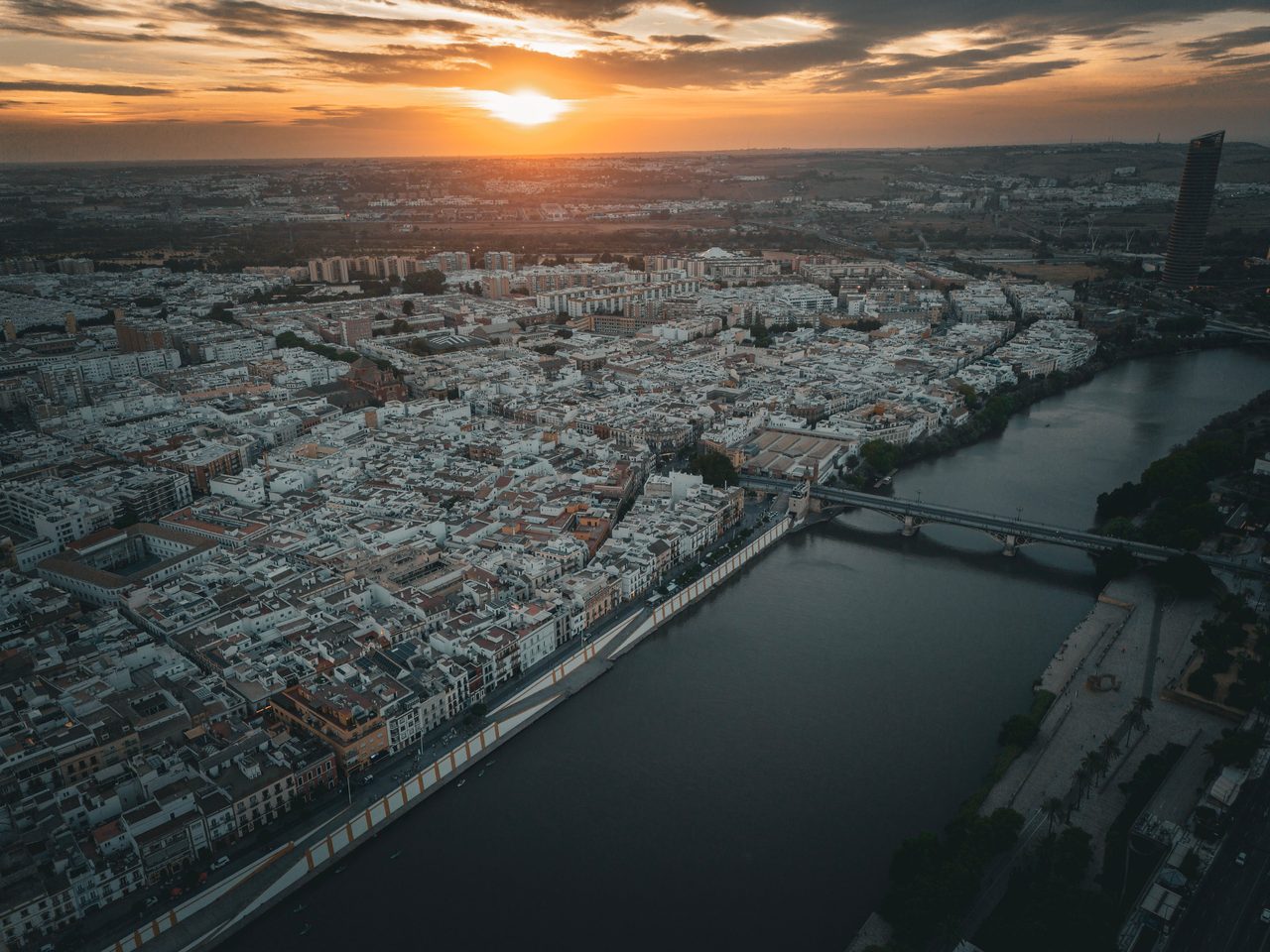
Seville is the capital of Andalusia and one of Spain's most captivating cities, celebrated for its flamboyant flamenco culture, Moorish palaces, and some of the country's finest tapas. The historic centre — a UNESCO-listed complex of cathedral, Alcázar and Archive of the Indies — sits on the east bank of the Guadalquivir River, walkable in minutes from the vibrant Triana and El Arenal barrios. Seville bakes under intense summer heat (July averages 36 °C / 97 °F) but blazes most brilliantly during Semana Santa and the Feria de Abril, two of Europe's most spectacular street festivals.
The 21 destinations our editors recommend — from iconic landmarks to under-the-radar finds.
Real Alcázar de Sevilla
The Alcázar began as a Moorish Almohad fortress and was rebuilt from the 1360s onward by Pedro I using Mudéjar craftsmen, producing a palace of carved stucco, horseshoe arches and tiled courtyards that sits directly beside the cathedral. It remains an official residence of the Spanish royal family when they visit Seville, so parts of the upper floor are closed to the public. The Patio de las Doncellas and the gardens, with their pools, fountains and citrus trees, take up as much of a visit as the palace rooms themselves.
Seville Cathedral & La Giralda
Seville Cathedral was built from 1401 over the site of the city's Almohad mosque, making it one of the largest Gothic churches anywhere, though it still holds Islamic-era elements from the original structure. La Giralda, the bell tower, was the mosque's minaret and keeps its square Moorish base under a later Renaissance belfry added after the tower was adapted for Christian use. Inside, the cathedral holds a monumental gilded altarpiece and a tomb attributed to Christopher Columbus, carried by four bronze figures.
Plaza de España
Plaza de España was built as the centerpiece of the 1929 Ibero-American Exposition, a vast curved building in brick and tile that wraps around a canal crossed by four bridges. Along its base, painted tile alcoves represent each Spanish province with a map and a historical scene, a detail most visitors only notice once they start walking the curve rather than viewing it from the center. The building now houses regional government offices, so the interior is not open to the public, but the plaza and surrounding Parque de María Luisa are.
Barrio Santa Cruz
Santa Cruz was Seville's Jewish quarter (judería) until the expulsion and pogroms of 1391, and its layout of narrow, deliberately irregular streets survives largely intact, originally built that way to stay cool and to slow movement through the quarter. Today it sits directly east of the cathedral and Alcázar, filled with small plazas, wrought-iron window grilles and orange trees, and it has become the city's densest concentration of tapas bars and souvenir shops. There's no single sight to tick off here; the value is in the walk itself and in using it as a base for eating.
Torre del Oro
The Torre del Oro is a 13th-century Almohad watchtower built on the bank of the Guadalquivir to control river access to the port, originally paired with a second tower on the opposite bank with a chain strung between them to block ships. Its name comes either from the golden-hued tiles that once covered it or from gold shipped back from the Americas that was stored there after Seville became the hub for that trade. It now houses a small naval museum with maps, models and objects tracing the city's role as a river port.
Metropol Parasol (Las Setas)
Metropol Parasol, known locally as Las Setas ("the mushrooms") for its shape, is a 2011 wooden lattice structure built over Plaza de la Encarnación after construction there uncovered Roman and Moorish remains. Those remains are preserved underneath in the Antiquarium, a small archaeological museum separate from the rooftop walkway above. The structure itself was controversial when built, dropped into a historic square with a frankly contemporary design, and it still divides opinion among residents.
Recommended itineraries
Pick a length, follow the route. Each itinerary balances headline sights with breathing room.
5-Day Seville Explorer
Day 1Arrive in Seville, explore city center
Day 2Visit top attractions and museums
Day 3Day trip to nearby highlights
Day 4Local markets and hidden gems
Day 5Final sightseeing, departure
7-Day Classic Seville
Days 1-2Seville city highlights
Days 3-4Regional exploration
Days 5-6Cultural immersion and local experiences
Day 7Return and departure
14-Day Ultimate Seville
Days 1-3Seville comprehensive city tour
Days 4-6Northern region exploration
Days 7-9Eastern highlights
Days 10-12Southern attractions
Days 13-14Return to Seville, departure
Where to stay in Seville
Three tiers, every traveller covered — from cost-conscious to flagship hotels.
Budget €38–€80/day (~$41–$87)
Hostels, budget hotels, and guesthouses offer affordable stays without sacrificing experience.
Mid-range €125–€230/day (~$136–$250)
Boutique hotels and well-located accommodations provide comfort and convenience at reasonable prices.
Luxury €370–€1030/day (~$403–$1118)
World-class resorts and premium hotels deliver unforgettable experiences.
A small, modern tapas bar in the San Lorenzo neighborhood that built its reputation on inventive, chef-driven plates rather than the classic tapas format. The kitchen leans toward playful, contemporary Andalusian cooking, and the dining room and bar fill up fast with a mixed crowd of regulars and visitors drawn by the reputation.
Casa Robles
Classic Andalusian · €20–€45/person (~$22–$49)
A long-running, formally set restaurant near the cathedral, with white tablecloths and a menu built on classic Sevillano and Andalusian cooking rather than bar-style tapas. It draws a lot of visitors given its location in the old quarter, but the kitchen sticks to traditional preparations like slow-braised oxtail.
La Brunilda Tapas
Creative modern tapas · €3–€8/tapa (~$3.30–$8.70)
A modern tapas spot near the Alameda de Hércules known for reworking Andalusian ingredients into more composed, restaurant-style plates rather than the classic bar tapa. The dining room is compact and casual, and the plating is more considered than at a typical traditional tapas bar.
Bar El Comercio
Traditional Sevillano tapas · €1.50–€3.50/tapa (~$1.65–$3.80)
An old-school bar near the Puente de Triana on Calle Pureza, with a plain tiled interior and a menu that hasn't strayed from simple, traditional Sevillano tapas. It has the feel of a neighborhood institution rather than a place styled for visitors.
Vinería San Telmo
Modern Andalusian with wine focus · €4–€10/tapa; €15–€35/person (~$4.35–$10.90 / ~$16–$38)
A wine-focused restaurant near the Jardines de Murillo and the Alcázar, pairing a serious Andalusian wine list with modern tapas-sized plates. The cooking is more refined than a standard tapas bar, aimed at people who want to sit and pair food with wine over a full meal.
El Rinconcillo
Traditional Andalusian · €2.50–€5/tapa (~$2.75–$5.45)
Seville's oldest tapas bar, dating to the 17th century, with dark wood, azulejo tiles, and hams hanging over the bar. The cooking is old-style Andalusian tapas - stews and simple vegetable dishes rather than anything modern - served in a room that still runs on its original character rather than a renovated one.
Seville is one of Spain's most walkable cities — the compact historic centre (Alcázar, cathedral, Santa Cruz, El Arenal, and Triana) fits within a 3 km radius. The city has a modern one-line metro, an extensive Tussam bus network, a SEVICI bike-share system, and abundant taxis and ride-share services. San Pablo Airport (SVQ) is 10 km northeast of the centre; the express bus takes 35 minutes.
Budget breakdown
Daily spend by tier in EUR, broken out by category.
Category
Budget
Mid-range
Luxury
Accommodation
€20–€40/night (~$22–$44) hostel dorm or budget guesthouse
€70–€130/night (~$76–$141) 3-star hotel or apartment
€200–€700/night (~$218–$760) 4–5-star hotel
Food (per day)
€15–€25/day (~$16–$27) eating at markets and budget restaurants
€30–€50/day (~$33–$54) restaurants and tapas bars
€80–€150/day (~$87–$163) fine dining and wine
Transportation
€3–€5/day (~$3.30–$5.50) city bus/metro
€5–€15/day (~$5.50–$16) taxis + city bus
€30–€60/day (~$33–$65) private taxi, car hire
Activities
€0–€10/day (~$0–$11) free monuments, free museums
€20–€35/day (~$22–$38) Alcázar, cathedral, flamenco show
Average daytime temperature in °C. Figures are for Spain.
Spring is the most popular travel season, combining pleasant temperatures with world-famous festivals. Autumn offers similar temperatures with smaller crowds. Winter is the rainy season but remains mild; Christmas markets appear in December.
Essential travel tips
Book Alcázar tickets online 2–3 weeks in advance; same-day walk-up queues can be 3+ hours
Restaurants open for dinner very late by northern European standards — 9 PM is normal, 10–11 PM is common
Siesta hours (2–5 PM) mean many small shops close; plan major shopping for mornings or evenings
The SEVICI bike-share system costs €13.33/week (~$14.50) for tourists and is ideal for flat city exploration
Tap water is safe to drink throughout Seville
Hidden gems
Off-the-beaten-path corners most travellers miss.
Safety information
INFO
Keep wallet and phone in a front trouser pocket or inside-zipper bag compartment
INFO
Make a photo of your passport on your phone; Spanish law requires carrying ID
INFO
Use official white-and-yellow taxis or app-based Uber/Cabify rather than unmarked vehicles
INFO
Drink 2+ litres of water daily in summer; free drinking water fountains are located throughout the historic centre
INFO
Report any theft to the Policía Nacional (091) or SATE (tourist police, +34 954 298 830) and get a 'denuncia' (crime report) for insurance claims
INFO
Be cautious around crowded Semana Santa and Feria de Abril processions — these are prime pickpocket events
Frequently asked questions
Is Seville safe to visit in 2026?
Seville ranks among Spain's safest cities for travellers. The main risks are opportunistic pickpocketing around the cathedral and Barrio Santa Cruz, and occasional bag-snatching by moped riders in busy streets. Violent crime directed at tourists is extremely uncommon. The police presence around the
What is the best time to visit Seville?
The best time to visit Seville is March–May and October–November. Seville has a semi-arid Mediterranean climate with hot, dry summers and mild winters. It is the hottest city in Western Europe, regularly recording 40–44°C (104–111°F) in July and August. Spring (Marc
Do I need a visa to visit Seville?
EU/EEA/Swiss citizens: no visa. US, UK, Canadian, Australian citizens: visa-free up to 90 days under Schengen rules. ETIAS electronic travel authorisation expected from late 2025. Requirements vary by nationality, so check with your nearest embassy or the official immigration website before traveling.
What currency is used in Seville?
The currency in Seville is the Euro (EUR) (EUR). ATMs are widely available in cities and tourist areas. Credit cards are accepted at most hotels and restaurants, but carry cash for markets and smaller establishments.
What language is spoken in Seville?
The main language(s) spoken in Seville: Spanish (Castilian), Andalusian Spanish dialect. In tourist areas, English is generally understood. Learning a few basic phrases in the local language is appreciated by locals.
What are the top attractions in Seville?
The top attractions in Seville include Real Alcázar de Sevilla, Seville Cathedral & La Giralda, Plaza de España, Barrio Santa Cruz, and Torre del Oro. Each offers a unique experience, from historic landmarks to natural wonders.