
Table Mountain Aerial Cableway
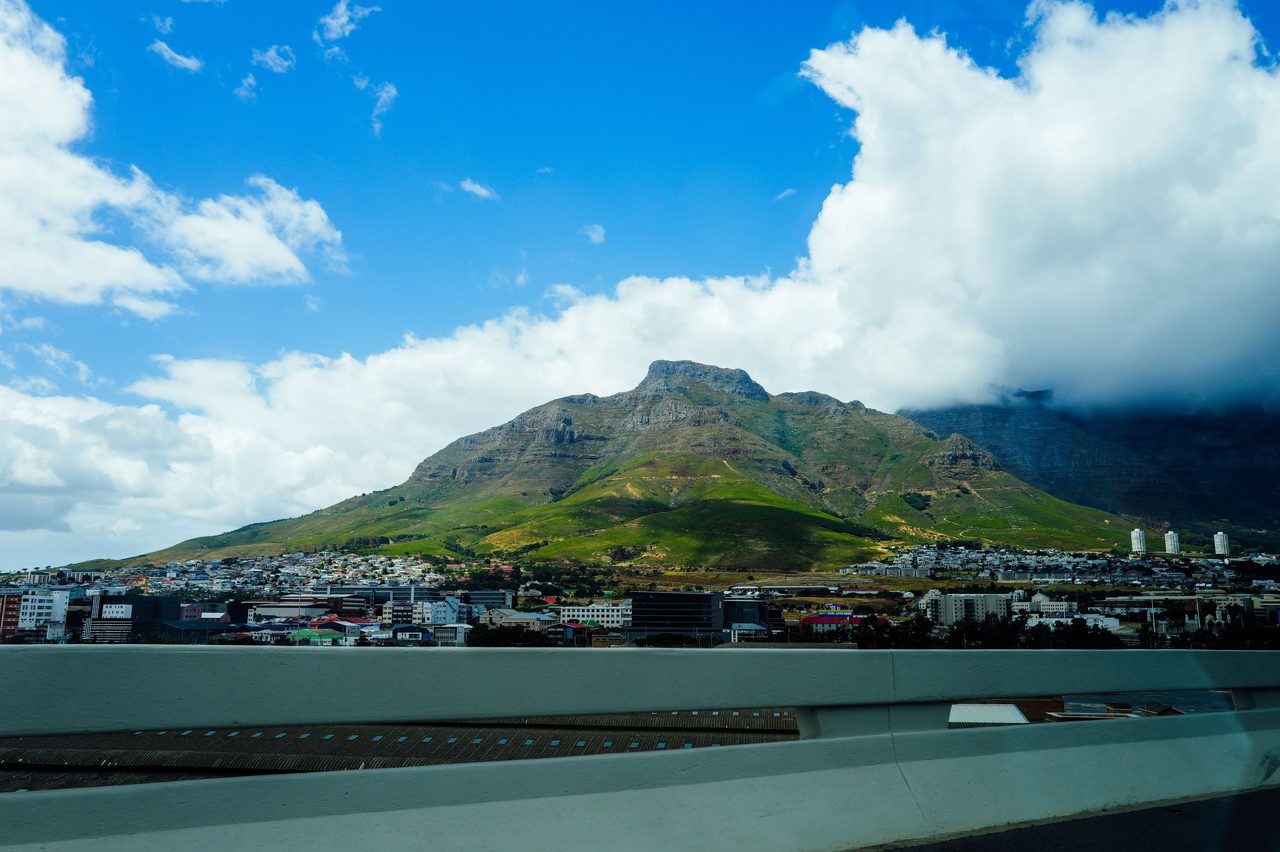
The flat-topped mountain above the city, reached by a rotating cable car in about five minutes, with marked trails and viewpoints on the 1,086 m summit.
Western Cape · 20 Places · Best November to March
Cape Town is the legislative capital of South Africa, a coastal city beneath Table Mountain known for dramatic scenery, beaches, the Cape Winelands, the Cape Peninsula, a Cape Malay food heritage and the history of Robben Island and apartheid-era District Six.
Cape Town, South Africa's oldest city, was founded in 1652 as a Dutch East India Company supply station and sits between the Atlantic Ocean and the flat-topped bulk of Table Mountain, a New7Wonders of Nature site. The city centre, the City Bowl, runs from the Victorian-era harbour at the V&A Waterfront past the colourful houses of Bo-Kaap, the Company's Garden and the Castle of Good Hope, while the beaches of Camps Bay, Clifton and Muizenberg line two oceans. Robben Island, where Nelson Mandela was imprisoned for 18 years, lies 9 km offshore, and the District Six Museum records the forced removals of the apartheid era. The Cape Peninsula includes Kirstenbosch National Botanical Garden, Chapman's Peak Drive, Boulders Beach penguin colony and Cape Point in Table Mountain National Park. Food is a highlight: Cape Malay curries and bobotie, braai (barbecue), fresh seafood, bunny chow and a leading restaurant scene, backed by the wine estates of Constantia, Stellenbosch, Franschhoek and Paarl within an hour's drive. Summers from November to March are warm, dry and windy; winters from June to August are cool and wet. Visitors should plan for load-shedding (scheduled power cuts, much reduced since 2024), the occasional cableway closure in wind, and standard urban safety precautions.
Jump straight to the experience you're planning.
The 20 destinations our editors recommend — from iconic landmarks to under-the-radar finds.
The flat-topped mountain above the city, reached by a rotating cable car in about five minutes, with marked trails and viewpoints on the 1,086 m summit.
A working harbour turned into a shopping, dining and entertainment district, with the Clock Tower, Two Oceans Aquarium, the Silo District and the departure point for Robben Island ferries.
The island prison where Nelson Mandela spent 18 of his 27 years in custody, visited by ferry with a tour led by former political prisoners.
A 528-hectare botanical garden on the eastern slopes of Table Mountain, home to indigenous fynbos and the elevated Boomslang tree canopy walkway.
The dramatic southwestern tip of the Cape Peninsula, with a historic lighthouse, wild coastline, baboons and the signed Cape of Good Hope viewpoint.
A protected colony of African penguins on sheltered granite coves where visitors walk the boardwalks and swim at Foxy Beach.
Pick a length, follow the route. Each itinerary balances headline sights with breathing room.
Three tiers, every traveller covered — from cost-conscious to flagship hotels.
Hostels, budget hotels, and guesthouses offer affordable stays without sacrificing experience.
Boutique hotels and well-located accommodations provide comfort and convenience at reasonable prices.
World-class resorts and premium hotels deliver unforgettable experiences.
Belmond Mount Nelson Hotel is a luxury accommodation in Gardens, Cape Town, at 76 Orange Street, Gardens, Cape Town 8001. Rooms run roughly R9,000-R25,000 per night (about $545-$1515).
Check rates on Booking.comThe Silo Hotel is a luxury accommodation in V&A Waterfront, Cape Town, at Silo Square, V&A Waterfront, Cape Town 8001. Rooms run roughly R25,000-R80,000 per night (about $1515-$4848).
Check rates on Booking.comOne&Only Cape Town is a luxury accommodation in V&A Waterfront, Cape Town, at Dock Road, V&A Waterfront, Cape Town 8001. Rooms run roughly R14,000-R50,000 per night (about $848-$3030).
Check rates on Booking.comTable Bay Hotel is a luxury accommodation in V&A Waterfront, Cape Town, at Quay 6, V&A Waterfront, Cape Town 8001. Rooms run roughly R7,000-R20,000 per night (about $424-$1212).
Check rates on Booking.comCafés, neighbourhood gems, and tasting menus worth the table reservation.
Shared-plate restaurant on the top floor of the Old Biscuit Mill silo with Table Mountain views.
Award-winning tasting-menu restaurant on a wine estate at Constantia Nek.
Top-ranked tasting-menu restaurant on an upper floor of Speakers Corner above the CBD.
Long-running halal Cape Malay family restaurant in the heart of the Bo-Kaap.
Victorian-house restaurant and bar on Kloof Street, popular for dinner and drinks.
Long Street restaurant serving game meat and African dishes with live marimba and band music.
Book a food tour in Cape Town We may earn a commission from bookings made through this link.
Cape Town is a long, narrow city squeezed between Table Mountain and the Atlantic, and most visitors move between the CBD and V&A Waterfront, the Atlantic Seaboard (Sea Point, Clifton, Camps Bay), the Southern Suburbs (Constantia, Kirstenbosch), the False Bay coast (Muizenberg, Simon's Town) and the Northern Suburbs (Bloubergstrand). Uber and Bolt cover most journeys cheaply, MyCiTi buses link the main tourist corridors, and a hire car unlocks the Peninsula and Winelands. Metrorail trains are not recommended for most visitors.
Daily spend by tier in ZAR, broken out by category.
| Category | Budget | Mid-range | Luxury |
|---|---|---|---|
| Accommodation | R500 (approx $30 USD) | R1,800 (approx $109 USD) | R6,000 (approx $364 USD) |
| Food (per day) | R300 (approx $18 USD) | R800 (approx $48 USD) | R2,500 (approx $152 USD) |
| Transportation | R150 (approx $9 USD) | R400 (approx $24 USD) | R700 (approx $42 USD) |
| Activities | R250 (approx $15 USD) | R500 (approx $30 USD) | R800 (approx $48 USD) |
| Daily total | R1,200 (approx $73 USD) | R3,500 (approx $212 USD) | R10,000+ (approx $606 USD) |
Best time Shoulder Worth avoiding
Average daytime temperature in °C.
Cape Town has a Mediterranean climate. November to March is warm and dry with highs of 25-28°C and long daylight, although the strong south-easterly wind (the Cape Doctor) blows often. March and April are calm and warm with fewer crowds. June to August is cool and wet with highs of 17-19°C, cold fronts and heavy swell, but also green mountains and the lowest hotel prices. Southern right whales visit False Bay and Hermanus from June to November.
Table Mountain's cableway runs a planned maintenance closure of roughly two to three weeks, usually in July or August, and also stops in strong wind or low cloud; check the live status at tablemountain.net before planning a summit day. Book accommodation months ahead for December and January. Water restrictions have eased since the 2018 drought but can be reintroduced. Wildfires on the mountain slopes are most likely from January to March.
Cape Town is a rewarding but crime-aware destination: the realistic risks for visitors are opportunistic theft, smash-and-grab from cars, ATM scams and mugging after dark in quiet streets; violent crime is concentrated in areas away from the tourist districts
Do not walk in the CBD, Bo-Kaap or on the Sea Point Promenade after about 21:00 away from busy restaurant streets; use Uber or Bolt door to door instead
Hike Table Mountain, Lion's Head and Devil's Peak in groups of three or more, in daylight, with a charged phone, water, a jacket and the mountain emergency number saved; weather and cloud (the 'tablecloth') can descend in minutes
Never leave anything visible in a parked car, keep car doors locked and windows up at traffic lights, and use secure parking at the V&A Waterfront and Camps Bay
Avoid the Cape Flats (including Khayelitsha, Mitchells Plain, Philippi and Nyanga) except on a guided township tour with a registered operator
Cape Town tap water is safe to drink; during load-shedding, which can be scheduled for two to four hours at a time, carry a phone power bank and a torch and follow the EskomSePush app for the schedule
Keep valuables in a hotel safe, carry a photocopy of the passport, and use a cross-body bag; leave expensive jewellery and cameras off the street in the CBD
Respect the ocean: the Atlantic coast is cold, with strong currents; swim only between the flags at lifeguarded beaches and heed Shark Spotters flags (black flag means a shark is present, white with a siren means a sighting)
Cape Doctor winds (strong south-easterlies, September to March) can ground flights, close the Table Mountain cableway and fan wildfires; check the cableway status page before planning
Dial 112 from any mobile phone for the unified emergency number, 10111 for police, 10177 for an ambulance, and 021 480 7700 for the City of Cape Town emergency communication centre from a landline
November to March is the best period, with warm, dry weather and highs of 25-28°C, although the wind can be strong. March and April are calmer with fewer crowds. June to August is cool and wet, but prices are lowest and whale watching is excellent from June to November.
Cape Town's main visitor areas are generally safe with normal precautions, but South Africa has a high crime rate. Visitors should avoid walking in the city centre after dark, use Uber or Bolt, keep valuables out of sight and hike in groups. Dial 112 from a mobile for emergencies and 10111 for police.
Cape Town International Airport is about 20 km from the city centre. Uber and Bolt cost about R300-450 (approx $18.18-27.27 USD) and take 25-45 minutes, and the MyCiTi A01 bus to the Civic Centre costs about R100 (approx $6.06 USD) with a myconnect card.
Citizens of the United States, United Kingdom, Canada, Australia and most EU countries can visit South Africa visa-free for up to 90 days, with a passport valid for 30 days beyond departure and two blank pages. Others need a visa; check dha.gov.za for current rules.
Table Mountain, Robben Island, the V&A Waterfront, Kirstenbosch Gardens, Cape Point, Boulders Beach penguins and Bo-Kaap are the highlights. The Table Mountain cableway costs about R495 (approx $30 USD) return, and the Robben Island tour about R600 (approx $36.36 USD); prices should be confirmed on the official sites.
The Cape Peninsula (Cape Point and Boulders Beach), Stellenbosch and Franschhoek wine regions, Hermanus for whale watching from June to November, and Robben Island are the best options. The Winelands are about 45-60 minutes by car, and Hermanus is about 90 minutes.