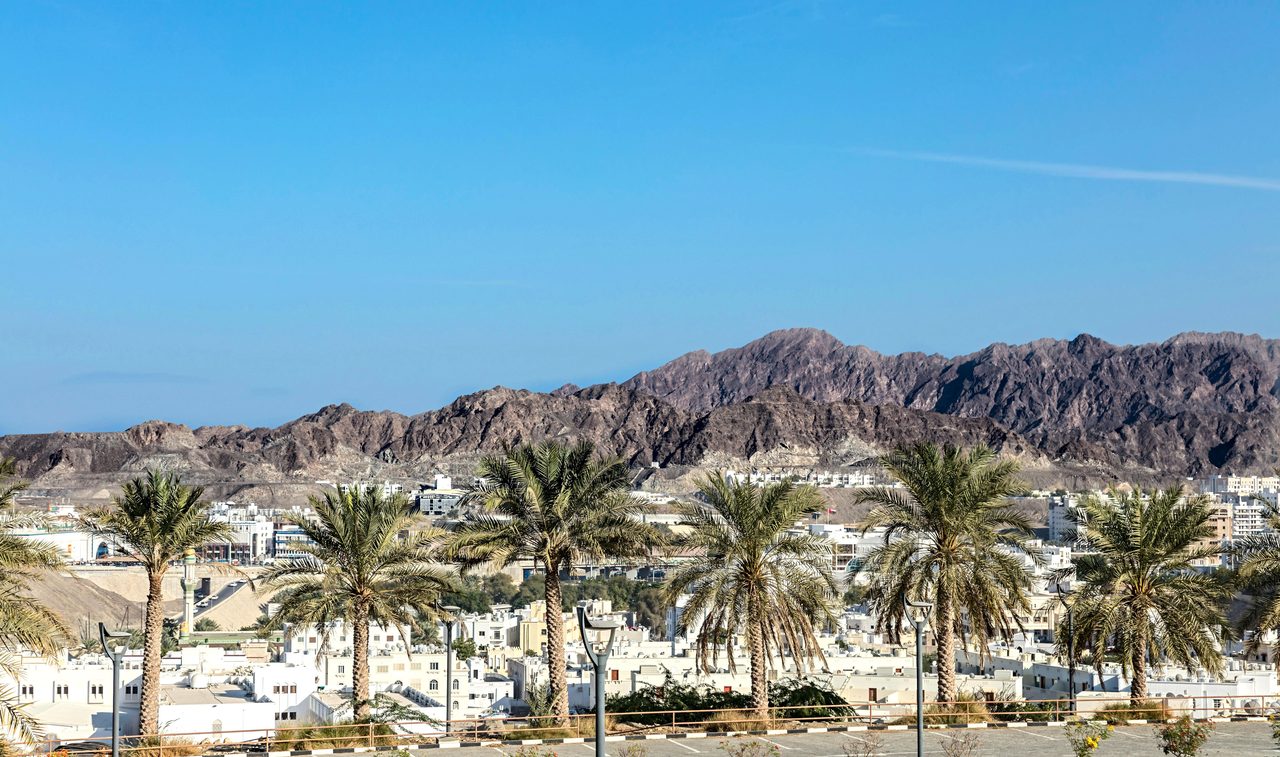
Muscat is the capital of Oman, a low-rise coastal city of white buildings set between the Gulf of Oman and the rugged Hajar Mountains. Its old harbour district of Mutrah, the vast Sultan Qaboos Grand Mosque, the Royal Opera House and a string of quiet beaches make it one of the Gulf's most relaxed and culturally rooted capitals.
Muscat stretches roughly 50 km along the Gulf of Oman, from Seeb and the airport in the west through Qurum, Shati Al Qurum and Ruwi to the old harbour of Mutrah and the palace district of Old Muscat in the east. Building height and colour are tightly regulated, so the skyline stays white and low against dark mountains. The main sights are the Sultan Qaboos Grand Mosque, Mutrah Souq and Corniche, Muttrah Fort, Al Alam Palace, the National Museum of Oman, Bait Al Zubair and the Royal Opera House. Outside the city, day trips reach the turquoise pools of Wadi Shab and Bimmah Sinkhole, the fort town of Nizwa, and the coastal city of Sur. Public transport is limited, so most visitors use taxi apps, metered taxis or a rental car. Summers are extremely hot, and the best months run from October to April.
The 17 destinations our editors recommend — from iconic landmarks to under-the-radar finds.
Sultan Qaboos Grand Mosque
Muscat's principal mosque, completed in 2001, with a prayer hall carpet woven as a single piece, a 14-metre Swarovski crystal chandelier and a 50-metre minaret-framed courtyard of Indian sandstone. Non-Muslim visitors are admitted to the courtyard and main prayer hall during morning visiting hours, with modest dress required.
Muttrah Souq
One of the oldest marketplaces in Arabia: a covered labyrinth of lanes selling frankincense, silver khanjar daggers, pashmina, Omani halwa, dried fruit and spices. Shopkeepers expect bargaining and prices are rarely marked.
Royal Opera House Muscat
Oman's performing arts centre, opened in 2011 and built in Omani-Islamic style with marble, carved teak and a retractable-seat auditorium. Guided daytime tours cover the main hall, while evening concerts require formal dress.
National Museum of Oman
Oman's flagship museum in Old Muscat, tracing 2 million years of history through galleries on archaeology, maritime trade, frankincense, Islamic civilisation and the modern state. Displays include a Bronze Age Magan copper collection and dioramas of daily life.
Al Alam Palace
The ceremonial palace of Sultan Haitham bin Tarik, with a facade of blue and gold columns on a plaza between two Portuguese-built forts. The palace itself is closed to visitors; the plaza and gates are open for viewing and photography.
Al Jalali Fort
A 16th-century Portuguese fort on a rocky outcrop on the eastern side of Muscat harbour, used historically as a prison and today as a ceremonial state building. The interior is generally not open to the public; the fort is best seen from the Al Alam Palace plaza and the harbour.
Recommended itineraries
Pick a length, follow the route. Each itinerary balances headline sights with breathing room.
5-Day Muscat Explorer
Day 1Arrive in Muscat, explore city center
Day 2Visit top attractions and museums
Day 3Day trip to nearby highlights
Day 4Local markets and hidden gems
Day 5Final sightseeing, departure
7-Day Classic Muscat
Days 1-2Muscat city highlights
Days 3-4Regional exploration
Days 5-6Cultural immersion and local experiences
Day 7Return and departure
14-Day Ultimate Muscat
Days 1-3Muscat comprehensive city tour
Days 4-6Northern region exploration
Days 7-9Eastern highlights
Days 10-12Southern attractions
Days 13-14Return to Muscat, departure
Where to stay in Muscat
Three tiers, every traveller covered — from cost-conscious to flagship hotels.
Budget OMR 28 (approx $73)
Hostels, budget hotels, and guesthouses offer affordable stays without sacrificing experience.
Mid-range OMR 75 (approx $195)
Boutique hotels and well-located accommodations provide comfort and convenience at reasonable prices.
Luxury OMR 190+ (approx $494+)
World-class resorts and premium hotels deliver unforgettable experiences.
Al Bustan Palace, A Ritz-Carlton Hotel
Al Bustan · $$$$
Palace-style beach resort on a private bay at the foot of the Hajar mountains, south of Old Muscat. Large gardens, a long private beach, several restaurants and a spa; about 25 minutes by taxi from Muscat International Airport.
Three-hotel resort (Al Waha, Al Husn and Al Bandar) spread over a coastal estate with private beaches, a spa and multiple restaurants, about 30 minutes from the airport by road.
Minimalist Asian-influenced beachfront hotel in Ghubra, known for its long lagoon-style pools, private beach, spa and the fine-dining restaurant The Restaurant.
Large Omani-styled five-star hotel in Shatti Al Qurum near the Royal Opera House, with a pool, spa, several restaurants and walking access to the beach area.
Upscale restaurant on Shatti Al Qurum near the Royal Opera House giving modern twists to Omani flavours, including camel shuwa, a shuwa burger and a frankincense ice cream.
Omani restaurant in a renovated merchant's house on the Mutrah Corniche, a short walk from Mutrah Souq. Known for harees, shuwa and a date cheesecake with ruby sauce.
Rozna Restaurant
Omani and Middle Eastern · $$ (OMR 5-12 / approx USD 13-31 per person)
Local restaurant serving Omani plates such as shuwa and qabuli with traditional fried snacks and sweets like luqaimat and mandazi.
Popular brunch cafe on the first floor of Jawharat A'Shatti serving shakshuka, smashed avocado on sourdough, pumpkin hummus toast and homemade macarons.
Muscat is a long, low-rise city stretched along the Gulf of Oman coast between Muttrah and the airport district of Seeb, with a mountain backdrop that limits road links. The sights are spread out, public transport is limited to Mwasalat buses, and there is no metro or passenger train, so most visitors use a mix of taxis (booked by app) and a rental car. A rental car is also the practical way to reach the major day-trip destinations such as Nizwa, Wadi Shab and Sur.
Budget breakdown
Daily spend by tier in Omani rial (OMR); 1 OMR = 2.60 USD, broken out by category.
Category
Budget
Mid-range
Luxury
Accommodation
OMR 10-18
OMR 40-75
OMR 120-250
Food (per day)
OMR 6-9
OMR 18-30
OMR 40-70
Transportation
OMR 1-4
OMR 12-20
OMR 30-60
Activities
OMR 0-5
OMR 15-30
OMR 40-100
Daily total
OMR 28 (approx $73)
OMR 75 (approx $195)
OMR 190+ (approx $494+)
Best time to visit Muscat
Weather through the year in Muscat
Best timeShoulderWorth avoiding
Average daytime temperature in °C. Figures are for Muscat.
Muscat is best from October to April, when daytime highs sit around 24-33 C and the sea is warm enough to swim. Summer (June to September) is extremely hot and humid, with highs of 38-45 C.
Rain is rare and falls mostly from December to March in short, sometimes heavy bursts that flood wadis; Wadi Shab and other canyons should not be entered when rain is forecast. Ramadan shifts the daily rhythm: daytime eating in public is restricted and many restaurants open only after sunset. Check the Hijri calendar for Ramadan and Eid dates, which move about 11 days earlier each year.
Essential travel tips
Dress modestly: cover shoulders and knees in public, and cover hair and arms inside the Grand Mosque
Eat and drink in public only after sunset during Ramadan
Use the right hand for eating and greeting; accept coffee and dates when offered
Carry small cash (OMR 1 and 5 notes) for taxis, souq stalls and wadi entry points
Plan outdoor sightseeing for early morning or after 4:00 PM from April to October
Alcohol is sold only in licensed hotels, bars and a few restaurants; buying it in shops requires a licence
Friday is the weekly holiday along with Saturday; many shops close at midday on Friday for prayer
Hidden gems
Off-the-beaten-path corners most travellers miss.
Bait Al Baranda
A small museum in a restored Omani house in Old Muscat covering the history of the city and its people, with far fewer visitors than the larger museums.
Old Muscat
Mutrah Fish Market
A working fish market on the Corniche where fishermen auction the morning catch; it is liveliest at dawn.
Mutrah
Riyam Park and incense burner viewpoint
A public park on a hill above Mutrah with a giant stone incense burner, a free viewpoint over the harbour and a quiet escape from the souq.
Mutrah
Qantab and Jebel Sifah coast
Rocky bays and small beaches south-east of Muscat where locals picnic, snorkel and fish.
Qantab, Muscat Governorate
Wadi Al Arbaeen
A hiking and swimming wadi in the mountains inland of Yiti, quieter than Wadi Shab and good for a half-day trip.
Quriyat, Muscat Governorate
Safety information
INFO
Check the US State Department (travel.state.gov) and UK FCDO (gov.uk/foreign-travel-advice/oman) pages before departure and again within 24 hours of flying; both were updated in 2026 as regional tensions changed
INFO
Enrol with the home government's traveller programme (US citizens: STEP at step.state.gov) so the embassy can send alerts and reach the traveller during airspace closures
INFO
Buy travel insurance that covers medical treatment, repatriation, and trip disruption from airspace closures; confirm the policy does not exclude the Gulf region or conflict-related disruption
INFO
Keep departure plans flexible: flights may be cancelled and airspace may close periodically; save the Oman Air, SalamAir, and the home airline's contact numbers offline
INFO
If told to shelter, move to an interior room with few external walls or windows and do not touch drone or missile fragments
INFO
Avoid areas around security or military facilities, and do not photograph government buildings, military sites, or airports; photography there is illegal and can lead to detention
INFO
Dress modestly in public, including malls: shoulders and knees covered; swimwear is for hotel pools and tourist beaches only
INFO
Heat is the most common medical risk: between May and September daytime highs reach 36-40 degrees Celsius, so carry water, avoid midday walking, and start desert or wadi trips at dawn
INFO
Wadis can flood suddenly after rain, mainly from October to March; check forecasts, never enter a wadi when rain is expected (including for at least a day afterwards), and move to high ground if water rises
INFO
Drive defensively outside Muscat: camels, goats, and sudden floods are road hazards, and drink-driving and mobile phone use at the wheel are illegal with heavy penalties
Frequently asked questions
Do I need a visa to visit Muscat?
Citizens of more than 100 countries can enter Oman visa-free for up to 14 days, with a passport valid for six months, proof of accommodation and an onward ticket. Longer stays require an e-Visa from the Royal Oman Police portal (evisa.rop.gov.om). Rules change, so confirm on the official site.
What is the best time to visit Muscat?
October to April is the most comfortable period, with highs of 24-33 C. Summers are extremely hot and humid, with temperatures above 40 C.
Can non-Muslims visit the Sultan Qaboos Grand Mosque?
Yes. Non-Muslim visitors are admitted free of charge on Saturday to Thursday mornings, from about 8:00 to 11:00 AM, with modest dress required and hair covered for women.
How do I get from Muscat airport to the city?
Metered airport taxis and OTaxi or Marhaba app rides cost about OMR 6-12 ($16-31) depending on the district; Mwasalat bus A1 is cheaper (OMR 0.5-1) but slower.
Is Muscat safe?
Crime is very low and visitors generally feel safe, but several governments, including the United States, raised their advisories for Oman in 2026 because of regional tensions. Check current advice before travel and follow the Royal Oman Police.
Explore Muscat by city
The cities below have their own guides — hotels, attractions and where to eat, in depth.