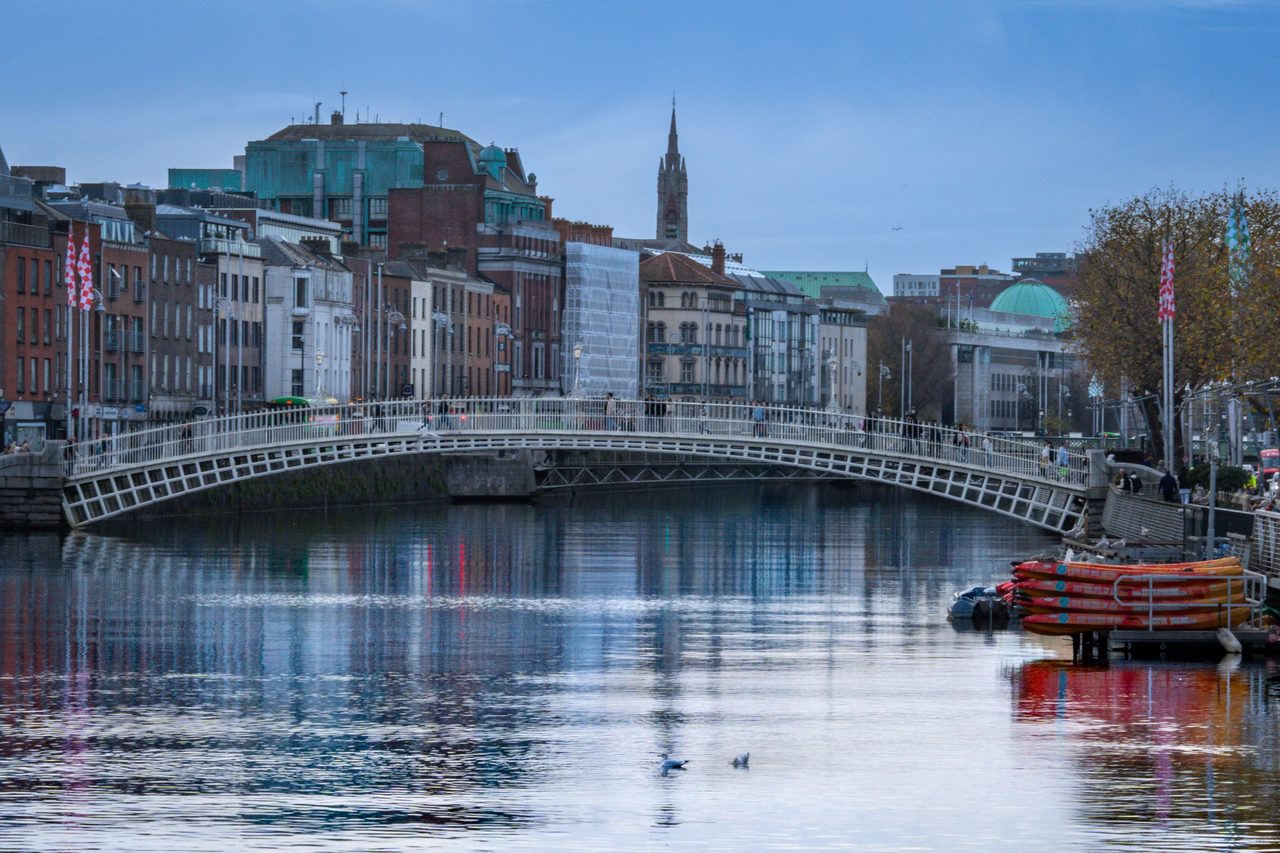
Dublin is one of Europe's most welcoming capital cities, blending a rich literary and cultural heritage with a thriving pub scene, world-class museums, and vibrant neighbourhoods. Straddling the River Liffey in the province of Leinster, Dublin offers medieval castles, Georgian squares, Michelin-starred restaurants, and easy access to wild countryside — all compact enough to explore on foot.
The 21 destinations our editors recommend — from iconic landmarks to under-the-radar finds.
Trinity College & Book of Kells
Founded in 1592, Trinity College is Ireland's oldest university and home to the Book of Kells, a lavishly illuminated 9th-century gospel manuscript. The visit combines the manuscript exhibition with the Old Library's Long Room, a 65-metre barrel-vaulted chamber lined with roughly 200,000 antique books and marble busts of scholars.
Guinness Storehouse
Built around the original 1904 fermentation plant, the Guinness Storehouse traces the beer's history from Arthur Guinness's 9,000-year brewery lease signed in 1759 through brewing, cooperage, and advertising. The self-guided tour ends at the rooftop Gravity Bar, where the included pint comes with a panoramic view over Dublin.
Dublin Castle
Dublin Castle served as the center of English and British administration in Ireland from the 13th century until 1922. Visitors can tour the opulent State Apartments and Chapel Royal, or take the Undercroft tour to see excavated Viking and Norman foundations beneath the castle courtyards.
St. Patrick's Cathedral
Founded in 1191, St Patrick's Cathedral is the largest church in Ireland and the national cathedral of the Church of Ireland. Jonathan Swift, author of Gulliver's Travels, served as dean here for over 30 years and is buried inside alongside his companion Esther Johnson.
Chester Beatty Library
Assembled by mining magnate Sir Alfred Chester Beatty, this collection spans Egyptian papyri, Persian miniatures, Chinese jade books, and some of the earliest surviving fragments of the New Testament. Named Europe's Museum of the Year in 2002, it remains one of Dublin's best free attractions.
National Museum of Ireland – Archaeology
This branch of the National Museum houses Ireland's most significant archaeological finds, including the Ardagh Chalice, the Tara Brooch, and a collection of preserved Iron Age bog bodies. The Treasury gallery alone represents over 4,000 years of Irish craftsmanship in gold and metalwork.
Recommended itineraries
Pick a length, follow the route. Each itinerary balances headline sights with breathing room.
5-Day Dublin Explorer
Day 1Arrive in Dublin, explore city center
Day 2Visit top attractions and museums
Day 3Day trip to nearby highlights
Day 4Local markets and hidden gems
Day 5Final sightseeing, departure
7-Day Classic Dublin
Days 1-2Dublin city highlights
Days 3-4Regional exploration
Days 5-6Cultural immersion and local experiences
Day 7Return and departure
14-Day Ultimate Dublin
Days 1-3Dublin comprehensive city tour
Days 4-6Northern region exploration
Days 7-9Eastern highlights
Days 10-12Southern attractions
Days 13-14Return to Dublin, departure
Where to stay in Dublin
Three tiers, every traveller covered — from cost-conscious to flagship hotels.
Budget €55–€127/day (~$60–$140)
Hostels, budget hotels, and guesthouses offer affordable stays without sacrificing experience.
Mid-range €200–€370/day (~$220–$407)
Boutique hotels and well-located accommodations provide comfort and convenience at reasonable prices.
Luxury €580–€1,650/day (~$638–$1,815)
World-class resorts and premium hotels deliver unforgettable experiences.
The Shelbourne Dublin, A Renaissance Hotel
St. Stephen's Green, Dublin 2 · €350–€900/night (~$385–$990)
Cafés, neighbourhood gems, and tasting menus worth the table reservation.
Restaurant Patrick Guilbaud
Modern French-Irish · €€€€ (lunch €55, dinner tasting menu €215 / ~$60–$237)
Housed in a Georgian townhouse beside the Merrion Hotel, this is the benchmark for fine dining in Ireland, run by chef Guillaume Lebrun on classical French lines built around Irish ingredients. The art collection on the walls is as serious as the kitchen — pieces by major 20th-century Irish painters hang throughout the dining room.
Set over a narrow, book-lined staircase on the north quays, The Winding Stair pairs Liffey views with a straightforward menu that leans on named Irish producers — Castletownbere fishermen, Connemara farms, Carlingford oyster beds. It is a reliable, unfussy choice for a solo traveler wanting good Irish food without fine-dining formality.
Uno Más
Spanish Tapas · €€–€€€ (tapas €7–€15, share 4–6 dishes per person / ~$7.70–$16.50)
A small, high-energy dining room on Aungier Street serving Spanish tapas built for sharing, with a natural-wine list that changes constantly. Portions are genuinely tapas-sized, so solo diners should expect to order three to four dishes for a full meal.
Boxty House
Traditional Irish · €€ (mains €16–€28 / ~$17.60–$30.80)
A Temple Bar institution built entirely around the boxty, the traditional Irish potato pancake, served with fillings from smoked salmon to Irish stew. It sits squarely in the tourist zone, so the room is busy and the menu leans traditional over adventurous, but it delivers exactly what a first-time visitor is looking for.
Leo Burdock's
Fish and Chips · € (cod and chips €12–€14 / ~$13.20–$15.40)
A tiny takeaway counter just below Christ Church Cathedral that has served fried fish and chips since 1913. There is no seating at the original Werburgh Street shop — food is wrapped for takeaway, and the nearby Cathedral steps and Dubh Linn Garden are the classic spots to eat it.
Pickle
Modern Indian · €€€ (mains €18–€32 / ~$19.80–$35.20)
Pickle reworks regional Indian dishes using Irish meat and produce — Wicklow lamb in the raan, Irish dairy in the dal makhani — in a lively Camden Street dining room. It holds a Michelin Bib Gourmand and books out weeks in advance, so this is a plan-ahead reservation rather than a same-week option.
Dublin Airport (DUB) is 12 km north of the city. Public transport is managed by the National Transport Authority (transportforireland.ie). The Leap Card is the universal transit card, available at newsagents, airports, and at leapcard.ie.
Budget breakdown
Daily spend by tier in EUR (€), broken out by category.
Category
Budget
Mid-range
Luxury
Accommodation
€20–€60/night (~$22–$66)
€120–€220/night (~$132–$242)
€350–€1,000/night (~$385–$1,100)
Food (per day)
€20–€35/day (~$22–$38)
€45–€80/day (~$49–$88)
€120–€300/day (~$132–$330)
Transportation
€5–€12/day (~$5.50–$13)
€10–€20/day (~$11–$22)
€50–€150/day (~$55–$165)
Activities
€10–€20/day (~$11–$22)
€25–€50/day (~$27–$55)
€60–€200/day (~$66–$220)
Daily total
€55–€127/day (~$60–$140)
€200–€370/day (~$220–$407)
€580–€1,650/day (~$638–$1,815)
Best time to visit Dublin
Weather through the year in Ireland
Best timeShoulderWorth avoiding
Average daytime temperature in °C. Figures are for Ireland.
May–June offers the longest days (up to 17 hours of daylight), relatively low rainfall, wildflower countryside for day trips, and pre-peak hotel prices. September retains mild weather with golden light and post-summer quieter streets.
Essential travel tips
Purchase a Leap Card (available at airport kiosks, convenience stores, and at leapcard.ie) for discounted fares on all bus, DART, and Luas services
Book Guinness Storehouse, Book of Kells, and Kilmainham Gaol tickets online in advance — walk-up queues can be 60–90 minutes
Many national museums (National Museum of Ireland, National Gallery of Ireland) are free
Pubs serve food until around 21:00; late kitchens are rare — plan dinner before 20:30 if eating in a pub
Hidden gems
Off-the-beaten-path corners most travellers miss.
Iveagh Gardens
A hidden Victorian garden with fountains and a rustic grotto, free and rarely crowded.
Moore Street Market
The cheapest fruit and vegetables in the city, used by locals rather than tourists.
Marsh's Library
Ireland's oldest public library (1707) sits behind St. Patrick's Cathedral and receives barely 1% of the visitors the cathedral attracts. Scholars in caged alcoves, 25,000 rare books, and almost no queues.
St Patrick's Close, Dublin 8
Glasnevin Cemetery Museum
Over 1.5 million people are buried here including Daniel O'Connell and Michael Collins. The museum uses genealogy records and actor-led tours to bring Irish history to life in a way most museums cannot.
Finglas Road, Glasnevin, Dublin 11
The Little Museum of Dublin
A two-room Georgian townhouse stuffed with 5,000 objects donated by Dublin citizens — from U2 memorabilia to 1916 Rising broadsides. Guided tours run every 30 minutes and cost €10 (~$11).
15 St Stephen's Green, Dublin 2
Glasnevin Cemetery grounds
The cemetery grounds are free to walk even without booking the paid guided tour.
Finglas Road, D11
Safety information
INFO
Keep bags zipped and in front of you on the Luas Red Line and Dublin Bus — pickpockets operate on crowded vehicles
INFO
Store valuables in hotel safes; hostel locker padlocks are often not provided — bring your own
INFO
Avoid walking alone in O'Connell Street after midnight — stick to busy, well-lit streets
INFO
Dublin is rainy — wet cobblestones in Temple Bar and the Liberties are slippery; wear shoes with grip
INFO
Know the Irish emergency number: 999 (or 112 from any mobile even with no credit)
Frequently asked questions
Is Dublin safe to visit in 2026?
Dublin is a safe city for tourists by European standards. The Republic of Ireland has no significant terrorism threat. Violent crime affecting tourists is rare. The main risks are petty theft in crowded tourist zones, minor scams targeting distracted visitors, and the hazards associated with heavy l
What is the best time to visit Dublin?
The best time to visit Dublin is May–June and September–October. Dublin has a temperate oceanic climate (Köppen Cfb) characterised by mild temperatures year-round, high humidity, and frequent rain spread across all seasons. Summers are warm but not hot (average Jul
Do I need a visa to visit Dublin?
EU/EEA citizens: no visa required. US, Canadian, Australian citizens: visa-free for up to 90 days. Note: Ireland is not part of the Schengen Area; a separate Irish visa may be required for those also visiting Schengen countries. Requirements vary by nationality, so check with your nearest embassy or the official immigration website before traveling.
What currency is used in Dublin?
The currency in Dublin is the Euro (EUR) (EUR). ATMs are widely available in cities and tourist areas. Credit cards are accepted at most hotels and restaurants, but carry cash for markets and smaller establishments.
What language is spoken in Dublin?
The main language(s) spoken in Dublin: English, Irish (Gaeilge). In tourist areas, English is generally understood. Learning a few basic phrases in the local language is appreciated by locals.
What are the top attractions in Dublin?
The top attractions in Dublin include Trinity College & Book of Kells, Guinness Storehouse, Dublin Castle, St. Patrick's Cathedral, and Chester Beatty Library. Each offers a unique experience, from historic landmarks to natural wonders.