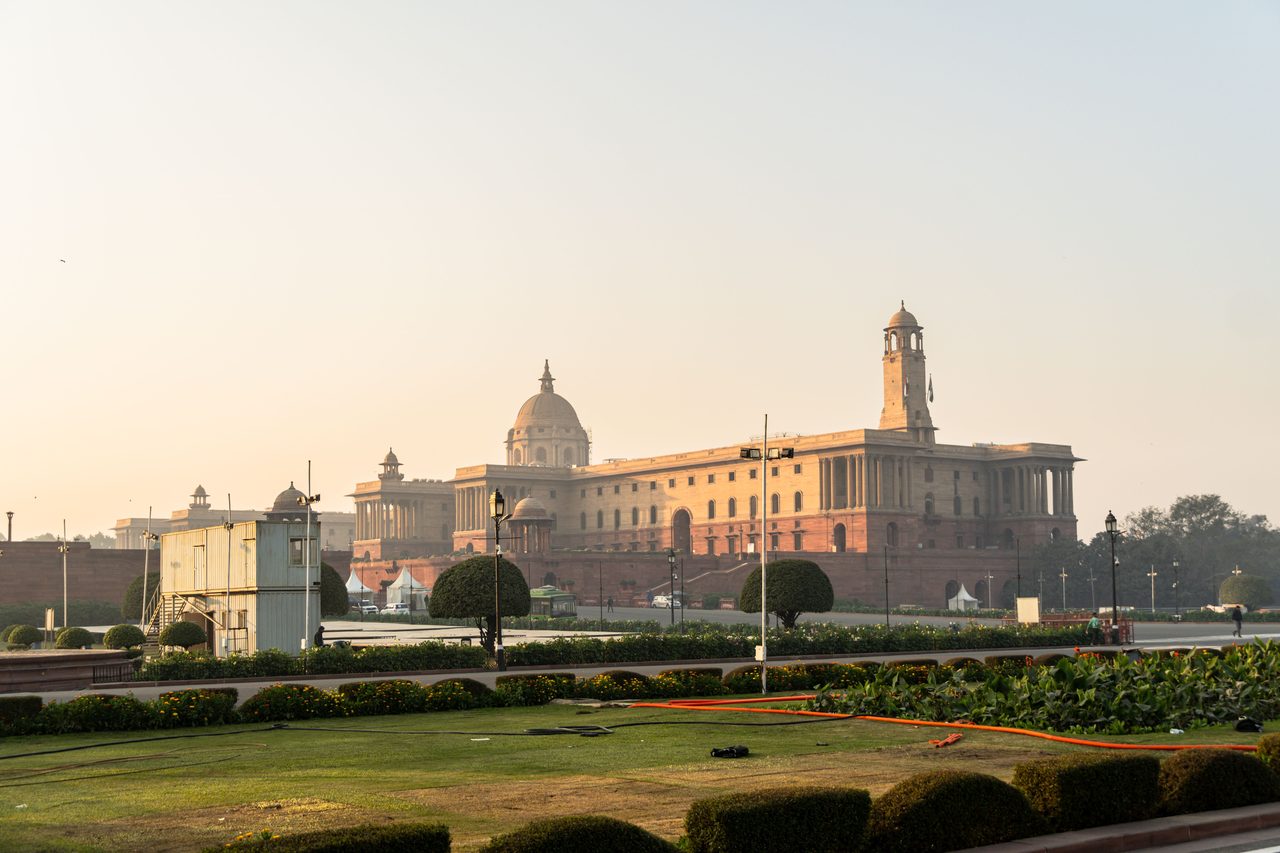
Delhi is India's capital territory and the country's political and cultural centre, a sprawling city on the Yamuna River where three UNESCO World Heritage monuments, seven historic capitals, and one of Asia's largest street-food cultures sit side by side. Old Delhi's Mughal lanes around the Red Fort and Jama Masjid contrast with the colonial avenues of Lutyens' New Delhi and the bars, boutiques, and design studios of South Delhi.
Delhi has been the seat of empires for more than a thousand years, and the layers are still visible on the ground. The Mughal core of Shahjahanabad, now called Old Delhi, holds the Red Fort, Jama Masjid, and the trading lanes of Chandni Chowk, where cycle rickshaws thread past spice warehouses and paratha stalls. A few kilometres south, Lutyens' New Delhi spreads out in wide colonial boulevards around India Gate, Rashtrapati Bhavan, and Kartavya Path. Further south again, the Qutub Minar complex and the ruins of Mehrauli mark the earliest Islamic capital in India, while Humayun's Tomb set the architectural template that led to the Taj Mahal. Modern Delhi runs on one of the world's largest metro systems, and its neighbourhoods range from the backpacker guesthouses of Paharganj to the galleries of Hauz Khas and the fine-dining rooms of Chanakyapuri. The city is also the natural gateway to the Golden Triangle, with Agra and Jaipur both within day-trip reach by fast train.
Capital
Delhi is India's capital; New Delhi is the seat of the national government
Largest city
Delhi
Population
~11 million in the city proper, ~22 million across the National Capital Territory, and roughly 33 million in the wider National Capital Region
The 24 destinations our editors recommend — from iconic landmarks to under-the-radar finds.
Red Fort (Lal Qila)
The vast red sandstone citadel that Shah Jahan raised between 1638 and 1648 as the palace-fort of his new capital Shahjahanabad. Inscribed by UNESCO in 2007, the complex holds the Diwan-i-Am, Diwan-i-Khas, Rang Mahal and the Naubat Khana drum house behind two kilometres of battlemented walls. India's prime minister addresses the nation from its ramparts every Independence Day.
Qutub Minar
At 72.5 metres, the tallest brick minaret in the world, begun by Qutb-ud-din Aibak in 1193 to mark the founding of the Delhi Sultanate and finished by his successors. The surrounding complex contains the Quwwat-ul-Islam mosque, the Alai Darwaza, the tomb of Iltutmish and the uncorroded fourth-century Iron Pillar. UNESCO inscribed the ensemble in 1993.
Humayun's Tomb
The first great garden-tomb of the Indian subcontinent, commissioned in 1569 by the empress Bega Begum for the second Mughal emperor and designed by the Persian architect Mirak Mirza Ghiyas. Its charbagh layout and red sandstone-and-marble dome became the template that culminated in the Taj Mahal. A UNESCO World Heritage Site since 1993, restored over two decades by the Aga Khan Trust for Culture.
India Gate and Kartavya Path
The 42-metre memorial arch designed by Sir Edwin Lutyens and completed in 1931, carrying the names of more than 13,000 Indian and British soldiers who died in the First World War and the Third Anglo-Afghan War. The National War Memorial and its eternal flame stand immediately behind it, and the redeveloped Kartavya Path promenade runs west towards Rashtrapati Bhavan.
Jama Masjid
India's largest mosque, built by Shah Jahan between 1644 and 1656 in red sandstone and white marble, with a courtyard that holds some 25,000 worshippers. Three great gateways, two 40-metre minarets and a broad flight of steps face the lanes of Old Delhi. The southern minaret can be climbed for one of the finest rooftop panoramas over Chandni Chowk and the Red Fort.
Lotus Temple (Bahá'í House of Worship)
Completed in 1986 to a design by Iranian-Canadian architect Fariborz Sahba, this Bahá'í House of Worship is formed from 27 free-standing marble-clad petals arranged in nine clusters around a 34-metre-high central hall. All faiths are welcome and the interior is kept silent, with no images, sermons or ritual. It is one of the most visited buildings on earth.
Recommended itineraries
Pick a length, follow the route. Each itinerary balances headline sights with breathing room.
5-Day Delhi Explorer
Day 1Arrive in Delhi, explore city center
Day 2Visit top attractions and museums
Day 3Day trip to nearby highlights
Day 4Local markets and hidden gems
Day 5Final sightseeing, departure
7-Day Classic Delhi
Days 1-2Delhi city highlights
Days 3-4Regional exploration
Days 5-6Cultural immersion and local experiences
Day 7Return and departure
14-Day Ultimate Delhi
Days 1-3Delhi comprehensive city tour
Days 4-6Northern region exploration
Days 7-9Eastern highlights
Days 10-12Southern attractions
Days 13-14Return to Delhi, departure
Where to stay in Delhi
Three tiers, every traveller covered — from cost-conscious to flagship hotels.
Budget ₹2,500 (approx $26 USD)
Hostels, budget hotels, and guesthouses offer affordable stays without sacrificing experience.
Mid-range ₹7,500 (approx $79 USD)
Boutique hotels and well-located accommodations provide comfort and convenience at reasonable prices.
Luxury ₹25,000+ (approx $264 USD)
World-class resorts and premium hotels deliver unforgettable experiences.
The Imperial New Delhi
Janpath / Connaught Place · INR 22,000-60,000 per night (approx $232-633 USD)
Opened in 1936 and designed by architect F.B. Blomfield, The Imperial holds one of the largest privately owned collections of colonial-era Indian art in its corridors, across 235 rooms and 44 suites on eight acres a short walk from Connaught Place.
Mansingh Road / Lutyens' Delhi · INR 20,000-55,000 per night (approx $211-580 USD)
294 rooms including 25 suites over 15 floors near India Gate, with signature restaurants House of Ming and Machan and the Rick's bar named after the film Casablanca.
Chanakyapuri / Diplomatic Enclave · INR 15,000-45,000 per night (approx $158-475 USD)
Set on six landscaped acres in the Diplomatic Enclave, Taj Palace holds around 400 rooms and suites and one of Delhi's largest banqueting estates, with dining at Spicy Duck, Capital Kitchen and The Blue Bar.
Dr Zakir Hussain Marg / Golf Links · INR 28,000-70,000 per night (approx $295-738 USD)
Reopened in January 2018 after a full rebuild, The Oberoi's 283 rooms overlook the Delhi Golf Club and Humayun's Tomb, with the rooftop bar Cirrus 9 and Michelin-mentored restaurants Dhilli and Baoshuan.
Cafés, neighbourhood gems, and tasting menus worth the table reservation.
Karim's Jama Masjid
Mughlai - North Indian · INR 400-800 per person (approx $4-8 USD)
Delhi's best-known Mughlai address, tucked in a courtyard off Gali Kababian a few steps from the southern gate of Jama Masjid. Running since 1913, it serves mutton korma, burra kebab and slow-cooked nihari to a constant crowd of locals and visitors. Seating spreads across several plain, functional rooms around a central lane where cooks work over open fires.
Al Jawahar
Mughlai - North Indian · INR 350-700 per person (approx $4-7 USD)
Al Jawahar faces Gate 1 of Jama Masjid on Matia Mahal Road and has been serving Mughlai food since 1948. The two-floor dining room is brighter and more orderly than most of the neighbourhood's eateries, and the kitchen is known for mutton korma, chicken changezi and sheermal bread. It opens early for breakfast nihari and stays busy until the small hours.
Pandit Gaya Prasad Shiv Charan
North Indian - stuffed parathas · INR 100-250 per person (approx $1-3 USD)
The most photographed of the handful of shops left on Paranthe Wali Gali, the narrow Chandni Chowk lane that once held more than a dozen paratha specialists. Breads are stuffed with potato, paneer, cauliflower, bitter gourd or sweet rabri and deep-fried to order in ghee, then served on a steel thali with pickle, tamarind chutney and a banana-and-curd side. Seating is a row of marble-topped benches.
Old Famous Jalebi Wala
Indian sweets · INR 80-200 per person (approx $1-2 USD)
A tiny corner counter where Dariba Kalan meets Chandni Chowk's main road, frying oversized jalebis in desi ghee since 1884. The jalebis are thicker and less brittle than the standard version and are sold by weight, eaten standing on the pavement. Samosas are the only other item on offer.
Natraj Dahi Bhalle Corner
North Indian chaat · INR 60-150 per person (approx $1-2 USD)
Natraj is a pavement counter on the main Chandni Chowk road that has sold only dahi bhalla and aloo tikki since 1940. The bhalle are soft lentil dumplings drowned in whisked curd and dusted with tamarind chutney and spice powders; the tikki is shallow-fried on a flat iron tawa. Customers eat standing, and turnover is constant through the afternoon.
Kake Di Hatti
Punjabi - North Indian · INR 250-500 per person (approx $3-5 USD)
Kake Di Hatti is a plain, always-full Punjabi dhaba at the Fatehpuri end of Chandni Chowk, open since 1942. Its signature is a tandoori naan of exaggerated size, ordered alongside dal makhani and rich paneer curries. The room is cramped and shared seating is normal, but portions are generous and prices low for the quantity served.
Getting around Delhi
Delhi is enormous, but it is also unusually easy to navigate because the metro reaches nearly everywhere a visitor needs to go. A typical day combines metro rides between districts with a short auto or e-rickshaw hop at each end. App cabs cover late evenings and airport runs, and long-distance trains from New Delhi, Hazrat Nizamuddin, and Old Delhi stations put Agra, Jaipur, and the Himalayan foothills within easy reach. Self-driving is best avoided entirely.
Budget breakdown
Daily spend by tier in INR, broken out by category.
Category
Budget
Mid-range
Luxury
Accommodation
₹1,000 (approx $11 USD)
₹4,000 (approx $42 USD)
₹15,000 (approx $158 USD)
Food (per day)
₹600 (approx $6 USD)
₹1,800 (approx $19 USD)
₹5,000 (approx $53 USD)
Transportation
₹300 (approx $3 USD)
₹800 (approx $8 USD)
₹2,500 (approx $26 USD)
Activities
₹600 (approx $6 USD)
₹900 (approx $9 USD)
₹2,500 (approx $26 USD)
Daily total
₹2,500 (approx $26 USD)
₹7,500 (approx $79 USD)
₹25,000+ (approx $264 USD)
Best time to visit Delhi
Essential travel tips
Buy a Delhi Metro smart card on arrival for a 10 percent fare discount and to skip token queues
Most Archaeological Survey of India monuments charge foreign visitors around ₹550 (approx $5.80 USD) against ₹35-40 (approx $0.37-0.42 USD) for Indian nationals; tickets are cheaper booked online in advance
Visit Old Delhi early in the morning, when the lanes are cool and the paratha stalls are frying
Remove shoes and cover the head at gurdwaras such as Bangla Sahib, where free head coverings are provided at the entrance
Carry cash for street food and markets, although UPI and cards are accepted almost everywhere else
Most monuments and museums close on Mondays; the Red Fort in particular is shut every Monday
Agra is 2 hours away on the Gatimaan or Vande Bharat express trains, making a Taj Mahal day trip straightforward
Hidden gems
Off-the-beaten-path corners most travellers miss.
Rajon ki Baoli
A three-tiered Lodhi-era stepwell of 1506 buried in Mehrauli Archaeological Park, with an arcaded gallery, a domed pavilion and incised plasterwork. It is usually deserted even when Qutub Minar next door is packed.
Mehrauli Archaeological Park, South Delhi
Khirki Masjid
A rare covered mosque of about 1380 built for Firoz Shah Tughlaq's minister Khan-i-Jahan Junan Shah, its heavy stone walls pierced by the latticed windows that give it its name. The nine-square plan with four small open courts is almost unique in Indian architecture.
Khirki Village, Saket, South Delhi
Feroz Shah Kotla
The ruined fifth city of Delhi, Firozabad, founded in 1354, crowned by a polished third-century BC Ashokan pillar that Firoz Shah Tughlaq transported from Ambala and raised on a stepped pyramid. Every Thursday people leave letters in the cellars for the djinns said to live there.
Bahadur Shah Zafar Marg, Central Delhi
Tughlaqabad Fort
The colossal sloping ramparts of Ghiyas-ud-din Tughlaq's fortress city, raised and abandoned within a few years around 1321-1327. Six kilometres of rubble-built walls up to 15 metres high enclose a wilderness of cisterns and collapsed halls, with the founder's red sandstone tomb on a causeway opposite.
Tughlakabad, South Delhi
Sanskriti Kendra Museums
Three small museums of everyday art, textiles and terracotta set in a landscaped campus on the Mehrauli-Gurgaon road, displaying kitchen tools, oil lamps, betel-nut cutters and folk terracotta gathered over decades by the collector O P Jain.
Anandagram, Mehrauli-Gurgaon Road
Nizamuddin Basti and Dargah
The settlement grown around the fourteenth-century shrine of the Sufi saint Nizamuddin Auliya, a warren of lanes holding the tombs of the poet Amir Khusrau and the Mughal princess Jahanara. Qawwali singers perform at the dargah on Thursday evenings after sunset prayers.
Nizamuddin West, South Delhi
Safety information
INFO
Pre-book transport through Uber or Ola, or use a hotel-arranged car, rather than accepting rides from drivers who approach at stations and the airport; the prepaid taxi booth at Indira Gandhi International Airport is the safe alternative on arrival.
INFO
Ignore anyone at New Delhi Railway Station who says the station, the ticket office or a tourist office is closed, relocated or under renovation; the International Tourist Bureau is upstairs inside the station itself and this claim is the city's most persistent scam.
INFO
The only official government tourist office in Delhi is the India Tourism office at 88 Janpath; every other 'government approved' or 'official' tourist office is a private travel agency paying commission.
INFO
Carry small notes of INR 10, 20, 50 and 100; drivers and stallholders routinely claim to have no change as a way of keeping the difference.
INFO
Withdraw cash from ATMs inside bank branches or hotel lobbies rather than standalone street machines, and cover the keypad.
INFO
Keep bags worn across the body and to the front in Chandni Chowk, Sarojini Nagar, Paharganj and on crowded Metro carriages, where pickpocketing is the main property crime.
INFO
Drink only sealed bottled or properly filtered water, avoid ice and cut fruit from street vendors, and eat street food only where it is freshly cooked and served hot.
INFO
Treat traffic as the single most dangerous thing in the city: cross at signals where possible, cross with a group of locals otherwise, and do not assume vehicles will stop.
INFO
Check the daily AQI from late October to January, when readings frequently exceed 300, and carry an N95 mask; anyone with asthma or a heart condition should plan indoor activity on the worst days.
INFO
Do not approach or feed monkeys around Mehrauli, the Qutub complex and government districts, and seek immediate medical attention for any animal bite or scratch, as rabies is present in India.
INFO
Register with a home-country embassy where that service exists, and keep a photograph of the passport and Indian visa stored separately from the documents themselves.
INFO
Use the women-only carriage at the front of every Delhi Metro train, which is enforced and monitored, when travelling alone.
INFO
Avoid arriving in Delhi late at night on a first visit; a daytime arrival makes the transfer to accommodation considerably less stressful and less exposed to touts.
INFO
Take out comprehensive travel insurance that includes medical evacuation, as private hospital treatment is billed upfront and public hospital capacity is stretched.
Frequently asked questions
Do travellers need a visa to visit Delhi?
Most foreign nationals need a visa for India. Citizens of roughly 165 eligible countries can apply online for an e-Tourist Visa in 30-day, 1-year, or 5-year variants, with government fees of about $25, $40, and $80 respectively plus a 3 percent bank transaction charge. Applications can be lodged between 4 and 120 days before travel, and passports must be valid at least six months. Rules and fees vary by nationality, so travellers should confirm current requirements on the official Indian government e-Visa portal or with the nearest Indian mission before booking.
What is the best way to see the Red Fort and Old Delhi?
The simplest approach is to take the Yellow Line metro to Chandni Chowk or Lal Qila station and start early, ideally by 8am, before the heat and crowds build. Red Fort tickets cost around ₹550 (approx $5.80 USD) for foreign visitors and are cheaper booked online in advance; the fort is closed on Mondays. From there, a cycle rickshaw through Chandni Chowk to Jama Masjid, followed by breakfast at the paratha stalls of Paranthe Wali Gali, covers the historic core on foot in half a day.
What food is Delhi famous for?
Delhi is best known for Mughlai cooking and street food. Signature dishes include seekh and galouti kebabs, mutton nihari, butter chicken (invented in the city at Moti Mahal), chole bhature, aloo tikki and other chaat, stuffed parathas from Paranthe Wali Gali, daulat ki chaat in winter, and kulfi faluda. Chandni Chowk, Nizamuddin, and Jama Masjid are the classic street-food areas, while Connaught Place and South Delhi hold the modern fine-dining scene.
What are the top attractions in Delhi?
The top attractions in Delhi are the Red Fort, Qutub Minar, and Humayun's Tomb, which together form the city's three UNESCO World Heritage Sites, plus Jama Masjid, India Gate and Kartavya Path, the Lotus Temple, and Akshardham. Chandni Chowk, Gurudwara Bangla Sahib, and the National Museum round out a first visit, and quieter sites such as Sunder Nursery, Agrasen ki Baoli, and Mehrauli Archaeological Park reward a longer stay.
Is the tap water safe to drink in Delhi?
No. Tap water in Delhi is not safe for visitors to drink. Sealed bottled water is inexpensive at around ₹20 (approx $0.21 USD) per litre, and many hotels and cafes provide filtered water. Travellers should also use safe water for brushing teeth and avoid ice in informal street stalls, though established restaurants generally use filtered ice.
When is the best time to visit Delhi?
October to March is the comfortable season, with daytime highs of 20-30°C. February and March are the strongest months overall because temperatures are mild and the winter smog has cleared. April to June brings extreme heat above 40°C, July to September is humid monsoon season, and air quality is at its worst from late October through December.