
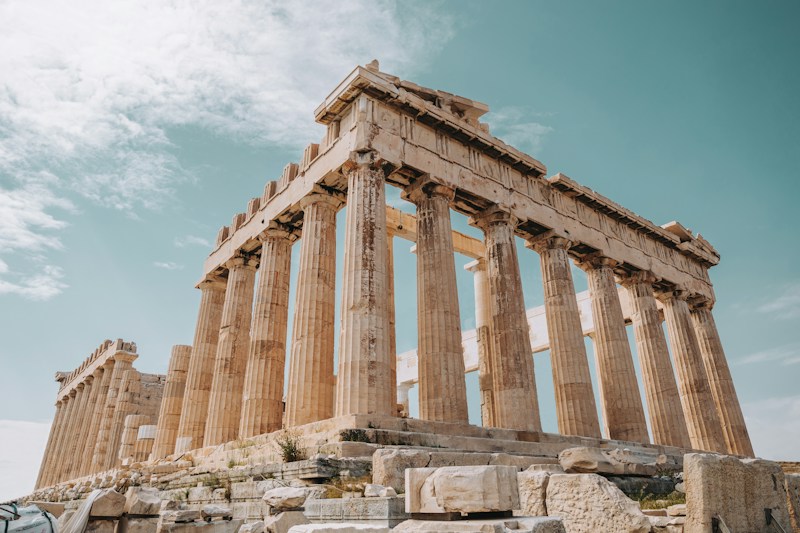
Birthplace of the Olympic Games, with Temple of Zeus, ancient stadium and outstanding museum.
Ancient Olympia occupies a sacred valley in the western Peloponnese region of Greece, where the Alpheios and Kladeos rivers meet beneath forested slopes. The site served as the religious and athletic heart of the ancient Greek world for over a millennium, hosting the Olympic Games every four years from 776 BC until AD 393. The Temple of Zeus, built around 460 BC, once housed the Chryselephantine statue of Zeus — one of the Seven Wonders of the Ancient World. Seventeen enormous fallen Doric columns still define the precinct, their drums toppled by earthquakes, giving the sanctuary an atmosphere of immense but weathered grandeur. The Heraion, older still and largely intact in its lower sections, dates to approximately 600 BC. The ancient Stadium — entered through the vaulted tunnel that athletes once used — accommodated up to 45,000 spectators on grass embankments; visitors can walk the 192-metre track and stand at the original starting and finishing stones. The Gymnasium and Palaestra training grounds complete the athletic precinct and remain evocative open-air spaces. The Archaeological Museum of Olympia, set just outside the sacred enclosure, is considered one of the finest in Greece. Its centrepiece is the reconstructed pediment sculpture from the Temple of Zeus, flanked by the Hermes of Praxiteles and the Nike of Paionios. A combined ticket (€12) covers both the open-air site and the museum. A full visit typically takes three to four hours. Early-morning arrivals from 8 am enjoy cooler temperatures and smaller crowds before tour coaches begin arriving around 10 am. The site is partially shaded but the open central sanctuary becomes very hot in July and August; late afternoon visits offer better light for photography of the column drums. The modern village of Olympia is five minutes from the main entrance and offers cafés and shops for a break.
| Admission | €12 / ~$13 USD |
|---|---|
| Hours | Daily 08:00–20:00 (summer); 08:00–15:00 (winter Oct–Mar). Museum: same hours, closed Tuesday. |
| Typical visit | 3–4 hours |
| Address | Ancient Olympia Archaeological Site, Archaia Olympia 270 65, Greece |
Location
Ancient Olympia Archaeological Site, Archaia Olympia 270 65, Greece
Highlights
- Walk through the vaulted athlete's tunnel into the ancient Olympic Stadium with original starting and finishing stones
- Examine seventeen toppled column drums from the Temple of Zeus, once home to a Wonder of the Ancient World
- See the Hermes of Praxiteles and Nike of Paionios in the renowned on-site Archaeological Museum
- Stand at the Altar of Hera where the Olympic torch is still ceremonially lit for each modern Games
- Explore the Gymnasium and Palaestra training grounds used by athletes across twelve centuries
Tips for visiting
- Arrive by 8 am when the gates open to beat tour groups that typically arrive from 10 am onwards
- Buy the combined ticket (€12) covering both the archaeological site and museum — the museum alone warrants 90 minutes
- Wear sturdy shoes; the site paths are compacted gravel and uneven, and the museum floors are polished marble
- Bring water and sun protection — there is little shade in the main sanctuary during summer months
- Greek state museums and archaeological sites offer free admission on the first Sunday of each month from November through March
When to visit
Spring (April–May) and autumn (September–October) offer the best conditions — cooler temperatures, fewer crowds, and lush surroundings. Arrive at opening (8 am) in summer to avoid the worst heat and the coach-tour rush that builds after 10 am.
Accessibility
The main sanctuary paths are compacted gravel and partially navigable by wheelchair, though some areas have uneven terrain. The Archaeological Museum has level access and ramps. The open site is very exposed to heat in summer, which can be a significant challenge for visitors with mobility limitations.
Visit, book or contact
Frequently asked questions
How long does a visit to Ancient Olympia take?
A thorough visit covering both the archaeological site and the Archaeological Museum typically takes 3–4 hours. Budget at least 90 minutes for the museum alone if interested in the sculpture collections.
Is photography allowed at Ancient Olympia?
Photography is permitted throughout the open-air site. Inside the Archaeological Museum, photography without flash is generally allowed for personal use, though tripods are not permitted.
Is Ancient Olympia suitable for children?
Yes — children find the ancient stadium particularly engaging and can run on the original track. The museum's large dramatic sculptures are accessible to young visitors. The site is extensive, so bring water and snacks for younger children.
Are guided tours available on site?
Licensed guides can be arranged through local agencies in the village of Olympia. Audio guides are available for hire at the museum entrance and are recommended for independent visitors wanting historical context.