Guadeloupe is an overseas department and region of France in the Caribbean, shaped like a butterfly formed by two main islands — volcanic Basse-Terre to the west and coral-limestone Grande-Terre to the east — connected by a narrow channel crossed by the Rivière Salée. Together with outer islands Les Saintes, Marie-Galante, and La Désirade, it offers volcanic hikes, world-class snorkeling, rum distillery tours, and sun-drenched beaches, all wrapped in an authentically French Caribbean culture.
Guadeloupe rewards travellers who want more than a single beach scene. Basse-Terre rises to La Soufrière, an active stratovolcano at 1,467 m (4,813 ft), surrounded by a national park with waterfalls, hot springs, and emerald rainforest. Grande-Terre delivers the postcard Caribbean: turquoise lagoons, powdery white-sand beaches from Saint-François to Sainte-Anne, and the lively port city of Pointe-à-Pitre with its lively market and the award-winning MÉMORIAL ACTe museum on the history of slavery. Offshore, Les Saintes (Îles des Saintes) form a cluster of tiny islands with an almost Mediterranean feel — bougainvillea lanes, red-roofed cottages, and snorkelling over the Cousteau Marine Reserve near Malendure. Marie-Galante moves at a slower pace, with ox-cart sugar cane farms and three traditional rum distilleries still open for tasting visits. Rum is fundamental to the island identity: Guadeloupe's rhum agricole (made from fresh cane juice) carries an AOC designation, and producers like Bologne, Damoiseau, and Longueteau welcome visitors. Creole cuisine fuses French technique with African spice: accras de morue (salt-cod fritters), boudin créole, colombo de poulet (chicken curry), and fresh lobster grilled over coals. French is universal; Guadeloupean Creole is widely spoken and lends the islands a warm, musical cadence. As an integral French département, Guadeloupe uses the euro, operates under French law, and European health standards apply throughout. Roads are good, petrol stations numerous, and rental cars widely available at Pointe-à-Pitre International Airport (PTP).
Capital
Basse-Terre
Largest city
Les Abymes
Population
395,000
Languages
French (official), Guadeloupean Creole
Currency
Euro (EUR, €)
Time zone
AST — Atlantic Standard Time (UTC-4), no daylight saving
The 22 destinations our editors recommend — from iconic landmarks to under-the-radar finds.
La Soufrière Volcano
La Soufrière is an active stratovolcano rising to about 1,467 metres, the highest point in the Lesser Antilles and the dominant feature of Basse-Terre's interior. It last had a significant eruptive phase in 1976, which forced a temporary evacuation of the surrounding area, and it remains monitored for volcanic activity today. The standard route from the Savane à Mulets parking area is a hike up bare volcanic ground past steaming fumaroles to the crater rim.
MÉMORIAL ACTe
MÉMORIAL ACTe is a large memorial and museum built on the site of a former sugar factory in Pointe-à-Pitre, dedicated to the history of slavery and the slave trade in the Caribbean and the wider Atlantic world. Its permanent exhibition traces the transatlantic slave trade, plantation society in Guadeloupe, and the long path to abolition and civil rights, using a mix of artifacts, film, and interpretive displays. The building itself, with its dark latticed facade evoking the roots of a silk-cotton tree, is a landmark on the Pointe-à-Pitre waterfront.
Les Saintes (Îles des Saintes)
Les Saintes is a small archipelago off the southern tip of Basse-Terre, reached by ferry, with Terre-de-Haut as the main inhabited island. The islands were settled by Breton and Norman fishing families rather than through the plantation economy that shaped the rest of Guadeloupe, which gives the villages a different architectural and cultural feel. Terre-de-Haut's main village is compact enough to explore on foot or by rented golf cart, with Fort Napoléon overlooking the bay.
Grande Anse de Deshaies
Grande Anse is a long stretch of golden sand backed by palm and sea grape trees on Basse-Terre's northwest coast, near the village of Deshaies. It is one of the largest beaches in Guadeloupe and known for calm, swimmable water for most of its length, making it popular with both visitors and locals. The northern end near the rocks tends to have more shade and slightly more surf.
Réserve Cousteau / Îlet Pigeon
The Réserve Cousteau is a protected marine area off Malendure beach surrounding the Pigeon Islets, named for Jacques Cousteau, who rated the site among the world's best diving spots after filming here in the 1970s. The reserve protects coral formations and reef fish in relatively shallow water, which makes it accessible to snorkellers as well as divers. Boats and glass-bottom boats run regularly from Malendure beach out to the islets for those who want to explore beyond swimming distance from shore.
Chutes du Carbet
The Chutes du Carbet are three waterfalls cascading down the eastern slopes of the Carbet mountains within Guadeloupe's national park, with the first fall recognized as one of the tallest in the Caribbean. Each fall has a different access difficulty: the second fall is reached by a well-maintained path suited to most visitors, while the first and third require longer, more demanding hikes. The falls feed the Carbet river and sit within dense rainforest that stays wet and green year-round.
Recommended itineraries
Pick a length, follow the route. Each itinerary balances headline sights with breathing room.
5-Day Guadeloupe Explorer
Day 1Arrive in Guadeloupe, explore city center
Day 2Visit top attractions and museums
Day 3Day trip to nearby highlights
Day 4Local markets and hidden gems
Day 5Final sightseeing, departure
7-Day Classic Guadeloupe
Days 1-2Guadeloupe city highlights
Days 3-4Regional exploration
Days 5-6Cultural immersion and local experiences
Day 7Return and departure
14-Day Ultimate Guadeloupe
Days 1-3Guadeloupe comprehensive city tour
Days 4-6Northern region exploration
Days 7-9Eastern highlights
Days 10-12Southern attractions
Days 13-14Return to Guadeloupe, departure
Where to stay in Guadeloupe
Three tiers, every traveller covered — from cost-conscious to flagship hotels.
Budget €90–€120 (~$97–$130)
Hostels, budget hotels, and guesthouses offer affordable stays without sacrificing experience.
Mid-range €150–€220 (~$162–$238)
Boutique hotels and well-located accommodations provide comfort and convenience at reasonable prices.
Luxury €300–€600+ (~$324–$648+)
World-class resorts and premium hotels deliver unforgettable experiences.
Cafés, neighbourhood gems, and tasting menus worth the table reservation.
Le Karacoli
Creole seafood · €20–€40 main (~$22–$43)
One of the oldest beach restaurants on Grande Anse, set right on the sand under sea grape trees with tables spilling out toward the water. The kitchen works a straightforward Creole seafood register, grilling the day's catch and lobster over charcoal, and the pace is unhurried rather than polished.
La Canne à Sucre
French-Creole gastronomic · €35–€65 main (~$38–$70)
Chez Yvette
Traditional Creole · €12–€22 main (~$13–$24)
Le Rocher de Malendure
French-Creole seafood · €15–€30 main (~$16–$32)
Perched on the rocky outcrop above Malendure beach, the jumping-off point for boat trips to the Cousteau reserve and Pigeon Island, this spot pairs a French-Creole seafood menu with a direct view over the dive boats and snorkelers below. Fish comes straight off the grill, and the cooking stays simple rather than composed.
Restaurant La Toubana
Contemporary French-Creole · €30–€60 main (~$32–$65)
The restaurant of La Toubana Hotel sits on a bluff above Sainte-Anne with an open view over the bay toward Marie-Galante, and the cooking is contemporary French-Creole rather than strictly traditional, built around fish and seafood with refined plating. The dining room and terrace are designed around that sunset view.
L'Amarante
French-Creole · €30–€55 main (~$32–$59)
Housed within the Auberge de la Vieille Tour, a hotel built around a restored 19th-century sugar mill in Le Gosier, this is a formal French-Creole dining room that leans on the estate's colonial-era architecture as much as the food. The menu favors lobster and other local seafood prepared with classic French technique.
Renting a car is essential for exploring Guadeloupe fully — the island road network is good on both Basse-Terre and Grande-Terre. Public buses (Karujet) run along main routes but schedules are irregular. The main airport is Pointe-à-Pitre International (PTP), also called Pôle Caraïbes, about 3 km from the city centre.
Budget breakdown
Daily spend by tier in EUR, broken out by category.
Category
Budget
Mid-range
Luxury
Accommodation
€30–€60 (~$32–$65)
€80–€130 (~$86–$140)
€180–€400 (~$194–$432)
Food (per day)
€25–€40 (~$27–$43)
€40–€60 (~$43–$65)
€60–€100 (~$65–$108)
Transportation
€15–€25 (~$16–$27)
€20–€35 (~$22–$38)
€40–€80 (~$43–$86)
Activities
€10–€20 (~$11–$22)
€20–€40 (~$22–$43)
€40–€80 (~$43–$86)
Daily total
€90–€120 (~$97–$130)
€150–€220 (~$162–$238)
€300–€600+ (~$324–$648+)
Best time to visit Guadeloupe
Weather through the year in France
Best timeShoulderWorth avoiding
Average daytime temperature in °C. Figures are for France.
The dry season (carême) runs December–May with sunny skies and low humidity. June–November is the wet season (hivernage); heavy showers are common but usually pass quickly. Hurricane risk peaks August–October — purchase travel insurance that covers hurricane cancellations if visiting during this period.
Essential travel tips
Guadeloupe uses the euro — ATMs (distributeurs automatiques) widely available in Pointe-à-Pitre, Le Gosier, Sainte-Anne, Saint-François, and Basse-Terre; carry cash for smaller restaurants and market vendors
Renting a car at Pointe-à-Pitre airport (Europcar, Avis, Hertz, Sixt from €40/day) is by far the best way to explore both islands — public bus coverage is limited
The Karujet hydrofoil ferry connects Pointe-à-Pitre to Les Saintes (~45 min, €24 return) and Marie-Galante (~45 min, €26 return) multiple times daily; book at karujet.com
La Soufrière summit trail (starting from Savane à Mulets parking, altitude 1,142 m) takes 2–3 hours return and requires no guide in dry weather; trail can be closed during eruption phases — check ONF at 0590-41-55-58
Guadeloupe rum distilleries welcome visitors with free or low-cost tours: Distillerie Bologne in Basse-Terre open Mon–Fri 08:00–12:00, 14:00–17:00; Domaine de Damoiseau in Le Moule open Mon–Fri 08:00–17:00, Sat 09:00–12:00
French is the official language; Creole is widely spoken — greetings in Creole (Bonjou, Mèsi) are warmly received
Tipping is not obligatory (service is included under French law) but rounding up or leaving €1–2 is appreciated at restaurants
Best time to visit: December to April (dry season, lower humidity, calm seas); avoid August–October peak hurricane risk
Hidden gems
Off-the-beaten-path corners most travellers miss.
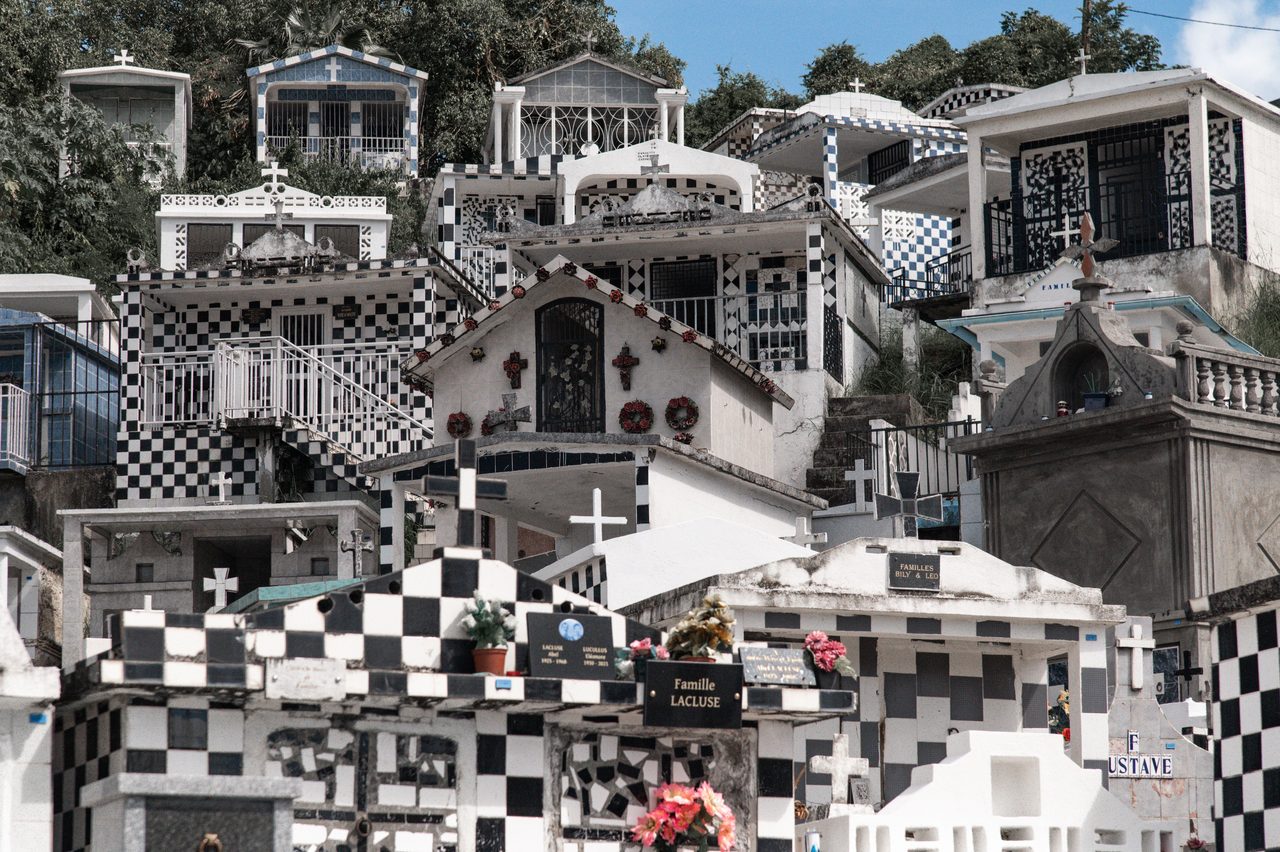
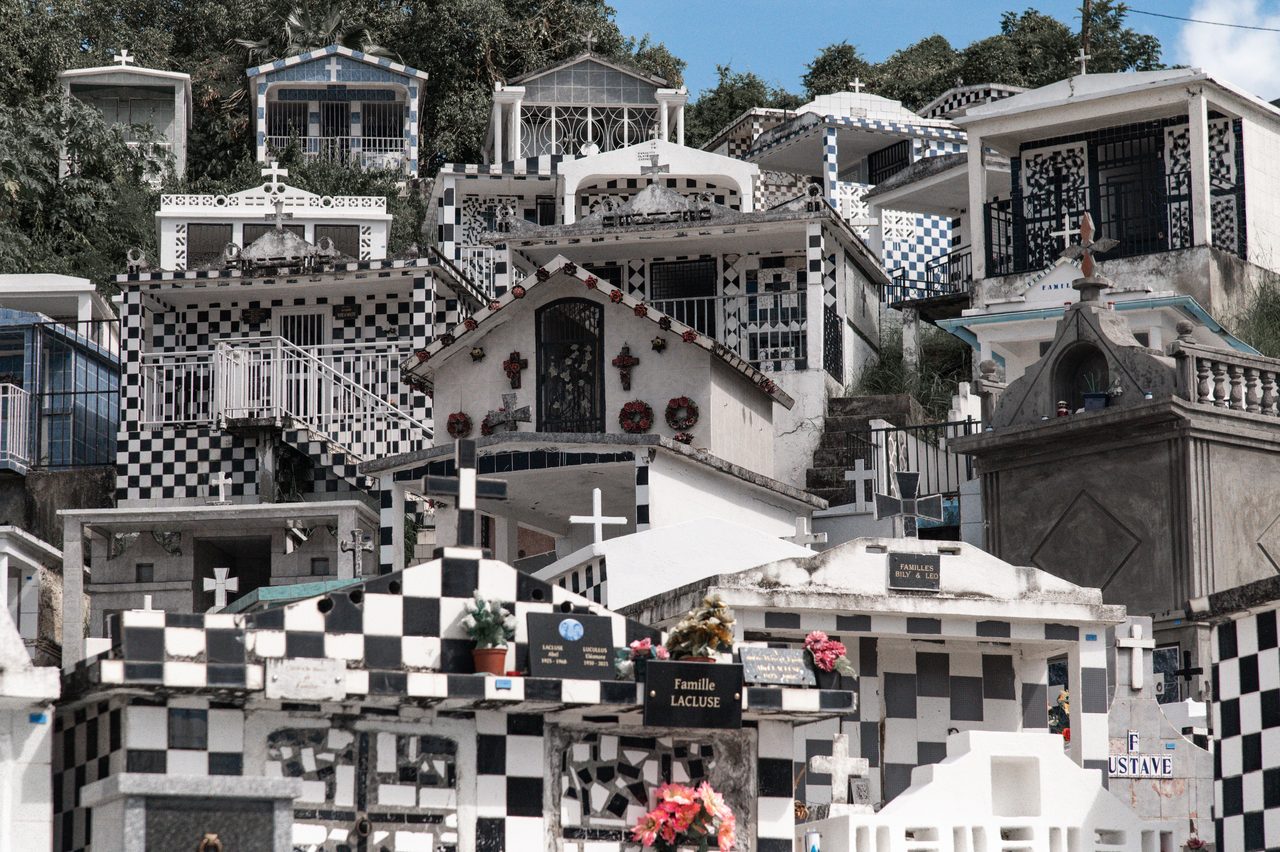
Morne-à-l'Eau Cemetery
A striking checkerboard cemetery covering a hillside with black-and-white geometric tombs — one of the Caribbean's most photogenic and moving burial grounds, especially at dusk.
Morne-à-l'Eau, Grande-Terre
Cascade aux Écrevisses
A beautiful waterfall tumbling into a natural freshwater pool in the heart of the Guadeloupe National Park — easily accessible with a 10-minute walk from the N1 road.
Pointe-Noire road, Basse-Terre
Pointe des Châteaux
The dramatic eastern tip of Grande-Terre where Caribbean and Atlantic seas collide around wind-eroded limestone cliffs. A large cross marks the headland with panoramic views toward La Désirade.
Eastern tip of Grande-Terre
Marie-Galante Rum Trail
The 'Island of 100 Windmills' hosts three active traditional distilleries — Bielle, Capesterre, and Père Labat — all open for tours and tastings within a short drive of each other.
Marie-Galante island
Safety information
INFO
Use DEET insect repellent — dengue fever is present year-round; no prophylaxis required but use repellent consistently
INFO
Do not leave valuables visible in rental cars, especially at trailheads on Basse-Terre
INFO
Swim only at supervised beaches during the day — Atlantic-facing beaches on Grande-Terre have strong rip currents
INFO
Monitor hurricane forecasts June through November via meteo.gp (Météo-France Guadeloupe) or weather.gov
The main hospital is CHU de Pointe-à-Pitre / Les Abymes: +590 590 89 10 10
INFO
Tap water is safe to drink throughout Guadeloupe
Frequently asked questions
Is Guadeloupe safe to visit in 2026?
Guadeloupe is considered safe for tourists by regional Caribbean standards. Resort areas in Le Gosier, Sainte-Anne, Saint-François, Deshaies, and Bouillante have very low crime rates. Pointe-à-Pitre city centre and parts of Les Abymes warrant more caution, particularly after dark. Exercise the same
What is the best time to visit Guadeloupe?
The best time to visit Guadeloupe is December to April. Guadeloupe has a tropical maritime climate moderated by trade winds. Two seasons define the year: the dry season (carême) from December to May, and the wet season (hivernage) from June to November, wh
Do I need a visa to visit Guadeloupe?
US citizens may enter visa-free for up to 90 days as Guadeloupe is an integral part of France and the EU. EU/Schengen passport holders enter freely. A valid passport is required; national ID cards accepted for EU citizens. No entry tax. Confirm return or onward flight at check-in. Requirements vary by nationality, so check with your nearest embassy or the official immigration website before traveling.
What currency is used in Guadeloupe?
The currency in Guadeloupe is the Euro (EUR, €) (EUR). ATMs are widely available in cities and tourist areas. Credit cards are accepted at most hotels and restaurants, but carry cash for markets and smaller establishments.
What language is spoken in Guadeloupe?
The main language(s) spoken in Guadeloupe: French (official), Guadeloupean Creole. In tourist areas, English is generally understood. Learning a few basic phrases in the local language is appreciated by locals.
What are the top attractions in Guadeloupe?
The top attractions in Guadeloupe include La Soufrière Volcano, MÉMORIAL ACTe, Les Saintes (Îles des Saintes), Grande Anse de Deshaies, and Réserve Cousteau / Îlet Pigeon. Each offers a unique experience, from historic landmarks to natural wonders.