
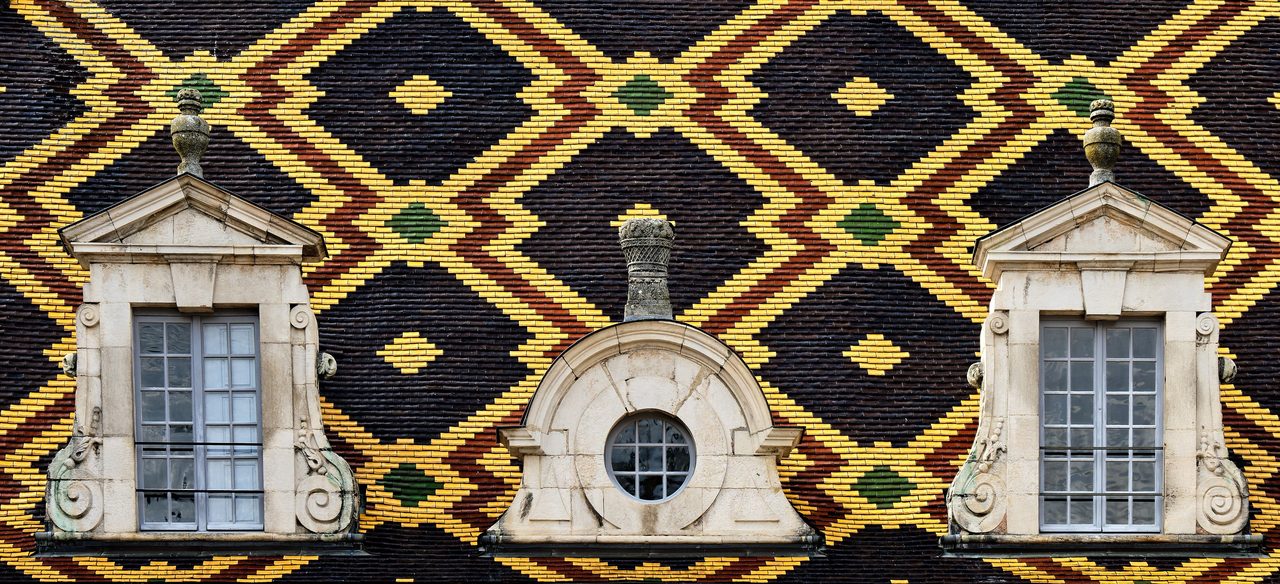
The Hospices de Beaune, also known as the Hôtel-Dieu, stands as one of the finest examples of Flemish-Burgundian Gothic architecture in France. Founded in 1443 by Nicolas Rolin, Chancellor of Burgundy, this former charitable hospital in Bourgogne-Franche-Comté served the poor and sick of Beaune for over five centuries. Visitors enter through a grand courtyard overlooked by the building's most iconic feature: steeply pitched roofs clad in polychrome glazed tiles arranged in geometric diamond patterns of gold, red, black, and green — a motif that has become synonymous with Burgundy itself. Inside, the Grande Salle des Pôvres (Great Hall of the Poor) preserves its original 15th-century oak barrel-vaulted ceiling and a long row of canopied beds where patients once lay, still furnished as they would have appeared in the medieval period. The Sursalle, or pharmacy wing, displays an extraordinary collection of apothecary jars and medical instruments illustrating five centuries of hospital practice. The visit culminates in the Salle du Polyptyque, which houses Rogier van der Weyden's masterwork, the Last Judgement polyptych — a large altarpiece commissioned around 1445 that unfolds to reveal vivid panels depicting the weighing of souls. A full visit takes 1.5 to 2 hours. The complex is busiest in late October and November during the internationally renowned Hospices de Beaune wine auction, which raises funds for the institution and sets benchmark prices for Burgundy wines. Mornings on weekdays offer the calmest atmosphere. The courtyard can be glimpsed briefly from outside but the interior requires a ticket.
Highlights
- Polychrome glazed tile roofs in diamond patterns — the defining symbol of Burgundian architecture
- Grande Salle des Pôvres with 15th-century barrel-vaulted ceiling and period-furnished patient beds
- Rogier van der Weyden's Last Judgement polyptych, one of the masterpieces of Flemish painting
- Medieval pharmacy collection with apothecary jars spanning five centuries
- Annual Hospices de Beaune wine auction, a global benchmark for Burgundy grand crus
Tips for visiting
- Buy tickets online in advance, especially in summer and during the November wine auction weekend when queues are long.
- Audio guides provide essential context for the polyptych and the Grande Salle.
- The courtyard interior is only accessible with a ticket — the rooftop cannot be admired from inside for free.
- Combine with Beaune's rampart walk and the town's wine négociant caves for a full day.
- Arrive before 10:00 on weekdays for the thinnest crowds; avoid late afternoon when tour groups concentrate.
When to visit
Visit between April and June or in September for mild weather and manageable crowd levels. Avoid the third weekend of November when the town fills for the famous wine auction. Weekday mornings offer the quietest experience year-round.
Accessibility
The ground floor and main courtyard are accessible to wheelchair users. The Grande Salle des Pôvres is on the ground floor and fully reachable. Some upper-level areas may have steps and limited lift access. The entrance on Place de la Halle has a smooth threshold.
Visit, book or contact
Frequently asked questions
How long does a visit to the Hospices de Beaune take?
Most visitors spend 1.5 to 2 hours inside. Allow extra time if reading the detailed panels describing the Last Judgement polyptych.
Is the Hospices de Beaune worth visiting for children?
Children engaged by medieval history will enjoy the period-furnished hospital ward. The Last Judgement altarpiece with its vivid depictions of heaven and hell often captivates older children. The site is not a hands-on museum, so younger children may find it less engaging.
Is photography allowed inside the Hospices de Beaune?
Photography for personal use is generally permitted in most areas of the museum, including the Grande Salle. Flash photography and tripods are typically restricted near the polyptych — check with staff on arrival.