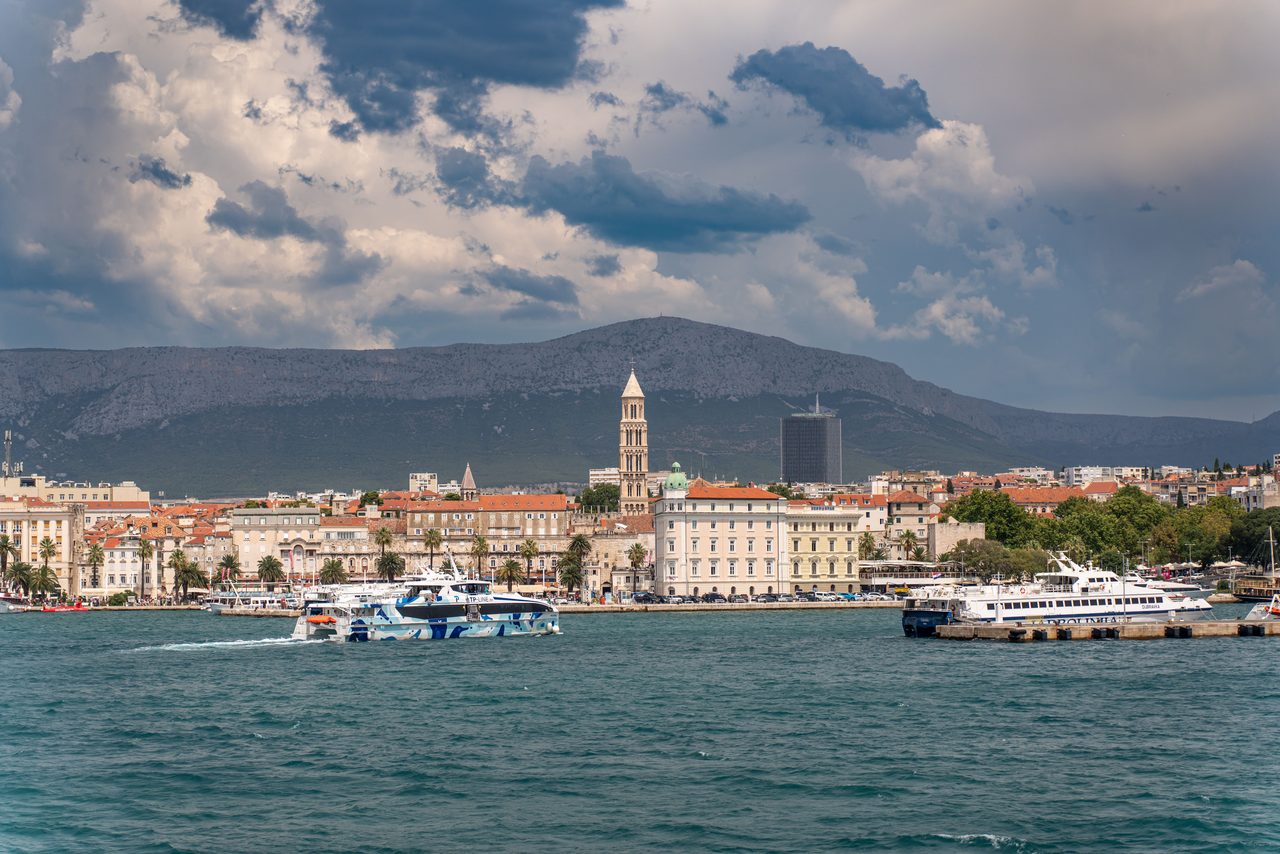
Split is Croatia's second-largest city and the beating heart of the Dalmatian coast. Built around and inside a UNESCO-listed Roman emperor's retirement palace, it is one of Europe's most remarkable urban sites: people live, work and party within walls raised by Diocletian in 305 AD. Sun-bleached limestone alleys open onto a grand seafront promenade, beaches lie a short walk from Roman columns, and ferries depart daily for the island playgrounds of Hvar, Brač and Vis. With Croatia's adoption of the Euro in January 2023 and the Schengen Area in the same month, Split is easier and cheaper to reach and navigate than ever.
Capital
Zagreb (national capital); Split is regional capital of Split-Dalmatia County
Largest city
Split
Population
170000
Languages
Croatian (official); English widely spoken in tourist areas
Currency
Euro (EUR, €) — Croatia adopted the euro on 1 January 2023
The 21 destinations our editors recommend — from iconic landmarks to under-the-radar finds.
Diocletian's Palace
This is the Roman emperor's retirement compound from around 305 AD, and unlike most ruins it was never abandoned - the old walls now contain apartments, shops, bars, and the cathedral, with the modern city built into and around the ancient structure. Walking through the Bronze Gate from the waterfront puts you directly into the substructure halls, and the Peristyle square sits at its center. It functions as Split's living downtown, not a fenced-off site.
Cathedral of Saint Domnius (Katedrala Sv. Duje)
Originally built as Diocletian's own mausoleum, this octagonal structure was converted into a Christian cathedral centuries after his death, making it one of the oldest buildings in the world still used for its (adapted) religious purpose. The interior is compact and dark, ringed by a colonnade of granite columns brought from Egypt, with a carved wooden door and a domed ceiling that still shows traces of the original Roman construction. The bell tower rises above it as a much later Romanesque-Gothic addition.
Peristyle (Peristil)
This sunken colonnaded courtyard was the ceremonial entrance to Diocletian's private quarters, where the emperor would have appeared to subjects gathered below. Red granite columns and an entablature with sphinxes frame the space, and the cathedral bell tower now rises directly behind it, creating the most photographed junction of ancient and later construction in the palace. It's still an open public square today, not a roped-off monument.
Meštrović Gallery (Galerija Meštrović)
This museum occupies the seaside villa that sculptor Ivan Meštrović designed and built as his own home and studio in the 1930s, and it now holds the largest collection of his work anywhere. The rooms are arranged much as a residence rather than a conventional gallery, with large-scale marble, wood, and bronze figures set against sea-facing windows and a garden of outdoor sculptures. Meštrović is Croatia's best-known modern sculptor, and this is the primary place to see the range of his output in one place.
Marjan Hill Forest Park
This forested peninsula rises directly behind Split's old town and has functioned as the city's green escape since medieval times, when it was already referenced as parkland. Paths wind up through pine woods past small stone chapels, climbing walls, and lookout points, with the developed western tip giving way to quieter trails further out. It's used constantly by residents for running and walking, not just visitors.
Riva Promenade
This palm-lined waterfront strip runs along the harbor side of the old town, directly outside the palace's former sea gate, and functions as Split's main public gathering space. Cafés and bars line the inland side under arcaded buildings, while the water side is kept open for walking, with ferries and boats docked just beyond. It's where the city actually socializes - locals use it for an evening walk (korzo) as much as tourists use it for photos.
Recommended itineraries
Pick a length, follow the route. Each itinerary balances headline sights with breathing room.
5-Day Split Explorer
Day 1Arrive in Split, explore city center
Day 2Visit top attractions and museums
Day 3Day trip to nearby highlights
Day 4Local markets and hidden gems
Day 5Final sightseeing, departure
7-Day Classic Split
Days 1-2Split city highlights
Days 3-4Regional exploration
Days 5-6Cultural immersion and local experiences
Day 7Return and departure
14-Day Ultimate Split
Days 1-3Split comprehensive city tour
Days 4-6Northern region exploration
Days 7-9Eastern highlights
Days 10-12Southern attractions
Days 13-14Return to Split, departure
Where to stay in Split
Three tiers, every traveller covered — from cost-conscious to flagship hotels.
Budget €50–€90/day (~$55–$99)
Hostels, budget hotels, and guesthouses offer affordable stays without sacrificing experience.
Mid-range €140–€280/day (~$154–$308)
Boutique hotels and well-located accommodations provide comfort and convenience at reasonable prices.
Luxury €360–€810/day (~$396–$891)
World-class resorts and premium hotels deliver unforgettable experiences.
Radisson Blu Resort Split
Put Trstenika 19, Split · €250–€500/night (~$275–$550)
Nostromo sits above Split's covered fish market (Ribarnica) just off the Riva, and the kitchen leans on that proximity — whatever came off the boats that morning is what you're eating. The cooking is simple and fish-forward rather than heavily sauced, built around grilling and letting the catch speak for itself, served in a modern dining room with an open display of the day's fish.
Bokeria Kitchen and Wine Bar
Modern Croatian · €€€ (€30–€55/person, ~$33–$60)
Bokeria pairs a modern Croatian menu with a wine list built around small Dalmatian and Croatian producers, in a sleek space that reads more contemporary wine bar than traditional konoba. Dishes take classic ingredients like peka lamb or local cheese and plate them in a more composed, restaurant style rather than home-style portions.
Zinfandel Food & Wine Bar
Modern Mediterranean · €€€ (€25–€50/person, ~$28–$55)
Fife
Traditional Dalmatian · €€ (€12–€22/person, ~$13–$24)
Fife is a longtime Split institution on the western waterfront, the kind of konoba where office workers and fishermen have eaten alongside tourists for decades. The food is unfussy home-style Dalmatian cooking — braises, grilled meats, simple sides — served at close-set tables in a room that hasn't been redesigned to look the part; it just is the part.
Konoba Fetivi
Dalmatian home cooking · €€ (€15–€28/person, ~$17–$31)
Restaurant Sperun
Dalmatian seafood · €€ (€18–€35/person, ~$20–$38)
Sperun occupies a tight stone-walled space on a narrow street near the Riva, serving Dalmatian seafood and grilled dishes in a format that's more sit-down restaurant than tavern. It draws heavily from the old town's tourist foot traffic, which has pushed the menu toward reliable, familiar renditions of regional standards rather than anything experimental.
Split is served by Split Airport (SPU), 24km north of the city. The city center is compact and walkable; ferries connect to Dalmatian islands; intercity buses serve the coast; the Bolt and Uber apps work for taxis.
Budget breakdown
Daily spend by tier in EUR, broken out by category.
Category
Budget
Mid-range
Luxury
Accommodation
€20–€35/night (~$22–$38)
€80–€160/night (~$88–$176)
€200–€500/night (~$220–$550)
Food (per day)
€15–€25/day (~$17–$28)
€30–€60/day (~$33–$66)
€80–€150/day (~$88–$165)
Transportation
€5–€10/day (~$6–$11)
€10–€20/day (~$11–$22)
€30–€60/day (~$33–$66)
Activities
€10–€20/day (~$11–$22)
€20–€40/day (~$22–$44)
€50–€100/day (~$55–$110)
Daily total
€50–€90/day (~$55–$99)
€140–€280/day (~$154–$308)
€360–€810/day (~$396–$891)
Best time to visit Split
Weather through the year in Croatia
Best timeShoulderWorth avoiding
Average daytime temperature in °C. Figures are for Croatia.
May–June and September–October for warm weather without peak crowds and prices.
June offers near-perfect beach weather, long daylight hours and festival atmosphere without August's intensity. September is arguably the best month: sea still warm from summer, crowds thinned, locals return to normal life.
Essential travel tips
Diocletian's Palace is free to enter and explore at any hour — the palace walls are a neighbourhood, not a museum
Buy ferry tickets from Jadrolinija (jadrolinija.hr) in advance for peak summer; walk-on passengers can usually board outside August
The Riva café scene runs on coffee culture — 'kava' means coffee and locals linger for hours
Promet Split city buses require tickets bought at a kiosk before boarding or via the Promet app
Most restaurants in the old town are open noon–midnight; kitchens may close between 3pm and 6pm
Tipping is not mandatory but 10% is appreciated at sit-down restaurants
ATMs (bankomats) are widely available; Visa and Mastercard accepted almost everywhere
Hidden gems
Off-the-beaten-path corners most travellers miss.
Sustipan Park
A tranquil headland park at the end of a pine-lined path west of the ferry terminal, with a ruined Benedictine monastery, a small cemetery and stunning sunset views over the outer islands — almost always uncrowded.
Jupiter's Temple
A tiny but perfectly preserved Roman temple to Jupiter hidden inside Diocletian's Palace, now serving as a baptistery. Few visitors linger past the Peristyle to find it.
Bene Beach on Marjan
A rocky cove on the western tip of Marjan Hill accessible by a scenic 30-minute walk through pine forest — far quieter than Bačvice and with crystal-clear water.
Safety information
INFO
Keep valuables in front pockets or a zipped bag in the packed Peristyle area
INFO
Beware of taxi drivers at the ferry terminal who don't use meters — use Bolt or Uber instead
INFO
The sea can have strong currents outside the bay; check local conditions before swimming at exposed beaches
Split is an extremely safe destination. The EU average crime index places Croatia consistently among the safest European countries. Violent crime against tourists is virtually unheard of. The main risks are typical of any summer tourist city: pickpocketing in crowded areas, drink-spiking in clubs (r
What is the best time to visit Split?
The best time to visit Split is May–June and September–October. Split has a classic Mediterranean climate: long hot dry summers, mild winters and minimal rainfall from June through September. The city receives approximately 2,700 sunshine hours per year, more than
Do I need a visa to visit Split?
Croatia is an EU/Schengen member since 2023. EU/EEA citizens enter with a valid national ID card. Most non-EU visitors (including US, UK, Canada, Australia) may stay up to 90 days within any 180-day period without a visa under Schengen rules. Requirements vary by nationality, so check with your nearest embassy or the official immigration website before traveling.
What currency is used in Split?
The currency in Split is the Euro (EUR, €) — Croatia adopted the euro on 1 January 2023 (EUR). ATMs are widely available in cities and tourist areas. Credit cards are accepted at most hotels and restaurants, but carry cash for markets and smaller establishments.
What language is spoken in Split?
The main language(s) spoken in Split: Croatian (official); English widely spoken in tourist areas. In tourist areas, English is generally understood. Learning a few basic phrases in the local language is appreciated by locals.
What are the top attractions in Split?
The top attractions in Split include Diocletian's Palace, Cathedral of Saint Domnius (Katedrala Sv. Duje), Peristyle (Peristil), Meštrović Gallery (Galerija Meštrović), and Marjan Hill Forest Park. Each offers a unique experience, from historic landmarks to natural wonders.