
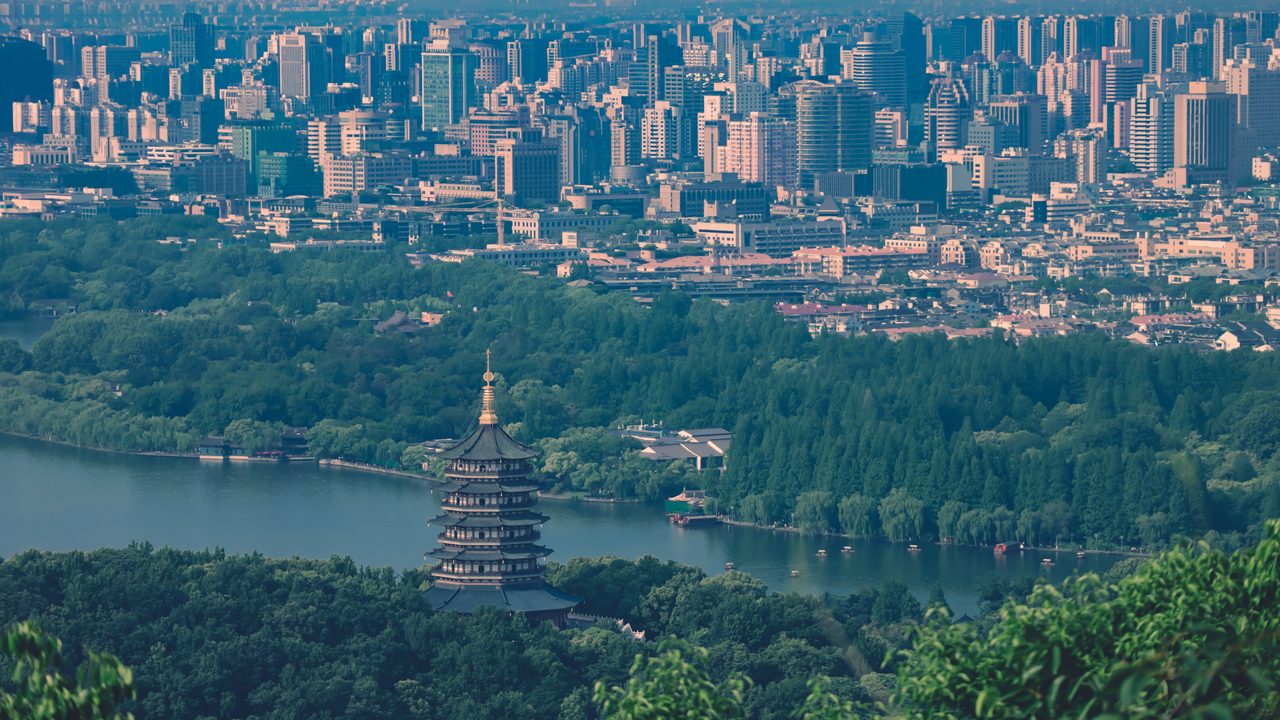
Leifeng Pagoda
Rebuilt pagoda on West Lake's south shore tied to the Legend of the White Snake, with an escalator up through the excavated original foundation.
Zhejiang · 10 Places · Best Late
Hangzhou travel guide — where to stay, what to do, and where to eat in Hangzhou, Zhejiang, China.
Hangzhou is the capital of Zhejiang province and one of China's most celebrated scenic cities, built around the UNESCO World Heritage-listed West Lake and its causeways, pagodas, and tea-covered hills. Once the capital of the Southern Song Dynasty and long praised in the saying 'above there is heaven, below there are Suzhou and Hangzhou,' the city pairs a thousand years of Jiangnan garden and tea culture with a modern identity as the headquarters of Alibaba and one of China's leading tech and e-commerce hubs. This guide covers the best hotels, attractions, restaurants, and experiences in Hangzhou.
Jump straight to the experience you're planning.
The 10 destinations our editors recommend — from iconic landmarks to under-the-radar finds.
Rebuilt pagoda on West Lake's south shore tied to the Legend of the White Snake, with an escalator up through the excavated original foundation.
Unticketed causeway on West Lake's north shore, the legendary meeting point in the Legend of the White Snake.
Willow- and peach-lined causeway across the west side of West Lake, popular for walking and cycling.
One of China's largest and wealthiest Chan (Zen) Buddhist temples, founded in 328 AD; requires a real-name reservation one day ahead.
Stream-side limestone grottoes carved with Buddhist statuary on the approach path to Lingyin Temple.
Reed-lined wetland canals toured by electric boat or on foot, home to herons and other waterbirds.
Pick a length, follow the route. Each itinerary balances headline sights with breathing room.
Three tiers, every traveller covered — from cost-conscious to flagship hotels.
Hostels, budget hotels, and guesthouses offer affordable stays without sacrificing experience.
Boutique hotels and well-located accommodations provide comfort and convenience at reasonable prices.
World-class resorts and premium hotels deliver unforgettable experiences.
Cafés, neighbourhood gems, and tasting menus worth the table reservation.
Louwailou is Hangzhou's best-known historic restaurant, tracing its name back to a Southern Song-era poem and operating on the Gushan Road site since the 19th century, looking out over West Lake near the Su Causeway. The cooking is classic Hangzhou banquet style: lightly sweetened, vinegar-forward sauces built around lake fish and local produce rather than heavy oil or chili. Dining rooms are formal and multi-floor, with the better tables facing the lake, and it draws a steady mix of tour groups and visiting officials rather than a quiet local crowd.
Zhiweiguan is a century-old Hangzhou snack institution built around steamed and pan-fried dim sum rather than a full banquet menu. It's the kind of place where you order a spread of small dishes at the counter or table and eat quickly among locals on their lunch break, with plain, canteen-style seating rather than any attempt at atmosphere. The food itself is unfussy Jiangnan snack cooking — soup-filled dumplings, cold noodle-style dishes, fried cakes — done at a volume that keeps it fresh.
Grandma's Home (Waipo Jia) is a large, popular home-style Hangzhou chain, and the Hubin Road branch sits close to the lake's eastern shore near the shopping strip, so it fills fast with both locals and visitors. The cooking is straightforward Hangzhou home cooking scaled up for a busy dining room — braised pork, vinegar fish, and stir-fried river shrimp done simply rather than as refined banquet plates. It's a big, noisy, brightly lit space built for quick turnover rather than a leisurely meal.
Operating as Kuiyuanguan, this is one of Hangzhou's oldest noodle houses, known for over a century for its noodle broths rather than banquet cooking. It's a casual, functional dining hall on Yan'an Road near the city center, where people come specifically for a bowl of noodles rather than a full meal experience, and the room reflects that — plain tables, fast service, no real decor to speak of.
Book a food tour in Hangzhou We may earn a commission from bookings made through this link.
Hangzhou runs a fast-growing metro network of more than a dozen lines connecting West Lake, Hangzhou East Railway Station, and the outer districts, backed by an extensive bus network, metered taxis, the Didi ride-hailing app, and one of the world's largest public bike-share systems, launched here in 2008. Hangzhou East Railway Station is one of China's busiest high-speed rail hubs, with frequent bullet trains reaching Shanghai in as little as 45 minutes. Hangzhou Xiaoshan International Airport (HGH) lies southeast of the city center and connects to the metro via Line 1.
Daily spend by tier in CNY, broken out by category.
| Category | Budget | Mid-range | Luxury |
|---|---|---|---|
| Accommodation | ¥80-150 (~$11.92-$22.35) in a hostel dorm or budget guesthouse near West Lake or Hangzhou East Station | ¥380-620 (~$56.63-$92.40) in a 3- to 4-star hotel near West Lake | ¥1,300-3,000 (~$193.74-$447.09) at a 5-star hotel on West Lake |
| Food (per day) | ¥45-85 (~$6.71-$12.67) eating at noodle shops, dumpling stalls, and food courts | ¥170-260 (~$25.34-$38.75) at casual restaurants and mid-range dinners, including a Hangzhou-cuisine meal | ¥450-950 (~$67.06-$141.58) at Michelin-listed restaurants, including a Hangzhou-cuisine tasting menu |
| Transportation | ¥10-20 (~$1.49-$2.98) on metro rides or a day pass | ¥50-100 (~$7.45-$14.90) including occasional taxis/Didi | ¥180-380 (~$26.83-$56.63) in private cars or business-class high-speed rail |
| Activities | ¥30-90 (~$4.47-$13.41) (most West Lake sights are free; one paid attraction such as Lingyin Temple) | ¥140-230 (~$20.86-$34.28) (Lingyin Temple, a Longjing tea tasting, or a West Lake boat ride) | ¥300-600 (~$44.71-$89.42) private tea ceremonies, private boat charters, and guided tours |
| Daily total | ¥300-430 (~$44.71-$64.08) | ¥800-1,250 (~$119.22-$186.29) | ¥2,100-4,500+ (~$312.97-$670.64+) |
Best time Shoulder Worth avoiding
Average daytime temperature in °C. Figures are for Zhejiang.
Hangzhou is best visited in late spring or autumn, when West Lake's gardens and causeways are at their most comfortable and photogenic; the hot, humid summer and the Golden Week holiday crowds in early October are the two conditions most worth planning around.
Spring brings blossoms along West Lake's causeways and the freshest Longjing tea harvest (late March-April); autumn offers clearer skies, comfortable temperatures, and osmanthus blossom scent through the old city in early-mid October.
Install a reliable VPN before arriving in China — Google, Gmail, Google Maps, WhatsApp, Instagram, Facebook, and most Western news sites are blocked without one
Carry a passport or a photocopy at all times; police can request ID checks, and airport-style security screening is required to enter the metro system daily
Set up Alipay or WeChat Pay with an international card before the trip, since much of daily life (taxis, small shops, vending machines) is effectively cashless, and Hangzhou is Alipay's home city
Save the accommodation's name and address in Chinese characters (screenshot or business card) to show taxi drivers or in case of getting lost
Decline unsolicited invitations to tea ceremonies or 'practice English' meetups from overly friendly strangers near West Lake and Hefang Street
Check the weather forecast for typhoon season (roughly July-September) — heavy rain can disrupt outdoor sightseeing and, rarely, transport schedules
Carry a light rain jacket or umbrella during the June plum-rain (meiyu) season, when sudden showers are common
Hangzhou has very low rates of violent crime and is considered one of China's safest and most prosperous major cities. The main concerns for visitors are tourist-targeted scams around West Lake and Hefang Street, such as overpriced tea-ceremony invitations, and occasional pickpocketing during Golden Week crowds. The US State Department places mainland China at Level 2: Exercise Increased Caution, citing arbitrary enforcement of local laws and exit bans rather than street-level danger; the UK FCDO advises standard precautions. Emergency services: police at 110, ambulance at 120, fire at 119.
The best time to visit Hangzhou is late March through May and late September through November, when West Lake's causeways are at their most comfortable and the fresh Longjing tea harvest (late March-April) or osmanthus blossom season (early-mid October) is underway. Summer (June-August) is hot, very humid, and starts with the meiyu 'plum rain' season of prolonged drizzle in June. Avoid the National Day Golden Week (1-7 October) if possible, as it brings the year's largest domestic crowds and highest hotel rates.
Many nationalities, including most EU countries, the UK, and Australia, can enter mainland China visa-free for up to 30 days under China's expanded unilateral visa exemption program, which applies in Hangzhou as anywhere else in the country. Travelers transiting through Hangzhou Xiaoshan International Airport to a third country can also use the 144-hour (6-day) visa-free transit policy covering the Yangtze River Delta region (Shanghai, Jiangsu, and Zhejiang) with a confirmed onward ticket. Other nationalities should apply for a visa in advance; requirements change periodically, so checking with the nearest Chinese embassy or consulate before traveling is advisable.
The currency in Hangzhou is the Renminbi (Yuan), CNY, symbol ¥. Mobile payment apps Alipay, headquartered in Hangzhou, and WeChat Pay handle the vast majority of transactions and can be linked to a foreign bank card; cash and international credit cards are accepted less widely, so setting up a mobile wallet before arrival is recommended.
The main language spoken in Hangzhou is Mandarin Chinese (Putonghua); Wu Chinese (the local Hangzhou dialect) is also spoken. English signage exists at major attractions and hotels, but English proficiency is inconsistent elsewhere, so a translation app is useful, particularly with taxi drivers and tea vendors.
The top attractions in Hangzhou center on West Lake: Lingyin Temple and the adjacent Feilai Feng grottoes, Leifeng Pagoda, the free Su Causeway and Broken Bridge, Xixi National Wetland Park, and Hefang Street's Southern Song-era shopping lane. The Longjing tea villages just southwest of the lake round out a classic first-time visit.