
Terracotta Army (Emperor Qin Shi Huang Mausoleum Site Museum)
The 8,000-strong buried army of life-size clay soldiers, chariots, and horses built to guard China's first emperor, discovered by farmers in 1974.
Shaanxi · 13 Places · Best March-May, September-November
Xi'an travel guide — where to stay, what to do, and where to eat in Xi'an, Shaanxi, China.
Xi'an is the capital of Shaanxi province and one of China's Four Great Ancient Capitals, having served as the seat of thirteen dynasties, including the Qin and Tang. It is best known worldwide as the home of the Terracotta Army, the vast buried force guarding the tomb of China's first emperor, but the city itself is ringed by one of the world's best-preserved ancient city walls and centered on a Ming-dynasty Bell Tower and Drum Tower. This guide covers the best hotels, attractions, restaurants and experiences in Xi'an.
Jump straight to the experience you're planning.
The 13 destinations our editors recommend — from iconic landmarks to under-the-radar finds.
The 8,000-strong buried army of life-size clay soldiers, chariots, and horses built to guard China's first emperor, discovered by farmers in 1974.
One of China's best-preserved ancient city walls, a 13.7-kilometer Ming-dynasty rampart that can be walked or cycled in full circuit.
Shaanxi's flagship provincial museum, holding over 370,000 artifacts spanning 1.1 million years of local history including Zhou bronzes and Tang gold.
A 64-meter Tang-dynasty Buddhist pagoda built in 652 AD to house scriptures brought back from India by the monk Xuanzang, still standing within an active temple.
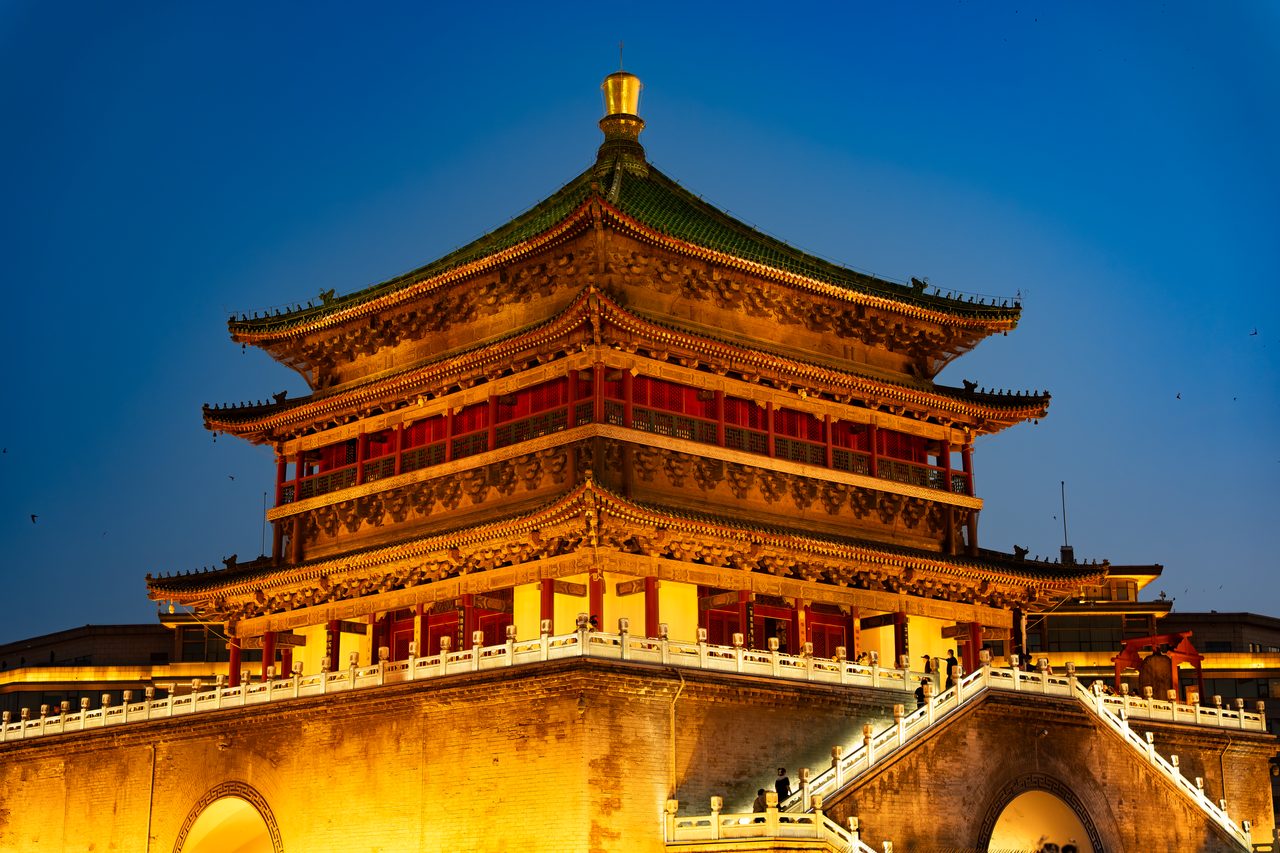
A Ming-dynasty timber tower at the exact geographic center of the old city, once used to sound the hour, now displaying replica bronze bells and Tang-dynasty artifacts.
A Ming-dynasty tower that once sounded the evening curfew, standing at the gateway to the Muslim Quarter with a collection of large drums and rotating exhibits.
Pick a length, follow the route. Each itinerary balances headline sights with breathing room.
Three tiers, every traveller covered — from cost-conscious to flagship hotels.
Hostels, budget hotels, and guesthouses offer affordable stays without sacrificing experience.
Boutique hotels and well-located accommodations provide comfort and convenience at reasonable prices.
World-class resorts and premium hotels deliver unforgettable experiences.
A landmark hotel first opened in 1953 and restored to its palace-style grandeur, set inside the City Wall a short walk from the Bell Tower; rooms from around ¥1,400/night (~$197).
Check rates on Booking.comA modern high-rise five-star tower in Xi'an's High-Tech Zone with an indoor pool and multiple dining venues; rooms from around ¥900/night (~$127).
Check rates on Booking.comA five-star hotel in Xi'an's financial and shopping district, a five-minute walk to mall and retail streets; rooms from around ¥850/night (~$120).
Check rates on Booking.comA modern flagship Ritz-Carlton tower in the High-Tech Zone with a rooftop bar overlooking the city; rooms from around ¥1,300/night (~$183).
Check rates on Booking.comCafés, neighbourhood gems, and tasting menus worth the table reservation.
The dumpling-banquet specialist at the foot of Xi'an's Bell Tower, serving 18-20 differently shaped dumplings in one seated meal.
A long-established Dong Dajie institution serving the full spread of Shaanxi classics -- paomo, biang biang noodles and guokui -- in one sit-down dining room.
Hotel-based Cantonese fine dining with a full dim sum service, roast meats and private rooms suited to business dinners.
The 1898-founded restaurant most closely associated with turning yangrou paomo into Xi'an's signature dish, so many later shops in the Muslim Quarter borrowed its name.
A 1920s-founded halal paomo house on West Street, a short walk from the Bell Tower, known for a slightly drier fried version of the classic soup.
One of Beiyuanmen's most queued-for stalls, serving thin-skinned soup dumplings packed with hot broth.
Book a food tour in Xi'an We may earn a commission from bookings made through this link.
Xi'an Xianyang International Airport sits about 45 km northwest of the city center, connected by an airport express bus network and Metro Line 14. Downtown Xi'an, largely contained within the Ming-era City Wall, is compact enough to explore on foot or by bike-share, while an expanding metro network (currently 10+ lines) and abundant taxis and ride-hailing apps make reaching outlying sites like the Terracotta Army straightforward.
Daily spend by tier in CNY, broken out by category.
| Category | Budget | Mid-range | Luxury |
|---|---|---|---|
| Accommodation | ¥70-130 (approx. $10-$18 USD) | ¥350-550 (approx. $49-$77 USD) | ¥1,100-2,600 (approx. $155-$366 USD) |
| Food (per day) | ¥45-80 (approx. $6-$11 USD) | ¥150-230 (approx. $21-$32 USD) | ¥400-800 (approx. $56-$113 USD) |
| Transportation | ¥8-18 (approx. $1-$2.50 USD) | ¥40-80 (approx. $6-$11 USD) | ¥150-350 (approx. $21-$49 USD) |
| Activities | ¥150-200 (approx. $21-$28 USD) | ¥160-250 (approx. $23-$35 USD) | ¥250-500 (approx. $35-$70 USD) |
| Daily total | ¥280-400 (approx. $39-$56 USD) | ¥700-1,100 (approx. $99-$155 USD) | ¥1,900-4,000+ (approx. $268-$564+ USD) |
Best time Shoulder Worth avoiding
Average daytime temperature in °C. Figures are for Shaanxi.
Spring and autumn bring mild, dry conditions (10-24°C / 50-75°F) and generally clear skies, ideal for walking the City Wall and visiting the Terracotta Army without excessive heat. Summer is hot and humid, frequently exceeding 33°C / 91°F, with a rainy spell in July-August. Winter is cold and can be grey with occasional smog, often dropping below freezing overnight, though snow on the City Wall and Bell Tower is a popular photo subject. Domestic travel surges during Golden Week and Chinese New Year, driving up hotel prices and crowd levels at major sites.
Install a reliable VPN before arriving in China — Google, Gmail, Google Maps, WhatsApp, Instagram, Facebook, and most Western news sites are blocked without one
Carry a passport or a photocopy at all times; police can request ID checks, and airport-style security screening is required to enter the metro system and major sites daily
Book Terracotta Army and Shaanxi History Museum tickets through the official online channel days in advance — real-name booking tied to a passport is mandatory, and on-site ticket windows have been removed
Set up Alipay or WeChat Pay with an international card before the trip, since much of daily life (taxis, small shops, vending machines) is effectively cashless
Save the accommodation's name and address in Chinese characters (screenshot or business card) to show taxi drivers or in case of getting lost
Decline unsolicited invitations to tea ceremonies, 'free' guided tours, or unofficial Terracotta Army transport from overly friendly strangers near the Bell Tower and tourist pickup points
Dress in warm layers for winter visits (temperatures regularly approach or fall below freezing December-February) and carry water and sun protection for hot, humid summer sightseeing at outdoor sites like the Terracotta Army and City Wall
Xi'an has very low rates of violent crime and is considered a safe major city for tourists. The main concerns for visitors are tourist-targeted scams near the Terracotta Army parking area and unofficial 'drivers' in the Muslim Quarter, plus occasional pickpocketing in crowded night markets. The US State Department places mainland China at Level 2: Exercise Increased Caution, citing arbitrary enforcement of local laws and exit bans rather than street-level danger; the UK FCDO advises standard precautions. Emergency services: police at 110, ambulance at 120, fire at 119.
The best time to visit Xi'an is March-May and September-November, when temperatures are mild (10-24°C / 50-75°F) and skies are generally clearer for walking the City Wall and visiting the Terracotta Army. Summer (June-August) is hot and humid, often exceeding 33°C / 91°F, with a rainy spell in July-August, while winter is cold, sometimes grey, and can dip below freezing. Avoid National Day Golden Week (October 1-7) if possible, as domestic travel surges and prices rise.
Many nationalities, including most EU countries, the UK, and Australia, can enter mainland China visa-free for up to 30 days under China's expanded unilateral visa exemption program. Travelers connecting through Xi'an Xianyang International Airport to a third country may be able to use China's 240-hour visa-free transit policy in some cases, but this should be confirmed with the airline in advance since it is less consistently available than at major hub airports. Other nationalities should apply for a visa ahead of time; requirements change periodically, so check with the nearest Chinese embassy or consulate before traveling.
The currency in Xi'an is the Renminbi (Yuan), CNY, symbol ¥. Mobile payment apps like Alipay and WeChat Pay are used for the vast majority of transactions and can be linked to a foreign bank card; cash and international credit cards are accepted less widely than in many other major cities, so setting up mobile payment before arrival is recommended.
The main language spoken in Xi'an is Mandarin Chinese (Putonghua), though many locals also speak the regional Guanzhong Mandarin dialect. English signage exists at major attractions and international hotels, but English proficiency is limited elsewhere, so a translation app is useful, especially in the Muslim Quarter and at local restaurants.
The top attractions in Xi'an include the Terracotta Army, the 13.7 km Ming-dynasty City Wall, the Muslim Quarter around Huimin Street, and the Big Wild Goose Pagoda. Each offers a distinct experience, from the buried imperial guardian army discovered in 1974 to the old city's food streets and Tang-dynasty Buddhist heritage.
Most travelers spend 2-3 full days in Xi'an: one day for the Terracotta Army and Huaqing Palace, one day for the City Wall, Bell Tower, Drum Tower, and Muslim Quarter, and an optional third day for the Shaanxi History Museum, Big Wild Goose Pagoda, and Tang Paradise. Travelers adding a Mount Hua hike should budget a full extra day for the round trip.