
Famen Temple Cultural Scenic Area
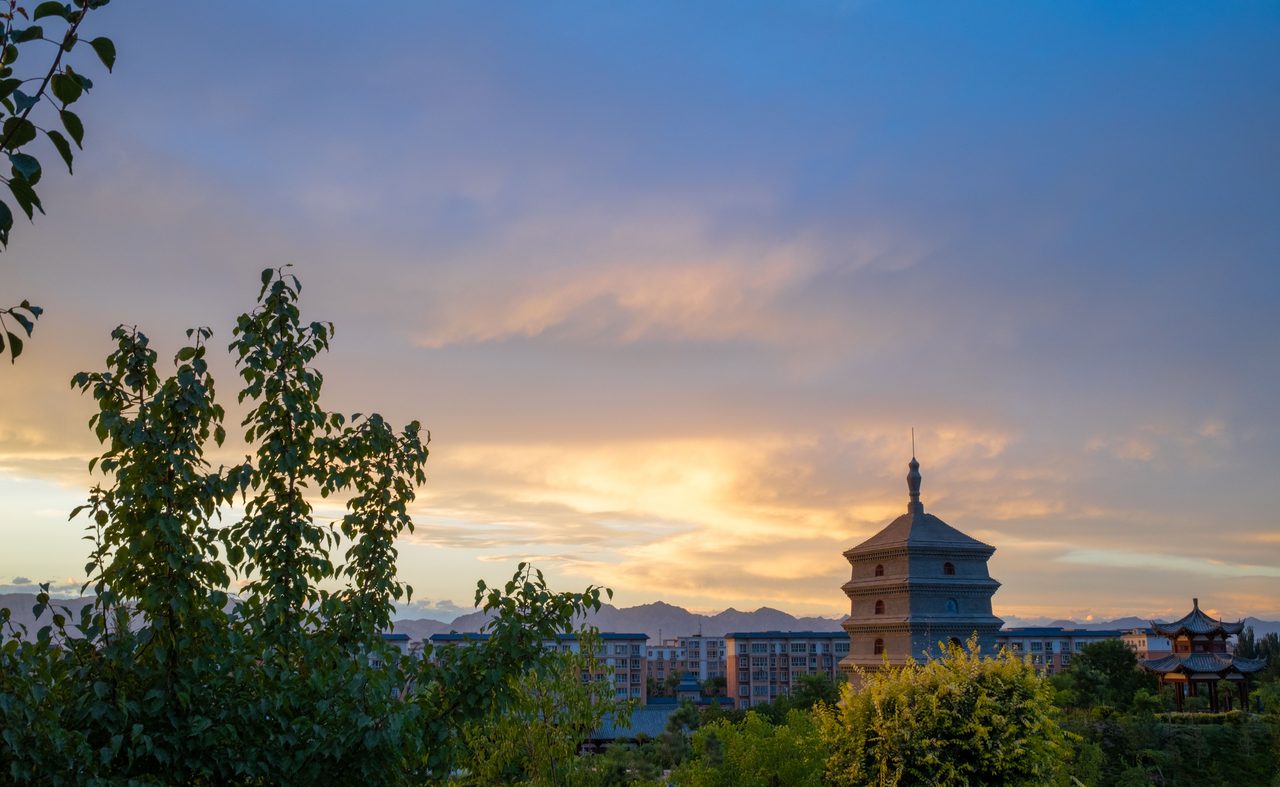
A Tang-dynasty Buddhist temple in Famen Town, Fufeng County, famous for the underground palace opened in 1987 that held a finger-bone relic of the Buddha, plus the 148 m Namaste Dagoba added in 2009.
Shaanxi · 16 Places · Best Late April-May and September-October
Baoji travel guide - where to stay, what to do, and where to eat in Baoji, Shaanxi, China.
Baoji is a prefecture-level city in western Shaanxi Province, on the Weihe River at the western end of the Guanzhong plain and the foot of the Qinling mountains. Its farmland, once called Zhouyuan, was the homeland of the Western Zhou, and nearby Yongcheng was the capital of the Qin state; the city is known as China's bronzeware hometown. Highlights include Famen Temple and its Buddha finger-bone relic, the Baoji Bronzeware Museum with the He Zun vessel, Mount Taibai (about 3,767 m, the highest peak in the Qinling range), Wuzhangyuan where Zhuge Liang died in 234 AD, Zhouyuan and the Duke of Zhou Temple, and the noodles and baijiu of the Qishan and Fengxiang area. This guide covers hotels, attractions, restaurants and practical tips for Baoji.
Jump straight to the experience you're planning.
The 16 destinations our editors recommend — from iconic landmarks to under-the-radar finds.
A Tang-dynasty Buddhist temple in Famen Town, Fufeng County, famous for the underground palace opened in 1987 that held a finger-bone relic of the Buddha, plus the 148 m Namaste Dagoba added in 2009.
China's only museum devoted to bronzes, holding the He Zun vessel with the earliest written 'Zhongguo' (China), in the Stone Drum Garden above the Weihe River; entry is free with a reservation.
The highest peak of the Qinling range (about 3,767 m) with alpine meadows, glacial lakes and a cable car; the park gate is at Tangyu Town, Mei County, south-east of Baoji.
A temple on the Wuzhang Plains where the Shu chancellor Zhuge Liang died in 234 AD during his last Northern Expedition; the plateau also has views over the Wei valley.
A site museum for the Zhouyuan plain, the homeland of the Western Zhou, showing excavated Western Zhou relics including a replica of the He Zun, near Famen Temple.
A temple complex in Qishan County honouring the Duke of Zhou, regent of the early Western Zhou, with ancient cypresses and inscribed steles.
Pick a length, follow the route. Each itinerary balances headline sights with breathing room.
Three tiers, every traveller covered — from cost-conscious to flagship hotels.
Hostels, budget hotels, and guesthouses offer affordable stays without sacrificing experience.
Boutique hotels and well-located accommodations provide comfort and convenience at reasonable prices.
World-class resorts and premium hotels deliver unforgettable experiences.
IHG-branded 336-room, 40-floor tower in the Jintai District core, next to Yintai City shopping mall. Highest-rated large hotel in Baoji on Ctrip (4.8 from 3,155 reviews). The IHG site lists no spa; the pool is a children's pool.
Check rates on Booking.comFour-star IHG hotel opened in 2017 with 239 rooms, 9.5/10 from 1,608 Trip.com reviews. About 880 m from Administrative Center Square and roughly 3.5-4.7 km from Baoji South station (Trip.com figures differ).
Check rates on Booking.comWyndham-branded business hotel in Jintai District with about 800 m2 of event space. A traveler review cited about CNY 524 per night over the May Day holiday and a map app about CNY 460.
Check rates on Booking.comRanked No. 3 on Ctrip's Baoji luxury hotel list; 267 rooms and three meeting rooms per Cvent. Street number not published in sources found.
Check rates on Booking.comCafés, neighbourhood gems, and tasting menus worth the table reservation.
Chain-style Xifu restaurant that serves Qishan and Fufeng noodle styles side by side.
Long-running Qishan noodle shop in central Baoji, one of the cheapest sit-down noodle meals in town.
South-bank branch of the Lingshi Jiawaijia noodle group.
Cheapest meal in the central Trip.com list at about ¥10 per person.
Local old brand for lamb paomo, a Baoji family staple.
Morning-to-early-afternoon rice-skin shop that often sells out.
Book a food tour in Baoji We may earn a commission from bookings made through this link.
Baoji has no commercial airport; a new civil airport (proposed name Baoji Fengxiang Airport) is under construction with an operating target around the end of 2027. Most visitors arrive by high-speed rail: Baoji Railway Station (1 Yingbin Road, Weibin District) and Baoji South Railway Station (Panlong Road, Weibin District) sit on the Xi'an-Baoji high-speed line, about 50 minutes from Xi'an, and trains also continue west toward Lanzhou. The nearest major airport is Xi'an Xianyang International (XIY), with an airport coach to Baoji South Bus Station taking about 2 hours; Tianshui Maijishan Airport is the nearest other airport. Inside the city, buses, taxis and the Didi app serve the sights; there is no metro.
Daily spend by tier in CNY, broken out by category.
| Category | Budget | Mid-range | Luxury |
|---|---|---|---|
| Accommodation | CNY 100-180 (approx. $15-$26 USD) | CNY 300-500 (approx. $44-$74 USD) | CNY 800-1,500 (approx. $118-$221 USD) |
| Food (per day) | CNY 60-100 (approx. $8.82-$15 USD) | CNY 150-250 (approx. $22-$37 USD) | CNY 350-700 (approx. $51-$103 USD) |
| Transportation | CNY 20-50 (approx. $2.94-$7.35 USD) | CNY 50-120 (approx. $7.35-$18 USD) | CNY 200-400 (approx. $29-$59 USD) |
| Activities | CNY 0-100 (approx. $0-$15 USD) | CNY 100-250 (approx. $15-$37 USD) | CNY 300-600 (approx. $44-$88 USD) |
| Daily total | CNY 180-430 (approx. $26-$63 USD) | CNY 600-1,120 (approx. $88-$165 USD) | CNY 1,650-3,200+ (approx. $243-$471+ USD) |
Best time Shoulder Worth avoiding
Average daytime temperature in °C. Figures are for Shaanxi.
Visit in late April-May or September-October for mild weather in the valley; go to Mount Taibai in summer; avoid the October 1-7 holiday crowds and the Chinese New Year period.
Baoji has a warm temperate semi-humid climate. The January mean high is 5.6C (42F) and the low is -2.8C (27F); the July mean high is 31.9C (89F) and the low is 22.0C (72F). Annual rainfall is about 638 mm, mostly in summer and early autumn. Spring and autumn are clear and mild in the Weihe valley, while Mount Taibai stays far cooler than the city: summer is the hiking season on the mountain, and snow lies on the summit well into spring.
Install a reliable VPN before arriving; Google and many Western apps are blocked in mainland China
Carry your passport; hotels, train stations and most attractions require it for real-name entry
Set up Alipay or WeChat Pay with a foreign card before arrival
Check mountain weather before Taibai Mountain; conditions change fast and the upper slopes are cold even in summer
Stay on marked trails in the Qinling; mobile signal is weak in the valleys
Keep a hotel card with the address in Chinese
Heavy rain in August-September can cause landslides on mountain roads; check Amap or the local weather bulletin
Use insect repellent in summer in the valleys
Baoji has low rates of violent crime and is generally safe for tourists. The main concerns are petty theft in crowded places, unlicensed taxis at stations, and price disputes at tourist-area restaurants. The US State Department places mainland China at Level 2: Exercise Increased Caution. Emergency numbers: police 110, ambulance 120, fire 119.
The best time is late April-May and September-October, when the Weihe valley is mild. July has a mean high near 32C (89F) in the valley, while January lows are near -3C (27F). Go to Mount Taibai in summer, and avoid the National Day Golden Week (October 1-7) and Chinese New Year if possible.
Baoji has no commercial airport yet. Take a high-speed train to Baoji South or Baoji station (about 50 minutes from Xi'an North), or fly into Xi'an Xianyang International Airport (XIY) and take the airport coach to Baoji South Bus Station (about 2 hours, about CNY 62). Book trains on the 12306 app or Trip.com.
The currency is the Renminbi (Yuan), CNY. Alipay and WeChat Pay are used for most transactions and can be linked to a foreign bank card; set up mobile payment before arrival. At 1 USD = 6.8 CNY, CNY 100 is about $14.70 USD.
Mandarin Chinese (Putonghua) is the main language; the local dialect is the Guanzhong variety of Central Plains Mandarin. English signage is limited outside major hotels and museums, so a translation app is useful.
The Baoji Bronzeware Museum, Famen Temple, Mount Taibai, Wuzhangyuan Zhuge Liang Temple, the Zhouyuan Museum and Zhougong Temple, and the Qin Gong No. 1 Tomb at Yongcheng.