
Goldenes Dachl (Golden Roof) and Maximilianeum
Gothic oriel balcony of 2,657 gilded copper tiles, built around 1500 for Emperor Maximilian I; the Maximilianeum museum behind it explains the court of Innsbruck.
Tyrol · 15 Places · Best May, June, September
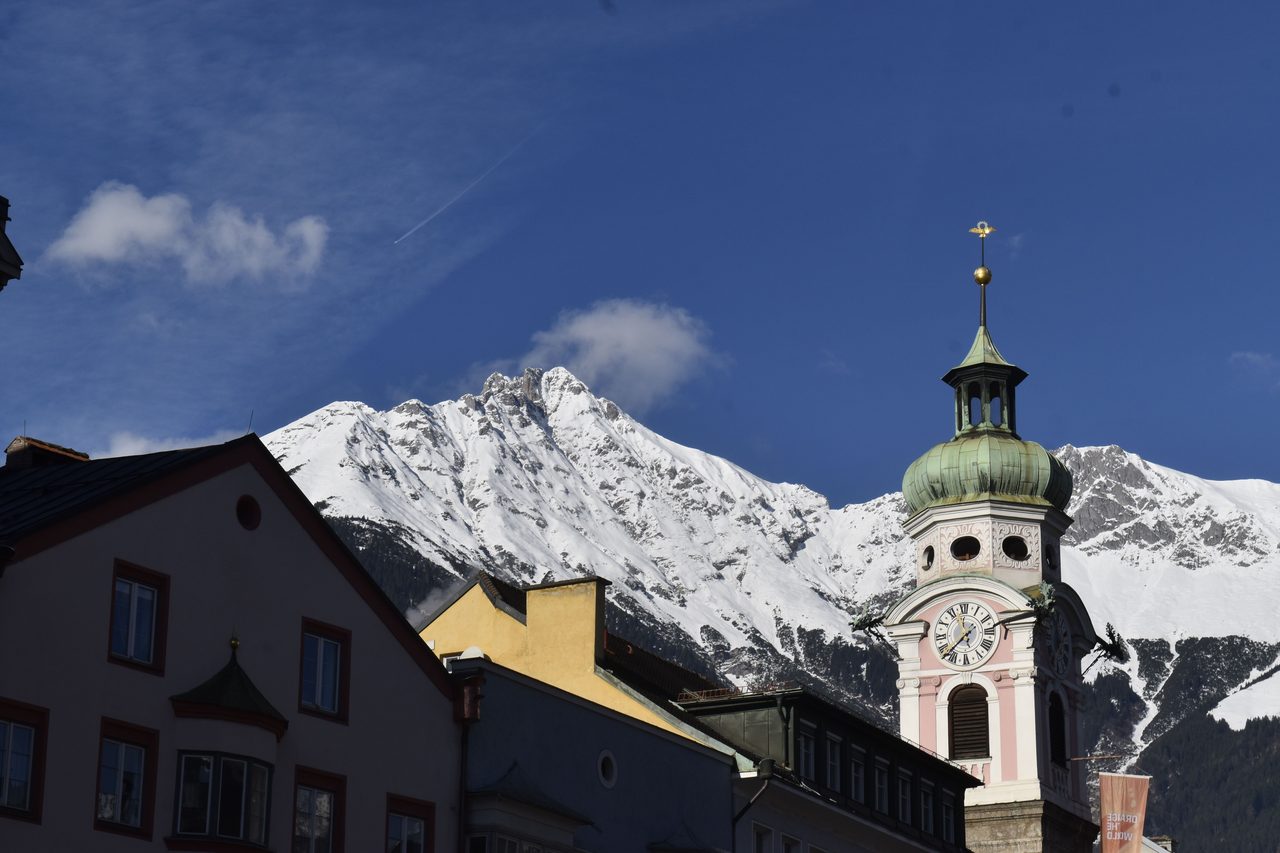
Innsbruck is the capital of the Austrian state of Tyrol, a city of about 132,000 people on the River Inn with the Nordkette mountain range rising directly behind the Old Town. It combines Habsburg-era landmarks such as the Golden Roof with cable cars that reach 2,334 m in about 20 minutes.
Innsbruck lies in the Inn Valley at about 575 m, surrounded on both sides by mountains: the Nordkette (Karwendel range) to the north and the Patscherkofel and Serles to the south. The Old Town (Altstadt) around Herzog-Friedrich-Strasse is compact and pedestrian, with the Golden Roof, the Hofburg and the Hofkirche within a few minutes' walk of each other. The Hungerburgbahn funicular and the Seegrubenbahn and Hafelekarbahn cable cars of the Nordkettenbahnen rise from the edge of the Old Town to the 2,334 m Hafelekar summit station, so a visitor can go from a cafe terrace to an alpine ridge in well under an hour. The city hosted the Winter Olympic Games in 1964 and 1976 and the Winter Youth Olympics in 2012, and the Bergisel ski jump designed by Zaha Hadid is a landmark on the southern skyline. Day trips by train or bus reach Hall in Tirol, Wattens (Swarovski Crystal Worlds), Schwaz, Achensee, the Stubai Valley, Kitzbuehel, Munich and Salzburg.
Jump straight to the experience you're planning.
The 15 destinations our editors recommend — from iconic landmarks to under-the-radar finds.
Gothic oriel balcony of 2,657 gilded copper tiles, built around 1500 for Emperor Maximilian I; the Maximilianeum museum behind it explains the court of Innsbruck.
Habsburg palace rebuilt under Empress Maria Theresa in the 18th century, with the Giant's Hall, imperial apartments and a portrait gallery of the Habsburg family.
Franciscan court church with the monumental cenotaph of Emperor Maximilian I, guarded by 28 over-life-size bronze statues known as the Schwarze Mander.
Funicular from the Congress station to Hungerburg, then two cable cars to Seegrube (1,905 m) and Hafelekar (2,334 m), with panoramas of the Inn Valley, the Stubai Alps and the Zillertal.
Olympic ski jump redesigned by Zaha Hadid in 2002, with a funicular to the tower, a viewing platform and the Bergisel Sky restaurant over the city.
Renaissance castle of Archduke Ferdinand II with the Chamber of Art and Curiosities, the Spanish Hall and a landscaped park.
Pick a length, follow the route. Each itinerary balances headline sights with breathing room.
Three tiers, every traveller covered — from cost-conscious to flagship hotels.
Hostels, budget hotels, and guesthouses offer affordable stays without sacrificing experience.
Boutique hotels and well-located accommodations provide comfort and convenience at reasonable prices.
World-class resorts and premium hotels deliver unforgettable experiences.
Four-star hotel on the Inn riverbank in Mariahilf with views toward the Nordkette and a short walk to the Altstadt.
Check rates on Booking.comFour-star hotel in Pradl, a residential district east of the centre, within reach of the Olympiaworld and the Hauptbahnhof.
Check rates on Booking.comFour-star hotel close to the Hofgarten and Maria-Theresien-Straße, in operation since the 19th century and known for its Café Central.
Check rates on Booking.comDesign hotel at the edge of the Altstadt with a rooftop terrace and bar overlooking the Nordkette mountains.
Check rates on Booking.comCafés, neighbourhood gems, and tasting menus worth the table reservation.
Historic Gasthaus in the Old Town serving Tyrolean classics in wood-panelled rooms; mains about EUR 14-24 (~$16-28).
Small Old Town restaurant for Tyrolean comfort food a few doors from the Golden Roof; mains about EUR 13-22 (~$15-26).
One of Innsbruck's oldest inns, dating to the 14th century, with guest rooms and a Tyrolean menu; mains about EUR 15-28 (~$17-32).
Traditional restaurant in a historic house beside Stift Wilten, with a shaded garden; mains about EUR 13-24 (~$15-28).
Cellar restaurant near the Hofgarten with Tyrolean mains and desserts; mains about EUR 14-25 (~$16-29).
Grand coffeehouse near the Landesmuseum with a pastry counter, newspapers and a breakfast menu; coffee about EUR 4-5 (~$5-6).
Book a food tour in Innsbruck We may earn a commission from bookings made through this link.
Innsbruck's Altstadt is compact and largely pedestrian, so most sights can be reached on foot. Trams, buses and the Hungerburgbahn run by the IVB (Innsbrucker Verkehrsbetriebe) and the Verkehrsverbund Tirol (VVT), plus S-Bahn trains, cover everything else, and the Innsbruck Card includes public transport.
Daily spend by tier in EUR, broken out by category.
| Category | Budget | Mid-range | Luxury |
|---|---|---|---|
| Accommodation | €40 | €130 | €350 |
| Food (per day) | €20 | €40 | €90 |
| Transportation | €5 | €8 | €30 |
| Activities | €10 | €22 | €50 |
| Daily total | €75 | €200 | €520 |
Best time Shoulder Worth avoiding
Average daytime temperature in °C.
Innsbruck is one of Austria's safest cities; the main risk is pickpocketing in the Altstadt around the Goldenes Dachl, on Maria-Theresien-Straße and at Innsbruck Hauptbahnhof
Keep bags zipped and phones out of back pockets at the crowded Christkindlmarkt and in cable-car queues at Congress station
Check mountain forecasts (zamg.ac.at, bergfex.at) and the Nordkettenbahn status before heading up to Seegrube or Hafelekar, as weather can change within an hour
For mountain emergencies dial 140 (Bergrettung) or 112; carry a charged phone and tell the hotel the planned route
Stay on marked trails, wear sturdy boots and carry a rain layer even in summer; the Innsbrucker Klettersteig needs a helmet, harness and experience
Avalanche risk is real off-piste from December to April; check the Lawinenwarndienst Tirol report (lawine.tirol.gv.at) and never ski off-piste without a local guide, transceiver, probe and shovel
Cyclists have right of way on marked lanes along the Inn; look before stepping off the pavement
Use licensed taxis from ranks or book by phone; avoid unofficial drivers approaching at the station
Wait for the green pedestrian light; jaywalking is fined and locals follow signals even on empty streets
The Altstadt is well lit at night, but avoid empty parks such as the Hofgarten late in the evening
The drink-driving limit is 0.5 per mille (0.1 for new licence holders) and police checks are frequent
Carry photo ID; clubs and the casino check age, and police may ask to see identification
Winter tyres are required on cars from 1 November to 15 April, and chains are needed on some mountain roads
Dial 112 from any phone for emergencies, 133 for police, 144 for ambulance and 122 for fire
Yes. Innsbruck combines a compact Habsburg Old Town with cable cars that reach 2,334 m in well under an hour, and it is a good base for the Stubai Valley, the Karwendel range, Hall in Tirol and Swarovski Crystal Worlds.
Two days cover the Old Town, the Hofburg and the Nordkette; three or four days allow Schloss Ambras, Bergisel, a hike on Patscherkofel and a day trip such as Achensee or the Stubai Glacier.
Bus line F runs to the Hauptbahnhof and city centre in roughly 15-20 minutes for about EUR 3.20 ($3.71); a taxi costs about EUR 15-20 ($17-23). Check ivb.at for current fares.
The 24-hour card was about EUR 59 ($68) for adults in 2026 and includes the Nordkette cable cars (regular return about EUR 39.50), Schloss Ambras, the Hofburg and public transport, so it pays off if you use the Nordkette plus two or three museums.
Innsbruck is very safe with low violent crime. Watch for pickpockets in crowds and take mountain weather seriously. Emergency numbers: 112 general, 133 police, 144 ambulance, 122 fire, 140 mountain rescue.
June to September is best for hiking and cable cars; December to March is best for skiing and the Christmas markets. November and April are quietest and some lifts close for maintenance.