Hanoi is the capital of Vietnam and the political and cultural centre of the country's north, a city of roughly 8.5 million people built around a chain of lakes on the Red River delta. Its compact core layers a thousand-year-old market quarter, a French colonial grid of villas and boulevards, and the ceremonial state architecture of Ba Dinh Square within a few kilometres of one another.
Hanoi was founded as Thang Long in 1010 when Emperor Ly Thai To moved his capital to the site, and the Imperial Citadel he began is now a UNESCO World Heritage Site excavated in the middle of the modern city. Around Hoan Kiem Lake, the Old Quarter still follows the guild layout of the 36 streets, each historically dedicated to a single trade, and sells everything from votive paper to silk to blacksmith tools. The French colonial administration added the Opera House, the Presidential Palace and wide tree-lined avenues east and south of the lake between 1883 and 1945, and much of that fabric survives in the area still called the French Quarter. North-west of the centre, West Lake (Ho Tay) is ringed by pagodas, lakeside cafes and the expatriate neighbourhoods of Tay Ho. Hanoi's food culture is regarded as the most distinctive in Vietnam, with pho, bun cha, cha ca and egg coffee all closely associated with the city, and since 2023 the Michelin Guide has awarded stars to restaurants here. Two metro lines now run through the city, and Noi Bai International Airport connects it to most of Asia and to Europe.
Capital
Hanoi
Largest city
Hanoi
Population
8,590,000 (metropolitan area)
Languages
Vietnamese (official); English spoken in hotels, tour agencies and much of the Old Quarter; French still used by some older residents
The 25 destinations our editors recommend — from iconic landmarks to under-the-radar finds.
Hoan Kiem Lake (Ho Hoan Kiem)
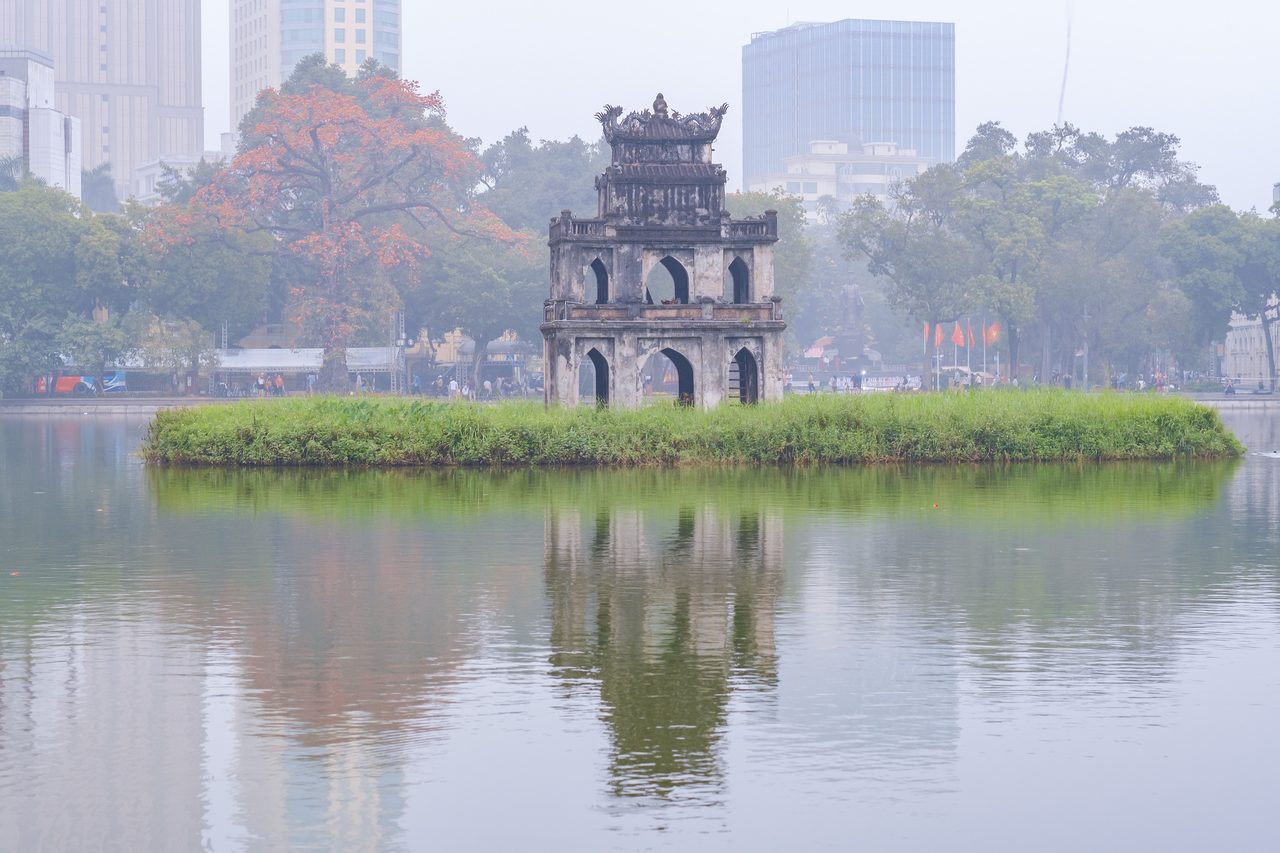
The lake is the geographic and social centre of Hanoi, a 12-hectare body of water whose name means Lake of the Returned Sword, after the legend in which Emperor Le Loi gave back a magic blade to a golden turtle. A 1.7-kilometre paved path circles it, passing the red-lacquered Huc Bridge to Ngoc Son Temple and the Turtle Tower on its small island. Residents use it for exercise at dawn and for strolling at night, and on weekends the ring road becomes a pedestrian zone with street games and live music.
Ngoc Son Temple (Den Ngoc Son)
Reached across the scarlet Huc Bridge, this 19th-century temple honours the 13th-century general Tran Hung Dao, the scholar-deity Van Xuong and the healer La To. Its rear hall displays a preserved specimen of one of the giant Hoan Kiem softshell turtles that lived in the lake, the last of which died in 2016 and was central to the sword legend. The complex is small, so the appeal is as much the island setting and the bridge as the shrine buildings themselves.
Hanoi Old Quarter (36 Streets)
The Old Quarter grew up around the Thang Long citadel as a craft and trading settlement, and its streets still carry the names of the guilds that occupied them, with Hang Bac for silversmiths, Hang Ma for votive paper and Hang Thiec for tinsmiths. The tube houses are narrow at the front and deep behind, a response to frontage-based taxation, and many still combine a shopfront with family living space. Traffic is dense and constant, and the district doubles as Hanoi's main concentration of street food, budget hotels and backpacker bars around Ta Hien.
Temple of Literature (Van Mieu - Quoc Tu Giam)
Founded in 1070 as a temple to Confucius and expanded in 1076 into Quoc Tu Giam, Vietnam's first national university, this walled complex of five successive courtyards trained mandarins for more than seven centuries. Its best-known feature is the set of 82 stone stelae mounted on tortoise backs, each inscribed with the names of doctoral graduates from examinations held between 1442 and 1779; UNESCO added them to the Memory of the World register in 2010. The rear courtyards hold the Confucian sanctuary and a reconstructed Thai Hoc hall honouring the scholars and emperors associated with the academy.
Ho Chi Minh Mausoleum
Ho Chi Minh's embalmed body lies in a granite mausoleum completed in 1975, modelled loosely on Lenin's tomb in Moscow but faced with stone brought from across Vietnam. Visitors file past the glass sarcophagus in a single silent line with no stopping, a visit that takes two or three minutes once inside. Photography, bags, phones and cameras are prohibited and must be left at the deposit counter on Ngoc Ha street, shorts and sleeveless tops are refused, and military guards enforce both rules strictly.
Ho Chi Minh Museum
Opened in 1990 for the centenary of Ho Chi Minh's birth, the museum occupies a white lotus-shaped modernist building designed with Soviet assistance. The upper galleries move chronologically through his years in France, the Soviet Union and China, his return to Vietnam and the founding of the Democratic Republic, using documents, photographs and personal effects. Several rooms are given over to surrealist symbolic installations rather than conventional display, which makes an English-speaking guide or the printed panels worth the extra time.
Recommended itineraries
Pick a length, follow the route. Each itinerary balances headline sights with breathing room.
5-Day Hanoi Explorer
Day 1Arrive in Hanoi, explore city center
Day 2Visit top attractions and museums
Day 3Day trip to nearby highlights
Day 4Local markets and hidden gems
Day 5Final sightseeing, departure
7-Day Classic Hanoi
Days 1-2Hanoi city highlights
Days 3-4Regional exploration
Days 5-6Cultural immersion and local experiences
Day 7Return and departure
14-Day Ultimate Hanoi
Days 1-3Hanoi comprehensive city tour
Days 4-6Northern region exploration
Days 7-9Eastern highlights
Days 10-12Southern attractions
Days 13-14Return to Hanoi, departure
Where to stay in Hanoi
Three tiers, every traveller covered — from cost-conscious to flagship hotels.
Budget 430,000-1,030,000 VND (~$16.50-39.60)
Hostels, budget hotels, and guesthouses offer affordable stays without sacrificing experience.
Boutique hotels and well-located accommodations provide comfort and convenience at reasonable prices.
Luxury 9,000,000-23,000,000 VND (~$346-885)
World-class resorts and premium hotels deliver unforgettable experiences.
Sofitel Legend Metropole Hanoi
French Quarter, opposite the Government Guest House and five minutes on foot from Hoan Kiem Lake · 5,700,000-18,200,000 VND (~$219-$700) per night
Hanoi's 1901 colonial grande dame, split between the shuttered Historical Metropole Wing and the newer Opera Wing, with a garden pool courtyard and a preserved wartime bomb shelter beneath it.
Opera House quarter, two streets from the Hanoi Opera House · 10,400,000-39,000,000 VND (~$400-$1,500) per night
A 47-key opera-themed hotel designed by Bill Bensley, housing Auriga Spa, the Michelin-starred teppanyaki counter Hibana by Koki and the Backstage restaurant.
Cafés, neighbourhood gems, and tasting menus worth the table reservation.
Bún Chả Hương Liên
Northern Vietnamese / Bún chả · 70,000–120,000 VND / USD 2.70–4.60 per person
A two-storey eatery on Lê Văn Hưu that grills pork patties and belly over charcoal and serves them in a warm sweet-sour fish-sauce broth with rice vermicelli and herbs. It became internationally known after a 2016 meal here, and that set is still sold on the menu as the Combo Obama.
Phở Thìn Lò Đúc
Northern Vietnamese / Phở · 60,000–90,000 VND / USD 2.30–3.45 per person
A narrow, perpetually crowded phở shop on Lò Đúc known for a house style in which the beef is stir-fried with garlic before joining the bowl. The broth is heavier and glossier than the clear northern standard, and bowls arrive under a thick layer of spring onion.
Phở Gia Truyền Bát Đàn
Northern Vietnamese / Phở · 60,000–80,000 VND / USD 2.30–3.10 per person
One of Hanoi's most traditional phở shops, holding a Michelin Bib Gourmand and serving nothing but beef phở from a clear, long-simmered broth. The queue runs out of the door at peak hours and the system is strict: pay at the counter, take the bowl, find a seat.
Phở 10 Lý Quốc Sư
Northern Vietnamese / Phở · 60,000–90,000 VND / USD 2.30–3.45 per person
A multi-floor phở house minutes from the cathedral, holding a Michelin Bib Gourmand and serving bowls that combine several cuts of beef. Long opening hours and an English menu make it the most approachable of Hanoi's celebrated phở addresses.
Chả Cá Lã Vọng
Northern Vietnamese / Turmeric fish · 200,000–300,000 VND / USD 7.70–11.55 per person
A single-dish restaurant in a creaking colonial-era house on the street that took its name, serving turmeric-marinated fish fried at the table with dill and spring onion. The set comes with rice vermicelli, peanuts, herbs and mắm tôm shrimp paste, and there is nothing else on the menu.
Chả Cá Thăng Long
Northern Vietnamese / Turmeric fish · 200,000–300,000 VND / USD 7.70–11.55 per person
A Michelin Bib Gourmand address for chả cá, spread over several floors with a table-top burner at every setting. Staff cook the turmeric fish and dill in front of diners and explain how to assemble each bowl, which suits anyone meeting the dish for the first time.
Visitors rarely need to own or drive anything in Hanoi. Ride-hailing apps cover the whole city at low fixed fares, the two metro lines handle a few useful corridors, and the Old Quarter is walkable. Driving a car in Hanoi is impractical for short stays, and riding a motorbike requires a Vietnamese licence or an International Driving Permit with an A1 motorcycle category, which most travel insurance policies also demand.
Budget breakdown
Daily spend by tier in VND (1 USD = 26,000 VND), broken out by category.
Category
Budget
Mid-range
Luxury
Accommodation
200,000-500,000 VND (~$7.70-19.20) for a hostel dorm or simple Old Quarter guesthouse
1,300,000-2,600,000 VND (~$50-100) for a 3-4 star boutique hotel
5,200,000-13,000,000 VND (~$200-500) for the Metropole, Capella or a Ho Tay resort
Food (per day)
150,000-300,000 VND (~$5.80-11.50) eating street food, bun cha and pho stalls
500,000-1,000,000 VND (~$19.20-38.50) mixing street food with sit-down restaurants
2,000,000-5,000,000 VND (~$76.90-192.30) including Michelin-starred tasting menus
Transportation
30,000-80,000 VND (~$1.15-3.10) using city buses and the metro
150,000-350,000 VND (~$5.80-13.50) using Grab cars and taxis
800,000-2,000,000 VND (~$30.80-76.90) for a private car and driver
Activities
50,000-150,000 VND (~$1.90-5.80) covering one or two museum admissions
300,000-700,000 VND (~$11.50-26.90) covering museums, a water puppet show and a guided walk
1,000,000-3,000,000 VND (~$38.50-115.40) for private guides and day trips
Daily total
430,000-1,030,000 VND (~$16.50-39.60)
2,250,000-4,650,000 VND (~$86.50-178.80)
9,000,000-23,000,000 VND (~$346-885)
Best time to visit Hanoi
Weather through the year in Hà Nội
Best timeShoulderWorth avoiding
Average daytime temperature in °C. Figures are for Hà Nội.
Hanoi's weather splits the year cleanly: visit in October or November for dry, clear, mild conditions, in March or April for warm humid days and festival season, and expect heat and heavy monsoon rain from May to September or cool grey drizzle and poor air quality from December to February.
Hanoi's weather changes character sharply between seasons, and packing for the wrong one is the most common mistake. Winter visitors regularly underestimate how cold a damp 12°C / 54°F feels in buildings without central heating, while summer visitors underestimate the humidity. Tet Nguyen Dan, the Lunar New Year, falls on 6 February 2027, with the statutory holiday running roughly 5–9 February and businesses closing from several days before to a week after. The city is strikingly quiet and beautiful during Tet itself, but most street-food kitchens shut.
Essential travel tips
Vietnam's e-visa is issued online at evisa.gov.vn for $25, is valid up to 90 days and takes about three working days; several nationalities also hold short visa exemptions
Withdraw cash from bank ATMs rather than airport kiosks; TPBank and VPBank machines dispense up to 5,000,000 VND (~$192) per withdrawal, while many others cap at 2,000,000-3,000,000 VND (~$77-115)
Install Grab and Xanh SM before arrival for metered car and motorbike rides; both take card payment and remove any need to negotiate fares
Tipping is not obligatory but 10,000-50,000 VND (~$0.38-1.92) for guides, drivers and hotel porters is normal practice
Most museums in Hanoi close on Mondays, and the Ho Chi Minh Mausoleum closes Mondays and Fridays and shuts entirely for roughly two months of annual maintenance each autumn
The area around Hoan Kiem Lake becomes a car-free walking zone from 19:00 Friday to 24:00 Sunday, with street performances and games
Temples and pagodas require covered shoulders and knees; the Ho Chi Minh Mausoleum enforces this strictly and bans cameras, bags and phones inside
SIM cards from Viettel, Vinaphone or Mobifone cost roughly 100,000-200,000 VND (~$3.85-7.69) for a tourist data package and are sold at Noi Bai arrivals with passport registration
Hidden gems
Off-the-beaten-path corners most travellers miss.
Safety information
INFO
Traffic is the real risk in Hanoi. Cross at a slow, constant pace without stopping, and never walk in the road looking at a phone.
INFO
Motorbike bag-snatching targets bags on the road-side shoulder on quieter streets after dark; carrying the bag on the inside shoulder removes most of the exposure.
INFO
Street-hailed metered taxis are the most common overcharge; booking in Grab or Xanh SM fixes the fare before the car arrives.
INFO
Agree cyclo and motorbike-taxi prices in dong, as a total for the ride rather than per person, before boarding.
INFO
Renting a motorbike without a Vietnamese licence or converted international permit is illegal and voids travel insurance entirely.
INFO
Hanoi tap water is not drinkable; ice from established restaurants and cafes is factory-made and safe.
INFO
The emergency numbers are 113 for police, 114 for fire and 115 for ambulance; Hanoi French Hospital is on +84 24 3574 1111 and Vinmec Times City on +84 24 3974 4333.
INFO
Air quality between November and March frequently reaches unhealthy readings, and a cheap mask is a reasonable purchase.
INFO
Dengue circulates from June to November, so repellent at dawn and dusk is a genuine precaution.
INFO
Pickpocketing occurs in the Dong Xuan night market and the Ta Hien crush; a front pocket or zipped crossbody handles it.
INFO
Decline the ATM's own currency conversion and let the home bank convert, which is consistently several per cent cheaper.
Frequently asked questions
Is Hanoi safe to visit in 2026?
Hanoi is a low-crime city where most travelers, including solo women, move around freely by day and late into the evening. The realistic dangers are not muggings but motorbike traffic, drive-by phone and bag snatching along the Old Quarter's narrow streets, and a handful of persistent scams involvin
What is the best time to visit Hanoi?
The best time to visit Hanoi is October and November. Hanoi has a humid subtropical climate with a monsoon rhythm and four recognisable seasons rather than the simple wet-and-dry split of southern Vietnam. Summer runs May to September and is hot, heavy,
Do I need a visa to visit Hanoi?
Most nationalities need an e-visa (USD 25 single entry, up to 90 days, apply at evisa.gov.vn) or a visa from an embassy. Citizens of about 25 countries, including the UK, France, Germany, Italy, Spain, Japan and South Korea, may enter visa-free for 45 days. Passports must be valid for at least six months on arrival. Requirements vary by nationality, so check with your nearest embassy or the official immigration website before traveling.
What currency is used in Hanoi?
The currency in Hanoi is the Vietnamese dong (VND); 1 USD = 26,000 VND (VND). ATMs are widely available in cities and tourist areas. Credit cards are accepted at most hotels and restaurants, but carry cash for markets and smaller establishments.
What language is spoken in Hanoi?
The main language(s) spoken in Hanoi: Vietnamese (official); English spoken in hotels, tour agencies and much of the Old Quarter; French still used by some older residents. In tourist areas, English is generally understood. Learning a few basic phrases in the local language is appreciated by locals.
What are the top attractions in Hanoi?
The top attractions in Hanoi include Hoan Kiem Lake (Ho Hoan Kiem), Ngoc Son Temple (Den Ngoc Son), Hanoi Old Quarter (36 Streets), Temple of Literature (Van Mieu - Quoc Tu Giam), and Ho Chi Minh Mausoleum. Each offers a unique experience, from historic landmarks to natural wonders.