
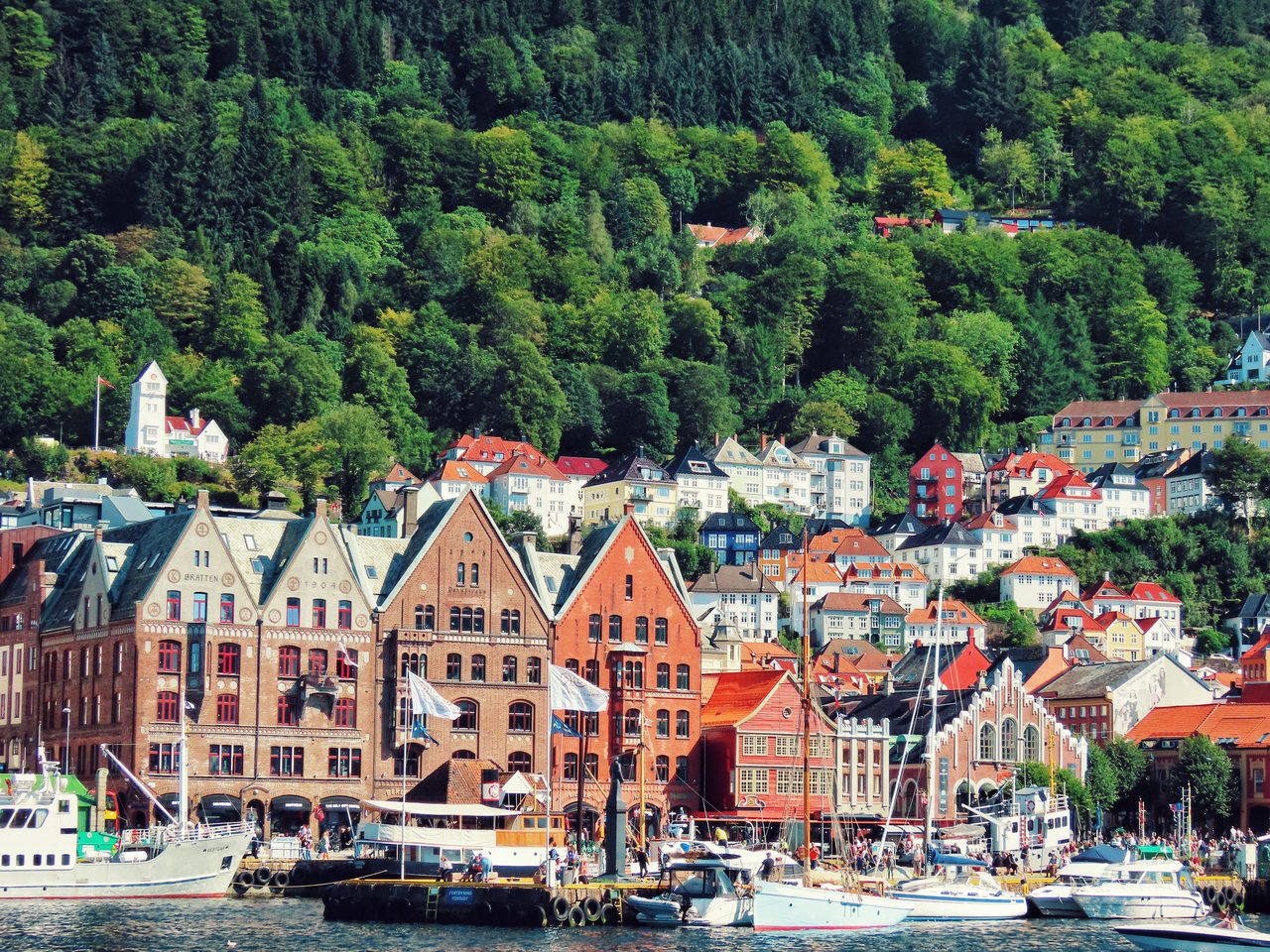
UNESCO-listed row of colourful wooden gabled warehouses on the Vagen harbour, the surviving core of the medieval Hanseatic trading post. Narrow timber passages, craft studios and restaurants fill the buildings today.
Bryggen is the waterfront row of gabled timber warehouses along the Vagen harbour in Bergen, in the Vestland region of western Norway. It is the visible remnant of the Hanseatic League's Norwegian trading post, which dominated the stockfish trade between northern Norway and northern Europe from the 14th century until the 1750s. The ensemble has been on the UNESCO World Heritage List since 1979. Visitors see a front line of brightly painted, steeply pitched buildings facing the harbour, and behind them a maze of narrow wooden passages called smauene, where lanes lined with leaning timber walls lead past craft studios, galleries, small shops and restaurants. The buildings sit on a slightly sloping wooden foundation, so floors tilt and creak, and several structures have been rebuilt after repeated fires, most seriously in 1702, using traditional methods. The best-known view is from the opposite side of the harbour or from the quayside near the Fish Market, where the whole facade fits in one frame; low sun in the evening gives the colours their richest tone. Inside the rear passages, photographers favour the contrast between dark timber and the lit shop windows. A short visit takes about one to two hours, longer when combined with the Hanseatic Museum and Schotstuene assembly rooms or the Bryggens Museum nearby. The open-air wharf is free and accessible at any hour, while shops and studios generally keep daytime hours of roughly 10:00 to 18:00. Crowds are heaviest from late morning to mid-afternoon on days when cruise ships are docked in Bergen, particularly in summer. Early morning and the hours after about 18:00 are noticeably calmer, and winter visits are quiet but often wet, since Bergen is among the rainiest cities in Europe. The wharf lies about two minutes on foot from Torget, and the Byparken stop on the Bybanen light rail is a short walk away.
| Admission | Free |
|---|---|
| Hours | Open-air wharf accessible 24 hours; shops and studios roughly 10:00-18:00 |
| Typical visit | 1-2 hours |
| Best time | Early morning before cruise-ship crowds, or evening light |
| Getting there | Walk from Torget Fish Market (2 min); Bybanen light rail to Byparken then 5 min walk |
| Address | Bryggen, 5003 Bergen |
Location
Bryggen, 5003 Bergen
60.3975, 5.3240 View on map
Highlights
- Facade of colourful gabled timber warehouses on the Vagen harbour
- Narrow rear passages (smauene) with craft studios and shops
- UNESCO World Heritage status since 1979
- Hanseatic Museum and Schotstuene assembly rooms
- Evening light photography from the Fish Market quay
Tips for visiting
- Walk the rear passages (smauene) between the buildings for the best atmosphere
- Combine with the Hanseatic Museum and Schotstuene
- Wooden floors are uneven; wear flat shoes
When to visit
Early morning or after 18:00 avoids cruise-ship crowds, and evening light suits photography. Summer is busiest; winter is quiet but frequently rainy.
Accessibility
The waterfront facade is reachable on level paving, but the rear passages have uneven, sloping timber floors and thresholds that are difficult for wheelchairs and walkers. Some shops and museum buildings have steps at the entrance.
Visit, book or contact
Frequently asked questions
How long does a visit to Bryggen take?
A walk along the wharf and through the passages takes about one hour. Adding the Hanseatic Museum or Bryggens Museum extends the visit to two hours or more.
Is Bryggen free to visit?
Yes. The open-air wharf and passages are free and accessible at any time. Museums and the Schotstuene assembly rooms charge separate admission.
Is photography allowed at Bryggen?
Photography is freely allowed outdoors and in the public passages. Individual museums and shops set their own rules for interiors.
Is Bryggen worth it for kids?
Children generally enjoy the labyrinth of wooden passages and the nearby harbour. The uneven wooden floors call for supervision of small children.