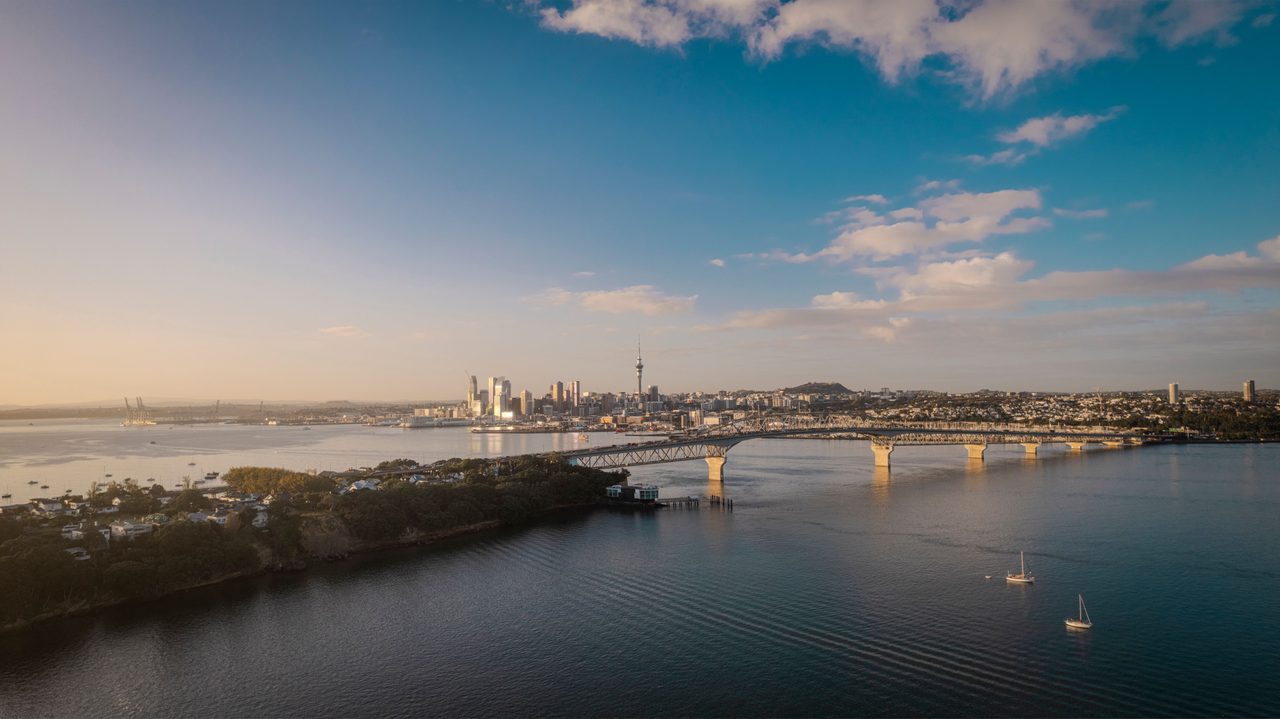
Auckland is New Zealand's largest city, built across a narrow isthmus between the Waitemata and Manukau harbours and dotted with dormant volcanic cones. Known as the City of Sails, it combines Maori and Pacific culture, harbourside dining and quick ferry access to the Hauraki Gulf islands.
Auckland is New Zealand's largest city and main international gateway, with Auckland Airport (AKL) about 21 km south of the CBD. The compact centre runs from the Viaduct Harbour and Britomart waterfront up Queen Street to Karangahape Road, with Ponsonby, Parnell and Devonport a short bus or ferry ride away. Volcanic cones such as Maungawhau (Mount Eden) and Maungakiekie (One Tree Hill) give free city views, and ferries reach Rangitoto Island and Waiheke Island in 25 to 40 minutes.
Capital
Wellington
Largest city
Auckland
Population
About 1.7 million (Auckland urban area)
Languages
English, Te Reo Maori, Samoan
Currency
New Zealand Dollar
Time zone
Pacific/Auckland (NZST UTC+12; NZDT UTC+13 from late September to early April)
The 21 destinations our editors recommend — from iconic landmarks to under-the-radar finds.
Sky Tower
At 328 metres, the Sky Tower is the tallest freestanding structure in the Southern Hemisphere and the Auckland skyline's defining feature. Indoor and outdoor observation levels give 360-degree views over both harbours and the volcanic cones, with SkyJump and SkyWalk add-ons for thrill-seekers.
Auckland War Memorial Museum Tamaki Paenga Hira
Perched on the Auckland Domain's volcanic hill, the museum holds one of the world's finest collections of Maori and Pacific taonga, plus natural history, a volcano gallery and the Hall of Memories war memorial. Daily Maori cultural performances are offered.
Auckland Art Gallery Toi o Tamaki
New Zealand's largest art collection is housed in a heritage French-chateau-style building joined to a prize-winning contemporary wing with a canopy of timber forms. The permanent collection includes major Maori portraits by Goldie and Lindauer.
Rangitoto Island
Auckland's youngest volcano rose from the sea about 600 years ago and is now an island of lava fields, pohutukawa forest and a summit walk with 360-degree views. It is a Department of Conservation scenic reserve reached by a 25-minute ferry.
Waiheke Island
A 40-minute ferry from the city, Waiheke has dozens of cellar-door vineyards, olive groves, sandy bays such as Onetangi, and the Oneroa village galleries and cafes. Public buses and wine tours link the main sites.
Kelly Tarlton's Sea Life Aquarium
Built inside disused storm-water tanks on the Tamaki Drive waterfront, the aquarium has a walk-through tunnel of sharks and rays, a colony of penguins and jellyfish exhibits.
Recommended itineraries
Pick a length, follow the route. Each itinerary balances headline sights with breathing room.
5-Day Auckland Explorer
Day 1Arrive in Auckland, explore city center
Day 2Visit top attractions and museums
Day 3Day trip to nearby highlights
Day 4Local markets and hidden gems
Day 5Final sightseeing, departure
7-Day Classic Auckland
Days 1-2Auckland city highlights
Days 3-4Regional exploration
Days 5-6Cultural immersion and local experiences
Day 7Return and departure
14-Day Ultimate Auckland
Days 1-3Auckland comprehensive city tour
Days 4-6Northern region exploration
Days 7-9Eastern highlights
Days 10-12Southern attractions
Days 13-14Return to Auckland, departure
Where to stay in Auckland
Three tiers, every traveller covered — from cost-conscious to flagship hotels.
Budget NZ$140 (~US$81)
Hostels, budget hotels, and guesthouses offer affordable stays without sacrificing experience.
Mid-range NZ$320 (~US$186)
Boutique hotels and well-located accommodations provide comfort and convenience at reasonable prices.
Luxury NZ$750 (~US$435)
World-class resorts and premium hotels deliver unforgettable experiences.
The Grand by SkyCity
Auckland CBD · $$$$ NZ$350-800 (~US$203-464) per night, typical range by season
Five-star hotel in the SkyCity precinct next to the Sky Tower, on the Federal Street dining strip.
Cafés, neighbourhood gems, and tasting menus worth the table reservation.
Paris Butter
Modern French / New Zealand · $$$$
Herne Bay fine-dining restaurant that appears at or near the top of Auckland's 2026 critic and tourism-board shortlists for a special-occasion dinner. Reservations are needed; book through the restaurant website.
Ahi
Modern New Zealand · $$$$
Chef Ben Bayly and front-of-house partner Chris Martin run this Commercial Bay restaurant, which champions New Zealand produce and is named in Auckland's 2026 best-of lists. It sits on Level 2 of the Commercial Bay precinct, a short walk from the ferry terminal and Britomart station.
Cassia
Modern Indian · $$$$
Contemporary Indian restaurant on Federal Street, recommended by Auckland Tourism's 2026 dining guide for a special dinner. Dinner is served daily and weekday lunch is offered Wednesday to Friday.
Mr Morris
Modern European · $$$$
Britomart restaurant on the corner of Galway and Commerce Streets, named among Auckland's top picks in 2026 editorial guides. Open for dinner Tuesday to Saturday with a Thursday and Friday lunch service.
Kazuya
Japanese kaiseki · $$$$
Intimate Japanese restaurant in the CBD, listed among Auckland's 2026 runner-up picks. Counter-style dining that suits a solo traveller; reserve ahead.
Ada Restaurant
Modern New Zealand · $$$$
Grey Lynn restaurant serving breakfast daily, with lunch Thursday and Friday and dinner Tuesday to Saturday. A neighbourhood destination about 4 km west of the CBD, reached by bus along Great North Road.
Auckland's public transport network combines buses, electric trains, ferries and, since September 2026, the City Rail Link (CRL) tunnel linking Waitemata (Britomart) with the new Te Waihorotiu (Aotea) and Karanga-a-Hape stations. One AT HOP card, or a contactless bank card or phone, pays for every mode. The CBD, Viaduct, Parnell and Ponsonby are walkable, but Auckland is spread out and a car helps for west-coast beaches and the Waitakere Ranges.
Bus
The widest network in the city. Frequent routes run along Symonds Street, Great North Road, Dominion Road, Sandringham Road and Tamaki Drive. The Northern Express (NX1/NX2) serves the North Shore and the Link buses loop the inner city. Services depart from Downtown Bus Station, Wellesley Street and Aotea Square.
Cost: AT HOP fares are zone based, about NZ$3.00 (~US$1.74) for one zone and up to about NZ$8.00 (~US$4.64) for four zones. A weekly cap of about NZ$50 (~US$29) applies. Check the current fare on at.govt.nz.
Train
Electric trains run on the Western, Southern, Eastern and Onehunga lines. Since the CRL opened in September 2026, trains run through Waitemata Station (Britomart), Te Waihorotiu (Aotea) and Karanga-a-Hape (Karangahape Road). Puhinui Station is the interchange for the airport bus.
Cost: Same zone fares as buses, about NZ$3.00-8.00 (~US$1.74-4.64). Contactless payment is accepted at the gates.
Ferry
Ferries leave from the Ferry Building and Downtown Ferry Terminal, 99 Quay Street, for Devonport (12 min), Waiheke Island (35-40 min via Fullers360 from Pier 1 and Pier 3), Half Moon Bay, Hobsonville and Gulf Harbour. Devonport sailings run about every 15-30 minutes in peak times.
Cost: Devonport about NZ$7-9 (~US$4.06-5.22) one way with AT HOP. Waiheke about NZ$24-26 (~US$14-15) one way, roughly NZ$48-52 return (~US$28-30). Fares vary by operator, so confirm at fullers.co.nz.
Airport bus
Direct airport express buses to the CBD (SkyDrive and similar operators) leave from outside both terminals to Sky City / Queen Street. The AirportLink 380 bus runs between the terminals and Puhinui Station, where it connects to the Southern and Eastern line trains.
Cost: Direct express bus about NZ$20 (~US$11.60) one way. AirportLink 380 plus train about NZ$6.50 (~US$3.77) with AT HOP. Confirm both before travelling.
Taxi and rideshare
Uber, Ola, DiDi and metered taxis cover the whole urban area. Taxi ranks are on Queen Street, at the Viaduct and at Britomart.
Cost: A typical inner-city ride is NZ$12-25 (~US$7-14.50).
Rental e-scooters and bikes
Lime and similar e-scooters operate in the CBD and inner suburbs. Tamaki Drive and the Waterfront Cycleway are the best routes. Scooters and bikes are restricted on some footpaths and in Queen Street shared zones, so follow the app's no-ride zones.
Cost: About NZ$1 (~US$0.58) to unlock plus roughly NZ$0.45-0.60 (~US$0.26-0.35) per minute.
Budget breakdown
Daily spend by tier in NZD, broken out by category.
Category
Budget
Mid-range
Luxury
Accommodation
NZ$50 (~US$29)
NZ$170 (~US$99)
NZ$420 (~US$244)
Food (per day)
NZ$45 (~US$26)
NZ$95 (~US$55)
NZ$200 (~US$116)
Transportation
NZ$20 (~US$11.60)
NZ$25 (~US$14.50)
NZ$70 (~US$40.60)
Activities
NZ$25 (~US$14.50)
NZ$30 (~US$17.40)
NZ$60 (~US$34.80)
Daily total
NZ$140 (~US$81)
NZ$320 (~US$186)
NZ$750 (~US$435)
Best time to visit Auckland
Weather through the year in Auckland
Best timeShoulderWorth avoiding
Average daytime temperature in °C.
Essential travel tips
Get an AT HOP card or tap a contactless bank card on trains, buses and ferries to avoid cash fares.
Book Waiheke and Rangitoto ferries ahead in December to February.
Pack layers and a rain jacket; weather can shift several times in a day.
Tipping is not expected in New Zealand; menu prices include GST (15 percent).
Hidden gems
Off-the-beaten-path corners most travellers miss.
Safety information
INFO
Call 111 (free, 24 hours, from any phone) for police, fire or ambulance; say which service you need.
INFO
Swim only between the red and yellow flags at patrolled beaches. Piha, Muriwai and other west coast surf beaches have powerful rips and are patrolled in summer only.
INFO
Use sun protection year-round: UV is very high to extreme from October to March. Apply SPF 50+ every two hours.
INFO
Lock cars and take everything with you. Car break-ins are common at beach car parks, trailheads and ferry terminals.
INFO
Do not leave phones, bags or laptops unattended on cafe tables or beaches.
INFO
Take care around Karangahape Road, Fort Street and lower Queen Street late at night; travel in groups or use a rideshare.
INFO
Use licensed taxis or ride-hailing apps (Uber, DiDi, Ola) rather than unmarked vehicles.
INFO
Check MetService (metservice.com) and the Auckland Emergency Management site (aucklandemergencymanagement.org.nz) before hiking or ferry trips; heavy rain can cause flooding and slips.
INFO
Install the NZ Alert app for national emergency alerts.
INFO
Stay on tracks on volcanic cones and Rangitoto; lava terrain is sharp and uneven. Take water, as there is none on Rangitoto's summit track.
INFO
Keep copies of your passport, insurance and NZeTA in a secure digital location.
INFO
Buy comprehensive travel insurance. ACC covers accident injury treatment for visitors, but not illness, repatriation or cancellations.
INFO
For earthquakes: Drop, Cover, Hold. For a long or strong shake near the coast, move to high ground at once without waiting for an official warning.
INFO
Drive on the left. Many visitors are caught out by roundabouts, one-lane bridges and the legal requirement to wear seatbelts in all seats.
Frequently asked questions
Is Auckland safe to visit in 2026?
Auckland is a very safe major city for visitors. Violent crime against tourists is rare; the realistic risks are opportunistic theft from cars, sunburn, strong surf and rips at west coast beaches, and fast-changing weather. Natural hazards (earthquakes, flooding and volcanic field activity) are low Emergency services: police at 111 for emergencies. 105 (or 105.police.govt.nz online) for non-urgent police matters such as theft reports., medical at 111 for ambulance. Healthline 0800 611 116 is a
What is the best time to visit Auckland?
The best time to visit Auckland is November to April. Auckland has a mild, humid, temperate maritime climate with no dry season. Normals for Auckland Airport (1991-2020, NIWA) give an annual average high of 19.2C (66.6F), low of 12.1C (53.8F) and about 1
Do I need a visa to visit Auckland?
Most visitors from visa-waiver countries need an NZeTA (NZ$17 or NZ$23 depending on whether applied through the app or website, about US$10 to US$13) plus the International Visitor Conservation and Tourism Levy (NZ$100, about US$58), paid with the NZeTA. Australian citizens do not need an NZeTA. Confirm the current fee at immigration.govt.nz before applying. Requirements vary by nationality, so check with your nearest embassy or the official immigration website before traveling.
What currency is used in Auckland?
The currency in Auckland is the New Zealand Dollar (NZD). ATMs are widely available in cities and tourist areas. Credit cards are accepted at most hotels and restaurants, but carry cash for markets and smaller establishments.
What language is spoken in Auckland?
The main language(s) spoken in Auckland: English, Te Reo Maori, Samoan. In tourist areas, English is generally understood. Learning a few basic phrases in the local language is appreciated by locals.
What are the top attractions in Auckland?
The top attractions in Auckland include Sky Tower, Auckland War Memorial Museum Tamaki Paenga Hira, Auckland Art Gallery Toi o Tamaki, Rangitoto Island, and Waiheke Island. Each offers a unique experience, from historic landmarks to natural wonders.