Rabat (national capital); Fes is the capital of the Fès-Meknès region
Currency
Moroccan Dirham (MAD) — a closed currency; it cannot be obtained or exchanged back outside Morocco, so convert cash at the airport, a bank or an authorized bureau de change
Language
Arabic and Tamazight (Berber) are official; Moroccan Arabic (Darija) is spoken day to day; French is widely used in business and tourism; English is increasingly common in hotels, riads and the medina
Time zone
Morocco is on UTC+1 for most of the year with a temporary shift to UTC+0 during Ramadan; the government has announced a move to permanent UTC+0 from 20 September 2026, so travelers should confirm the offset before travel
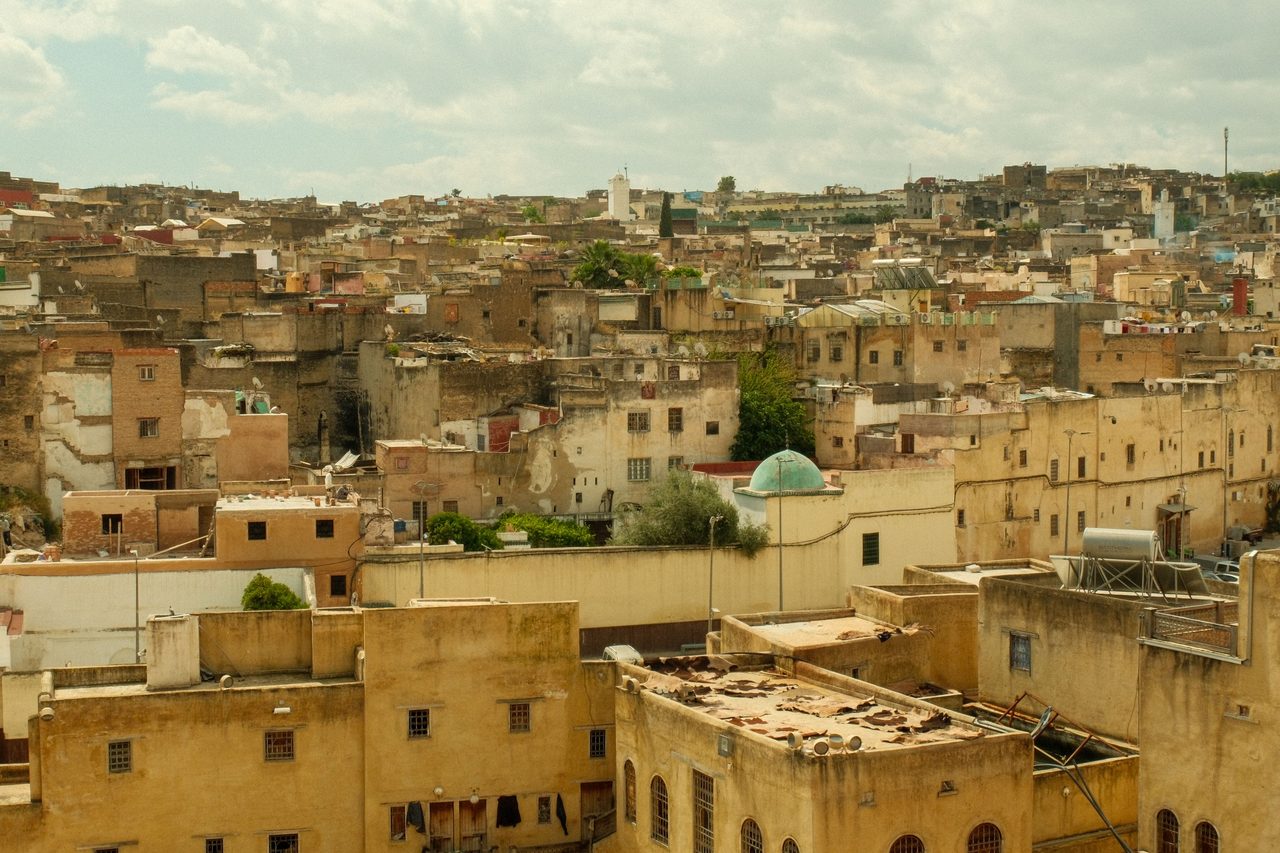
Fes is Morocco's oldest imperial city and its spiritual and intellectual capital. Fes el-Bali, founded in 789, is a UNESCO World Heritage medina and the largest car-free urban area in the world, home to Al-Qarawiyyin, founded in 859 and widely considered the oldest continuously operating university. Marinid madrasas such as Bou Inania and Al-Attarine, the Chouara Tannery, and the coppersmith and dyers' souks make it Morocco's craft capital. Fes el-Jdid, founded in 1276, holds the Royal Palace and the Mellah, and the Ville Nouvelle holds the train station, banks and restaurants. Meknes and the Roman ruins of Volubilis lie within a day trip.
Capital
Rabat (national capital); Fes is the capital of the Fès-Meknès region
Largest city
Fes
Population
approximately 1.1 million in the city (2024 census), within a region of about 4.2 million
Languages
Arabic and Tamazight (Berber) are official; Moroccan Arabic (Darija) is spoken day to day; French is widely used in business and tourism; English is increasingly common in hotels, riads and the medina
Currency
Moroccan Dirham (MAD) — a closed currency; it cannot be obtained or exchanged back outside Morocco, so convert cash at the airport, a bank or an authorized bureau de change
Time zone
Morocco is on UTC+1 for most of the year with a temporary shift to UTC+0 during Ramadan; the government has announced a move to permanent UTC+0 from 20 September 2026, so travelers should confirm the offset before travel
The 19 destinations our editors recommend — from iconic landmarks to under-the-radar finds.
Fes el-Bali Medina
The world's largest car-free urban zone, with an estimated 9,000 lanes inside walls dating from the 9th century. Inscribed as a UNESCO World Heritage Site in 1981, it holds the Al-Qarawiyyin complex, madrasas, fondouks, tanneries and craft souks. Signage is sparse, so a downloaded offline map and a fixed meeting point are advisable for solo visitors; licensed guides charge about MAD 300-400 (~$32-43) per half day through hotel desks or the official tourist office.
Chouara Tannery
A medieval tannery quarter where hides are still soaked, limed and dyed by hand in stone vats of white lime and natural dyes. The view is from the terraces of the surrounding leather shops, which hand out sprigs of mint against the smell. Entry is free, but staff expect a purchase or a tip of MAD 20-50 (~$2-5); a firm refusal of pushy side-guides is normal practice.
Al-Qarawiyyin Mosque and University (exterior)
Founded in 859 by Fatima al-Fihri, the complex is widely cited as the oldest continuously operating university in the world. Non-Muslims cannot enter the prayer hall, but the carved cedar doorways and courtyard views can be seen from outside, and the adjoining library, restored in 2016, can be visited only by arrangement.
Bou Inania Madrasa
Built between 1351 and 1356 under the Marinid sultan Abu Inan Faris, this is one of the few religious buildings in Fes open to non-Muslims. The courtyard combines zellige tilework, carved stucco and cedar, with a fountain and a prayer hall visible from the threshold. The ticket office is at the entrance; cash only.
Bab Bou Jeloud (Blue Gate)
A ceremonial gate completed in 1913 in Moorish style, tiled blue on the outer face (the colour of Fes) and green on the inner face (the colour of Islam). Cafe terraces on the adjoining square overlook the entrance and are a common meeting point for guides and visitors.
Dar Batha Museum
A late-19th-century Hassanian palace turned museum in 1915, displaying Fassi ceramics, carved wood, astrolabes, manuscripts and Moroccan embroidery in rooms around a shaded Andalusian garden. It is the best single stop for the arts and crafts of Fes.
Recommended itineraries
Pick a length, follow the route. Each itinerary balances headline sights with breathing room.
5-Day Fes Explorer
Day 1Arrive in Fes, explore city center
Day 2Visit top attractions and museums
Day 3Day trip to nearby highlights
Day 4Local markets and hidden gems
Day 5Final sightseeing, departure
7-Day Classic Fes
Days 1-2Fes city highlights
Days 3-4Regional exploration
Days 5-6Cultural immersion and local experiences
Day 7Return and departure
14-Day Ultimate Fes
Days 1-3Fes comprehensive city tour
Days 4-6Northern region exploration
Days 7-9Eastern highlights
Days 10-12Southern attractions
Days 13-14Return to Fes, departure
Where to stay in Fes
Three tiers, every traveller covered — from cost-conscious to flagship hotels.
Budget MAD 210-520/day (~$23-56)
Hostels, budget hotels, and guesthouses offer affordable stays without sacrificing experience.
Mid-range MAD 850-2,020/day (~$91-217)
Boutique hotels and well-located accommodations provide comfort and convenience at reasonable prices.
Luxury MAD 3,800-9,500/day (~$409-1,022)
World-class resorts and premium hotels deliver unforgettable experiences.
Palais Faraj Suites & Spa
Bab Guissa heights, Fes el-Bali medina · MAD 1,800-4,200/night (~$194-$452)
Five-star palace-style hotel on the hillside above Fes el-Bali with terraces overlooking the medina rooftops, a pool and a spa.
Cafés, neighbourhood gems, and tasting menus worth the table reservation.
The Ruined Garden
Modern Fassi / Moroccan · MAD 200-400 per person (~$22-$43)
A walled garden restaurant in the Siaj quarter of the medina, with tables among trees and a wood-fired indoor room for cooler evenings. The menu reworks Fassi dishes and street food, with mechoui as the signature.
Café Clock
Moroccan cafe / international · Under MAD 200 per person (~$22)
A long-running cafe in a restored house just off Talaa Kebira, known for its camel burger, brunch dishes and terrace. It also hosts art shows, concerts, movie nights and cooking classes.
NUR Restaurant
Contemporary Moroccan tasting menu · MAD 400+ per person (~$43+)
An inventive tasting-menu restaurant inside the medina, run by chef Najat Kaanache. Roughly eight courses are served, and the menu changes nightly.
Dar Hatim
Traditional Moroccan home cooking · Under MAD 200 per person (~$22)
A family house turned restaurant in the Fondouk Lihoudi quarter, serving a few set menus of traditional Moroccan dishes. Pastilla, tagines and couscous are the usual orders.
Fez Café at Le Jardin des Biehn
Mediterranean and Moroccan · MAD 200-400 per person (~$22-$43)
A formal garden restaurant attached to the Jardin des Biehn hotel in the former palace of a pasha. The seasonal menu leans Mediterranean, and wine is served at lunch, which is rare in the medina.
La Maison Bleue
Traditional Moroccan · MAD 400+ per person (~$43+)
A candlelit restaurant on Batha Square, with live oud music in the evenings. It is known for lamb tagines and pigeon pastilla.
Fes-Saiss Airport (FEZ) is about 15 km south of the center. The ONCF train station sits in the Ville Nouvelle, and the medina is reached by petit taxi, then on foot because its lanes are car-free.
Budget breakdown
Daily spend by tier in MAD, broken out by category.
Category
Budget
Mid-range
Luxury
Accommodation
MAD 100-250/night (~$11-27)
MAD 500-1,200/night (~$54-129)
MAD 2,500-6,000/night (~$269-645)
Food (per day)
MAD 70-130/day (~$8-14)
MAD 200-400/day (~$22-43)
MAD 600-1,200/day (~$65-129)
Transportation
MAD 20-40/day (~$2-4)
MAD 50-120/day (~$5-13)
MAD 300-800/day (~$32-86)
Activities
MAD 20-100/day (~$2-11)
MAD 100-300/day (~$11-32)
MAD 400-1,500/day (~$43-161)
Daily total
MAD 210-520/day (~$23-56)
MAD 850-2,020/day (~$91-217)
MAD 3,800-9,500/day (~$409-1,022)
Best time to visit Fes
Weather through the year in Morocco
Best timeShoulderWorth avoiding
Average daytime temperature in °C. Figures are for Morocco.
Spring and autumn are the best seasons; avoid peak summer heat unless sightseeing is limited to early morning and evening.
Spring offers green countryside and mild evenings; autumn is warm with fewer crowds. Winter is cold and damp but quiet and inexpensive, and riads can be chilly without heating.
Essential travel tips
Cash is needed for most medina shops, cafes and taxis; ATMs are at Place de l'Istiqlal and in the Ville Nouvelle
Begin bargaining at about 40-50% of the first asking price and be ready to walk away
Dress modestly with shoulders and knees covered
Friday midday prayer closes many sites and shops from about 12:30 to 3pm
Download an offline map; mobile signal inside the medina is patchy
Hidden gems
Off-the-beaten-path corners most travellers miss.
Jewish Cemetery (Miara)
A hillside cemetery of whitewashed tombs, in use for centuries and still maintained.
Merenid Tombs
Ruined 14th-century Marinid royal tombs on a hill, now best known for the panoramic view over the medina.
Place Seffarine and Coppersmiths' Souk
A small square lined with brass and copper workshops, beside the library of the Qarawiyyin and beneath a big plane tree.
Dyers' Souk (Souk el-Sebbaghine)
The lane where wool and silk are dyed in vats and hung to dry on the walls in brilliant colours.
Dar al-Magana (Water Clock)
A 14th-century building facing Bou Inania, with thirteen carved cedar brackets above a row of windows that once held the mechanism of a water clock.
Safety information
INFO
Politely decline unofficial guides at Bab Boujloud and the medina gates; hire a licensed guide through the tourist office or the riad for a fixed price agreed beforehand
INFO
Carry a phone map or a riad business card in Fes el-Bali; the lanes are unsignposted and a wrong turn is the most common problem, so ask shopkeepers or women rather than anyone offering to lead the way
INFO
Insist on the meter in petit taxis (red in Fes) and use the grands taxis only at a fixed, pre-agreed fare; keep small MAD notes for change
INFO
Keep bags zipped and in front of you in crowded souks such as Talaa Kebira and Talaa Seghira, and move aside for donkeys and handcarts when porters shout 'balak'
INFO
Dress modestly, with shoulders and knees covered, and ask before photographing people; non-Muslims may not enter active mosques or the Al-Qarawiyyin prayer hall
INFO
Drink bottled water, avoid ice from informal stalls, and carry rehydration salts; summer highs above 35 C make sun protection and regular water essential
INFO
Public displays of affection are frowned upon, and drug offences carry real penalties; do not buy hashish offered on the street
INFO
In an emergency call the police on 19 or the ambulance and fire service on 15; contact the embassy for lost passports
Frequently asked questions
Is Fes safe to visit in 2026?
Fes is one of Morocco's safest large cities for tourists, with visible police and a tourist-police presence around Bab Boujloud and the main medina gates. Day-to-day problems are non-violent: persistent unofficial guides, tannery tip pressure, overcharging and occasional pickpocketing in crowded sou
What is the best time to visit Fes?
The best time to visit Fes is March–May and September–November. Fes has a hot-summer Mediterranean climate (Köppen Csa) on the Saïss plain between the Rif and Middle Atlas. Summers are hot and dry, with July and August highs around 36–38°C and heatwaves above 40°C
Do I need a visa to visit Fes?
Citizens of the US, UK, Canada, Australia, the EU/Schengen area and many other countries may enter Morocco visa-free for stays of up to 90 days within a 180-day period; no advance application or fee is required, only a passport valid for at least 6 months beyond arrival (3 months minimum for UK passports, though 6 months is recommended). An arrival card is completed on the plane or at the border. Staying beyond 90 days requires a residence permit application before the visa-free period expires; overstaying can result in a fine on departure. Requirements vary by nationality, so check with your nearest embassy or the official immigration website before traveling.
What currency is used in Fes?
The currency in Fes is the Moroccan Dirham (MAD) — a closed currency; it cannot be obtained or exchanged back outside Morocco, so convert cash at the airport, a bank or an authorized bureau de change (MAD). ATMs are widely available in cities and tourist areas. Credit cards are accepted at most hotels and restaurants, but carry cash for markets and smaller establishments.
What language is spoken in Fes?
The main language(s) spoken in Fes: Arabic and Tamazight (Berber) are official; Moroccan Arabic (Darija) is spoken day to day; French is widely used in business and tourism; English is increasingly common in hotels, riads and the medina. In tourist areas, English is generally understood. Learning a few basic phrases in the local language is appreciated by locals.
What are the top attractions in Fes?
The top attractions in Fes include Fes el-Bali Medina, Chouara Tannery, Al-Qarawiyyin Mosque and University (exterior), Bou Inania Madrasa, and Bab Bou Jeloud (Blue Gate). Each offers a unique experience, from historic landmarks to natural wonders.