World · 25 Places · Best May–June and September–October
Thessaly
Thessaly is the heartland of mainland Greece, a vast fertile plain ringed by dramatic mountains that cradles some of the country's most extraordinary sights. The region is home to Meteora, where ancient monasteries perch impossibly atop towering sandstone rock pillars, and to the Pelion Peninsula, a forested mountain arm curving into the Aegean with traditional stone villages and secluded coves.
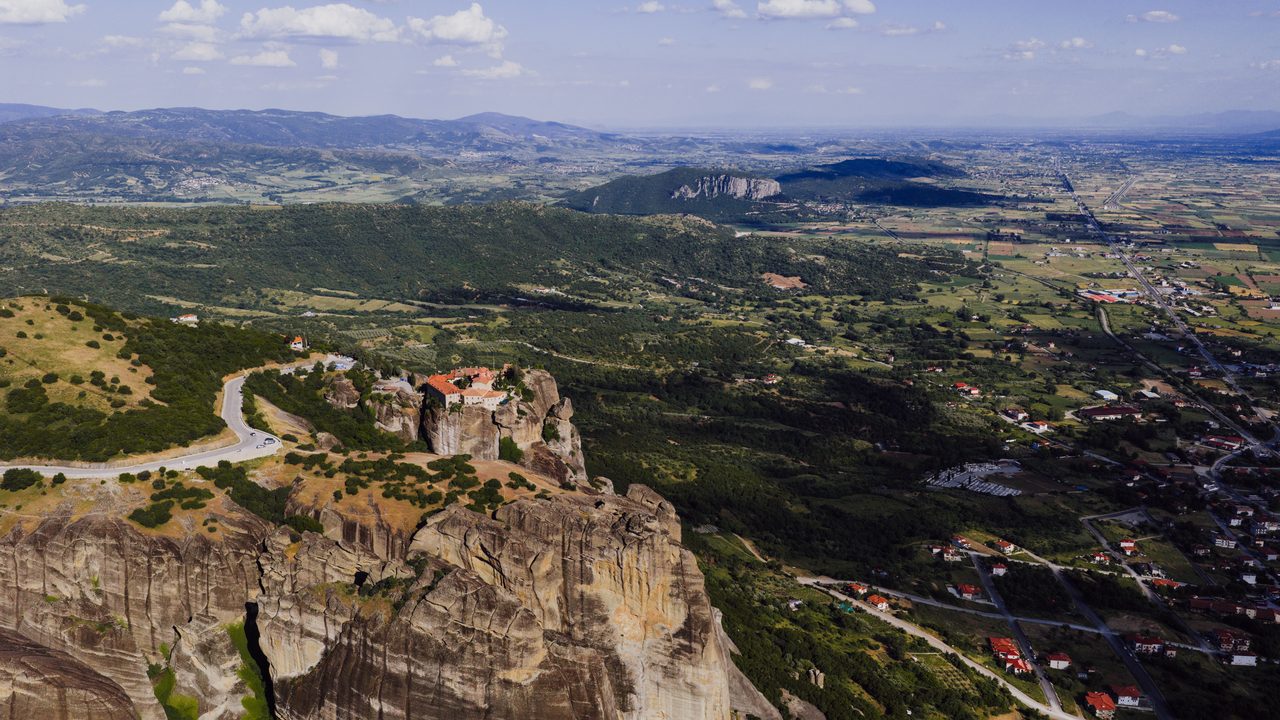
Thessaly occupies the largest plain in Greece, the Thessalian Plain, which has been farmed continuously since Neolithic times and still produces cotton, wheat, and livestock on an industrial scale. The region is bounded by the Pindus mountain range to the west, the Kamvounia mountains to the north, the Othris range to the south, and the Pelion massif projecting east into the Aegean. Four major cities anchor the region: Larissa (the capital), Volos (the port and university city), Trikala (gateway to Meteora), and Karditsa (market town on the western plain). Thessaly is famous beyond Greece for Meteora, a UNESCO World Heritage Site where six active monasteries crown a cluster of natural sandstone pillars rising abruptly from the valley floor near Kalambaka. The Pelion Peninsula, curving south and east from Volos into the Pagasetic Gulf and Aegean Sea, is celebrated for its dense chestnut and beech forests, terraced stone villages, clear-water beaches, and a cuisine built around local products — chestnuts, wild greens, trout, and the anise-flavoured spirit tsipouro. Volos itself is among Greece's most vibrant food cities, famous across the country for its tsipouradiko culture, in which small glasses of tsipouro are always accompanied by generous plates of meze.
The 25 destinations our editors recommend — from iconic landmarks to under-the-radar finds.
Meteora Monasteries
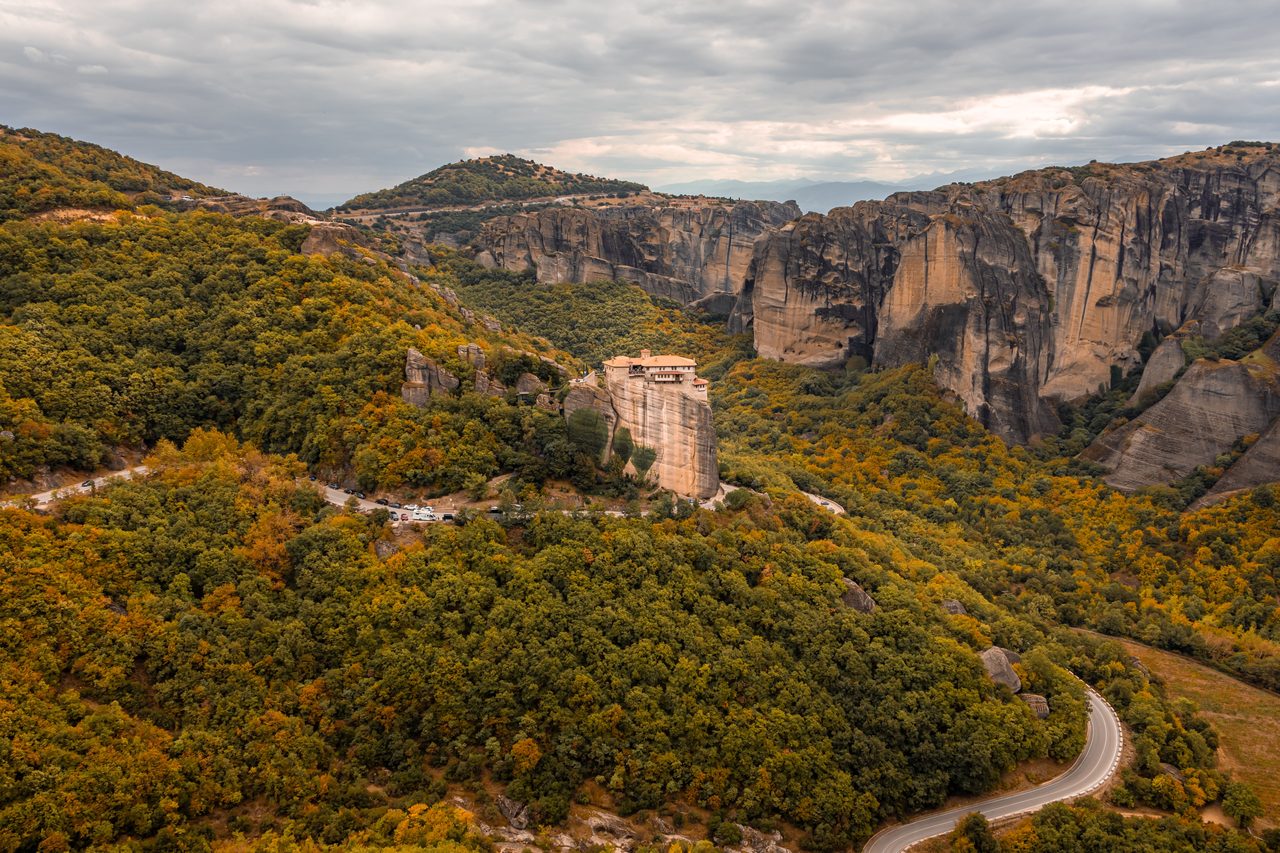
Meteora is a cluster of Eastern Orthodox monasteries built on top of sandstone rock pillars above the town of Kalambaka, founded from the 14th century onward by monks seeking isolation. Six of the original twenty-four monasteries remain active and open to visitors, each reached by steps cut into the rock rather than the rope ladders and hoist-nets monks once used. Because the six sites are spread across the rock formations, seeing more than two or three in a day usually means driving or walking between them rather than a single walking loop.
Great Meteoron (Transfiguration) Monastery
Great Meteoron is the largest and highest of the Meteora monasteries, founded in the 14th century by St. Athanasios the Meteorite on the tallest of the rock pillars. It houses a katholikon (main church) with a domed roof and an old refectory now used as a museum, along with an ossuary containing the skulls of monks who lived there. The climb up involves a long stone staircase carved into the rock face before reaching the entrance.
Varlaam Monastery
Varlaam is the second-largest monastery at Meteora, built in the mid-16th century on a pillar close to Great Meteoron. Its katholikon contains frescoes painted by Frangos Catellanos, a noted post-Byzantine painter from Thebes, covering the walls with scenes of the Last Judgment and the lives of saints. A rebuilt version of the original hoist tower and barrel used to winch supplies and monks up the rock face still stands at the entrance.
Roussanou Monastery
Roussanou sits on a narrower, lower pillar than the other Meteora sites and today functions as a working convent of nuns rather than a monastery of monks. It's reached by a short bridge connecting two rock outcrops, which makes it one of the more physically accessible of the six sites despite its dramatic perch. The katholikon holds frescoes depicting the martyrdoms of saints, painted in the second half of the 16th century.
Holy Trinity Monastery
Holy Trinity (Agia Triada) occupies one of the most isolated pillars at Meteora and requires descending into a ravine and climbing roughly 140 steps carved into the rock to reach it, making it one of the more demanding of the six to visit. It appeared as a filming location in the 1981 James Bond film For Your Eyes Only, which brought it wider recognition outside Orthodox pilgrimage circles. The small katholikon and monk's cells reflect its history as a place chosen specifically for seclusion.
Saint Stephen's Monastery
St. Stephen's is a convent of nuns and the most accessible of the six Meteora sites, connected to the road by a short bridge with no stairs to climb. Its church of Agia Charalambos, built in the 1700s, holds the relics of the saint along with a collection of icons and embroidered vestments displayed in an adjoining museum room. Its position at the edge of the rock formation gives it a different vantage point over the Kalambaka valley than the more centrally clustered monasteries.
Recommended itineraries
Pick a length, follow the route. Each itinerary balances headline sights with breathing room.
5-Day Thessaly Explorer
Day 1Arrive in Thessaly, explore city center
Day 2Visit top attractions and museums
Day 3Day trip to nearby highlights
Day 4Local markets and hidden gems
Day 5Final sightseeing, departure
7-Day Classic Thessaly
Days 1-2Thessaly city highlights
Days 3-4Regional exploration
Days 5-6Cultural immersion and local experiences
Day 7Return and departure
14-Day Ultimate Thessaly
Days 1-3Thessaly comprehensive city tour
Days 4-6Northern region exploration
Days 7-9Eastern highlights
Days 10-12Southern attractions
Days 13-14Return to Thessaly, departure
Where to stay in Thessaly
Three tiers, every traveller covered — from cost-conscious to flagship hotels.
Budget 45–95
Hostels, budget hotels, and guesthouses offer affordable stays without sacrificing experience.
Mid-range 120–230
Boutique hotels and well-located accommodations provide comfort and convenience at reasonable prices.
Luxury 280–700
World-class resorts and premium hotels deliver unforgettable experiences.
Thessaly is served by Larissa train station on the main Athens–Thessaloniki intercity rail line. Volos has regular bus connections. A rental car is strongly recommended for Pelion and Meteora exploration.
Budget breakdown
Daily spend by tier in EUR, broken out by category.
Category
Budget
Mid-range
Luxury
Accommodation
20–40
60–120
150–400
Food (per day)
15–25
30–50
60–120
Transportation
5–15
15–30
30–80
Activities
5–15
15–30
40–100
Daily total
45–95
120–230
280–700
Best time to visit Thessaly
Weather through the year in Greece
Best timeShoulderWorth avoiding
Average daytime temperature in °C. Figures are for Greece.
Spring (May–June) offers lush green Pelion landscapes and mild Meteora temperatures. Autumn (Sep–Oct) brings warm sea temperatures and thinner crowds. Summer (Jul–Aug) is hot on the plain but pleasant at altitude and on beaches. Winter offers authentic Greek mountain life and lower prices.
Essential travel tips
Book Meteora monastery entrance tickets online in advance at summer peak — visitor numbers are capped
Rent a car to fully explore the Pelion Peninsula — public buses are infrequent
Volos makes the best base: easy day trips to Pelion, Meteora (2.5 hrs), and ferry departures to the Sporades
The six Meteora monasteries have staggered closing days — check schedules to visit multiple in one day
Dress modestly for monastery visits: covered shoulders and knees; monastery shops sell wraps if needed
Tsipouro in Volos is traditionally served with meze at no extra charge — the spirit is the focus, not the food
The Pelion narrow-gauge railway (Moutzouris) between Ano Lechonia and Milies runs on weekends — book in advance
Hidden gems
Off-the-beaten-path corners most travellers miss.
Damouchari harbour
Vizitsa car-free village
Kastraki rock churches
Porta Panagias Byzantine church
Sesklo Neolithic settlement
Safety information
INFO
Keep valuables secured in busy city centres
INFO
Carry cash as many small villages and tavernas do not accept cards
INFO
Mountain roads on Pelion can be narrow — drive carefully
INFO
Flash floods can occur in river gorges during heavy rain — check weather forecasts before hiking
INFO
EU health card (EHIC) is valid for emergency treatment in public hospitals
Frequently asked questions
Do I need a visa to visit Thessaly (Greece)?
Greece is part of the Schengen Area. EU/EEA citizens need only a valid ID. Citizens of the USA, Canada, Australia, UK, and many other countries can stay up to 90 days without a visa. Other nationalities should check requirements at visas.gov.gr or at the nearest Greek embassy before traveling.
What currency is used in Thessaly?
Greece uses the Euro (EUR). ATMs are readily available in Larissa, Volos, Trikala, and Kalambaka. Smaller villages in Pelion and rural areas are predominantly cash-only, so carry sufficient euros when leaving the main towns.
How do I get to Meteora from Athens?
Take a direct train from Athens (Larissa station) to Kalambaka via the Paleofarsalos junction — journey time approximately 4 hours 30 minutes. Trains depart 2–3 times daily. Tickets cost €8–30 depending on class and booking in advance at trainose.gr. Alternatively, buses (KTEL) depart from Athens' Liossion terminal to Kalambaka in about 5 hours for €28.
Is Meteora worth visiting?
Meteora is one of the most extraordinary sights in Europe and is firmly on most visitors' Greece itineraries. The combination of UNESCO-listed monasteries perched on towering natural rock pillars creates a landscape unlike anywhere else. At minimum, allow a full day from Kalambaka. Two nights allows a more relaxed experience with sunrise and sunset visits.