
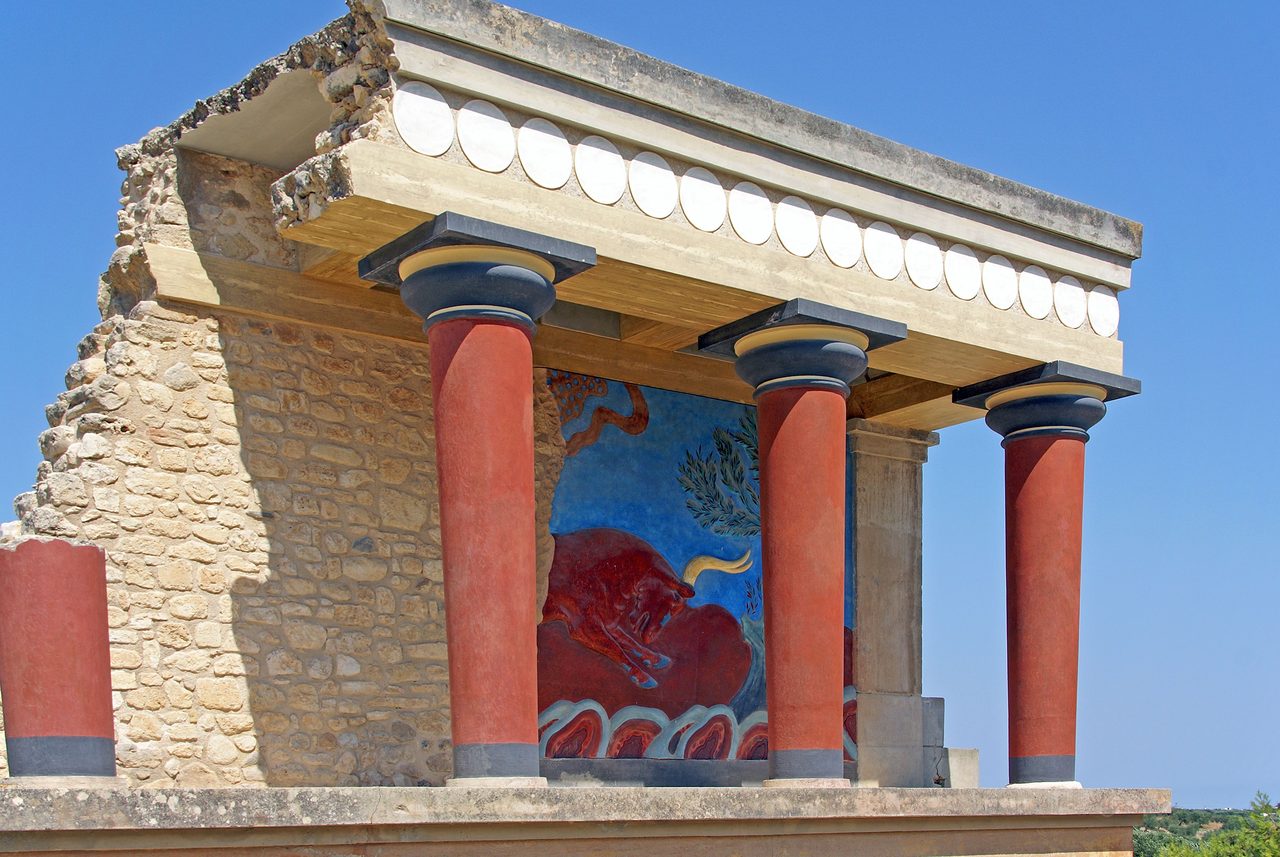
Europe's oldest city and the center of Minoan civilization, this 3,500-year-old palace complex features the legendary labyrinth of the Minotaur. The partially reconstructed ruins reveal sophisticated Bronze Age architecture.
The Palace of Knossos lies about five kilometres south-east of Heraklion on the Greek island of Crete and is the largest Bronze Age archaeological site on the island. The complex was the ceremonial and political centre of Minoan civilization, and the palace at its heart dates in its main form to roughly 1700-1400 BC. Visitors walk through the West Court and the Central Court, then into the royal apartments, the Throne Room with its alabaster-style seat and griffin frescoes, the Grand Staircase, and the storage magazines lined with enormous clay pithoi. Much of what is visible was reconstructed in the early twentieth century under the British archaeologist Arthur Evans, using concrete and painted columns that narrow toward the base in the Minoan style. The reconstructions remain debated, but they help make the multi-storey layout legible. Copies of the famous frescoes, including the Prince of the Lilies, the Dolphin Fresco and the bull-leaping scene, mark the walls, while the originals are held in the Heraklion Archaeological Museum. The site is linked in Greek myth to King Minos, the Minotaur and the labyrinth, and the maze of corridors and rooms explains part of that legend. A typical visit takes two to three hours, and the open site has little shade, so early morning or late afternoon is the most comfortable time in summer. Crowds peak between about 10:00 and 14:00 when tour buses and cruise groups arrive. Good vantage points include the raised walkway above the Central Court and the upper-floor reconstruction of the Piano Nobile, which give a view across the palace footprint toward the surrounding cypress and olive hills of central Crete. Information panels explain each area, and licensed guides wait near the entrance. Photography without flash is generally permitted outdoors.
| Admission | Adult $18 · Child $9 |
|---|---|
| Hours | 8:00 AM - 8:00 PM (summer), 8:00 AM - 3:00 PM (winter) |
| Typical visit | 2-3 hours |
| Address | Knossos, Heraklion 714 09, Crete, Greece |
Good to know
- Best for
- history enthusiasts, families, mythology fans, cultural travelers
Location
Knossos, Heraklion 714 09, Crete, Greece
35.2979, 25.1632 View on map
Highlights
- Throne Room with griffin frescoes
- Reconstructed Piano Nobile and Grand Staircase
- Giant storage pithoi in the west magazines
- Fresco copies including the bull-leaping scene
- Central Court and the labyrinth legend
Tips for visiting
- Hire a licensed guide for the full mythological context
- Visit early morning before cruise ship crowds
- Combine with Heraklion Archaeological Museum
- Arthur Evans' reconstructions are controversial but help visualize the palace
When to visit
Arrive at opening time in spring or autumn to avoid heat and tour-group crowds. Late afternoon is quieter in summer.
Accessibility
Main paths are uneven stone and gravel with steps between levels, and some areas are hard to reach by wheelchair. A limited accessible route covers parts of the central complex.
Visit, book or contact
Frequently asked questions
How long does a visit to Knossos take?
Most visitors spend two to three hours on site. A guided tour usually lasts about 90 minutes, and extra time is useful for walking the perimeter and the nearby museum pairing.
Are the ruins authentic or reconstructed?
Large parts were reconstructed in the early twentieth century by Arthur Evans, using concrete and painted plaster. Original foundations and some masonry survive beneath and between the restored sections.
Is Knossos worth it for kids?
Children often enjoy the Minotaur legend and the maze of rooms, but there is little shade and a lot of walking. Visiting early with water and hats works best.
Where are the original frescoes?
Most original wall paintings are displayed in the Heraklion Archaeological Museum in central Heraklion. The frescoes seen on site are painted reproductions.