
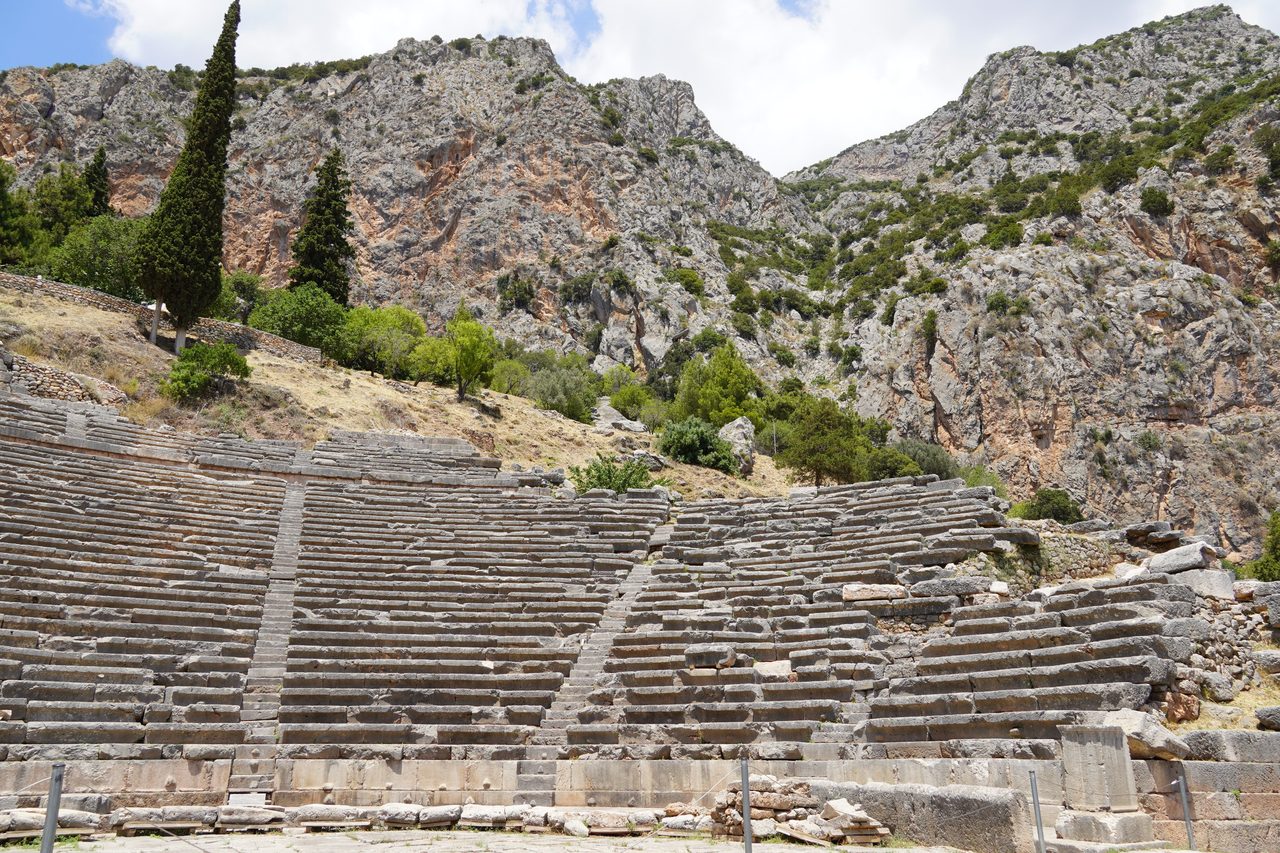
Ancient Greeks considered Delphi the center of the world, home to the famous Oracle. The stunning mountainside sanctuary includes the Temple of Apollo, ancient theater, and stadium with panoramic valley views.
Delphi lies on the slopes of Mount Parnassus in Central Greece, about 180 kilometres northwest of Athens, and was considered by the ancient Greeks to be the centre of the world. The UNESCO-listed sanctuary was home to the Oracle of Apollo, where the priestess known as the Pythia delivered prophecies that shaped decisions of city-states for centuries. The site climbs a steep hillside above the Pleistos valley, with views toward the olive groves of Itea and the Gulf of Corinth. Visitors enter the sanctuary and follow the Sacred Way, a winding stone path that rises past the foundations of treasuries built by Greek cities to hold offerings. The Athenian Treasury, rebuilt from its original stones, is the best preserved. Higher up are the remaining columns of the Temple of Apollo, the ancient theatre with a view over the valley, and, at the top of the site, the stadium where the Pythian Games took place. The climb to the stadium is steep, and sturdy footwear is essential because the paths are uneven and slippery in places. The Archaeological Museum of Delphi is next to the site, and many visitors tour it first to understand what they will see outdoors. Its highlights include the bronze Charioteer, the Sphinx of Naxos, and the twin kouroi of Kleobis and Biton. A visit to the sanctuary and museum together typically takes three to four hours. About a kilometre down the road is the sanctuary of Athena Pronaia, where the circular Tholos, with three reconstructed Doric columns, is among the most photographed monuments in Greece. The Castalian Spring, where pilgrims once purified themselves, lies between the two areas along the main road. Crowds build from late morning, when coach tours from Athens arrive. Early morning gives cooler air and quieter paths, and the last hours before closing offer softer light over the valley. Summer afternoons are hot with little shade. The nearby town of Delphi has tavernas and guesthouses, and some visitors stay overnight to see the site at opening time, making the visit part of a longer route through Central Greece.
| Admission | Adult $15 · Child $8 |
|---|---|
| Hours | 8:00 AM - 8:00 PM (summer), 8:30 AM - 3:30 PM (winter) |
| Typical visit | 3-4 hours |
| Address | Delphi 330 54, Greece |
Good to know
- Best for
- history buffs, hikers, photographers, cultural travelers
Location
Delphi 330 54, Greece
38.4824, 22.5010 View on map
Highlights
- Sacred Way and the reconstructed Athenian Treasury
- Temple of Apollo terrace and the theatre above it
- Stadium at the top of the site
- Tholos of Athena Pronaia
- Bronze Charioteer in the on-site museum
Tips for visiting
- Visit the museum first to understand the site's context
- Wear sturdy shoes - steep, uneven terrain
- Come early to beat tour buses from Athens
- The Tholos at Athena Pronaia is incredibly photogenic
When to visit
Visit in spring or autumn, ideally at opening time before the tour buses arrive. Late afternoon in summer is cooler and quieter.
Accessibility
The site is steep with uneven ancient stones, and full access is difficult for wheelchair users. The museum is largely accessible, and lower parts of the sanctuary can be reached with assistance.
Visit, book or contact
Frequently asked questions
How long does a visit take?
The site and museum together take about three to four hours. The sanctuary alone can be seen in around two hours.
Is Delphi worth it for kids?
Older children who enjoy myths and climbing often like it, but the steep paths and heat are demanding for toddlers.
Is photography allowed?
Photography is generally allowed at the site and in the museum without flash, but tripods and commercial shoots require permission.
How far is Delphi from Athens?
It is roughly a two-and-a-half to three-hour drive. Public buses run from Athens, and many day tours operate in season.